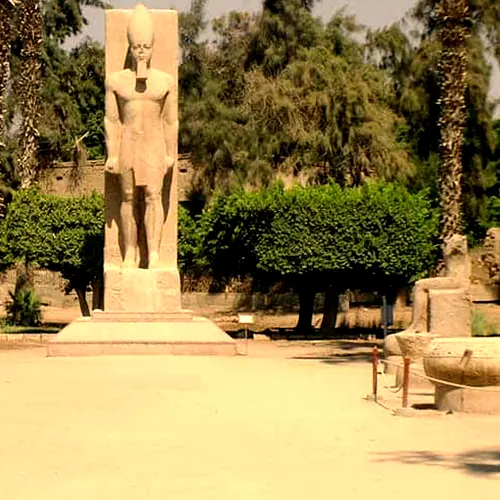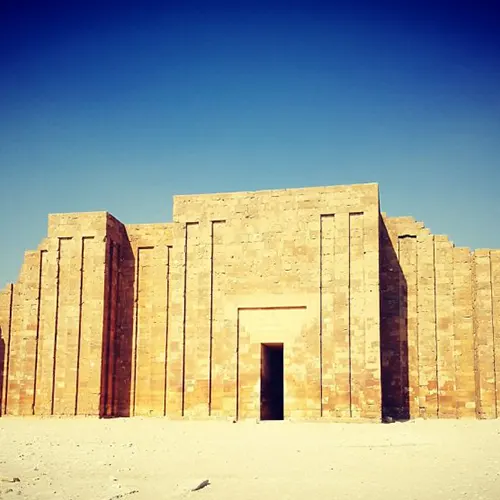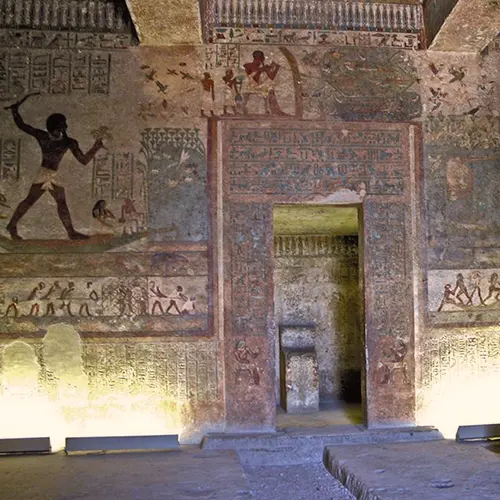
Beni Hassan in Al Minya Governorate

Beni Hassan Necropolis is an important historical site in Al Minya Governorate. It is located on the east bank of the Nile River.

The importance of Beni Hassan Necropolis in Al Minya Governorate The golden history of Beni Hassan began during the middle kingdom in ancient Egyptian civilization, as local rulers and military ‎leaders built their tombs there. It houses approx. 39 carved tombs in a limestone hill. These tombs reflect the power of the high officials at that time.

To know more about these tombs: These tombs distinguish with their decorations presenting the daily life of ancient Egyptians, especially sports as wrestling, violent warfare, and military training.

Let’s go on a tour in these tombs: 1 – Kheity tomb: Kheity was a governor of the nome during the 11th dynasty, the first intermediate period. The scenes in this tomb show the daily life activities as hunting in the deserts and soldiers playing some sports. The Ministry of Tourism and Antiquities launched a virtual reality tour for the Kheity tomb.

2 – Baqete III tomb: Baqete III was the father of Kheity. He was the governor of the nome during the 6th dynasty, the old kingdom. The scenes in this tomb depict the same theme of other tombs in Beni Hassan Necropolis, but the different depiction is showing Baqete III in battles taking place in the 6th ‎dynasty.

3 – Khnumhotep tomb: Khnumhotep was a governor during king Amenemhat III period in the 12th dynasty, middle kingdom. Like other tombs, this tomb has depictions of daily life activities and military training during the Middle Kingdom. Besides, it includes the biography of Khnumhotep. It is written in 222 columns.

Kindly submit the Egypt Vacation Tours day tours to enjoy discovering this unique necropolis with our experts.
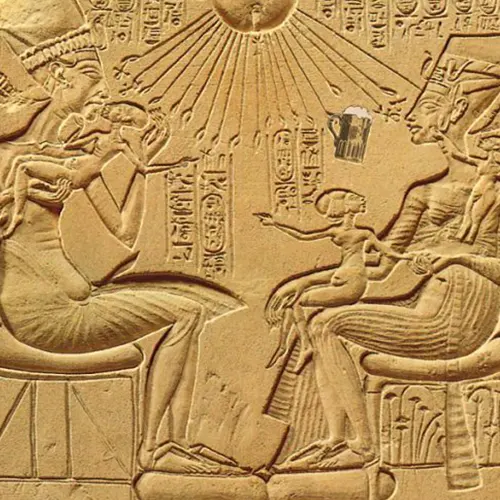
Tell El-Amarna in Al Minya Governorate

Tell El-Amarna lies in Al Minya Governorate on the east bank of the Nile River. It is also called Akhetaten. It was the capital of ancient Egypt during king Akhenaten or Amenhotep IV period in the eighteenth dynasty.

The history of Tell El-Amarna city After king Amenhotep IV become the ruler in the 18th dynasty, he believed in the god Aten (the solar disk). But the god Amun was the main god of Egypt in that time.

    So king Amenhotep IV decided that:
  • He changed his name to be Akhenaten, meaning effective for the god Aten.
  • He transferred the ancient Egyptian capital from Thebes to a new place, where no god was worshiped before to establish his new town, Akhetaten, meaning the horizon of Aten.

When king Akhenaten constructed Akhetaten, he surrounded it with official boundary stelae to determine the borders of the city.

After king Akhenaten, this city had been deserted, and the priests of Amun reopened temples and returned the cults as old age.

  • He announced the god Aten, the main god of ancient Egypt, eliminated other gods, and closed temples. Aten took the shape of the solar disk with human hands holding (Ankh) sign referring that Aten god giving life to humans.

The origin of the name of Tell El-Amarna The name Amarna comes from the Beni Amran tribe living in the area and founded a few settlements.

This site should be distinguished from Tell Amarna in Syria, a Halaf period archaeological tells.

Let’s go on a tour in Tell El-Amarna Tell Al-Amarna city contains several attractions back to the Amarna period as the royal palaces and tombs and tombs of high officials as Hoya, Ahmos, Meriri, and Maho. All of these sightseeing depict a new type of art called Amarna art.

Visit Tell El-Amarna or Akhetaten to discover this great capital and know more about king Akhenaten history with Egypt Vacation Tours day tours to Al Minya.

Port Said City – A Coastal Destination

Port Said city is one of the most important cities in Egypt, after Cairo and Alexandria. It is a coastal city overlooking the Mediterranean Sea, It is considered the entrance of the Suez Canal from the north.

Let’s learn more about the history of Port Said City Port Said City was constructed after the foundation of the Suez Canal by Ferdinand De Lesseps to be the entrance to this canal In 1855, the international committee chose the name of Port Said to be the name of this new city, It is divided into two words. The first one is (Port) for referring to it as a coastal city, while the second word is (Said), who is Khedive Said, the ruler at that time.

Let’s take a tour of Port Said Port Said houses several attractions as its port, the second largest port in Egypt, the Suez Canal Authority Building, the Old Lighthouse, the Obelisk of Martyrs, and the Base of the Statue of De Lesseps.

  • The Old Lighthouse of Port Said was established by Khedive Ismail in 1869 to guide ships passing through the Suez Canal. This lighthouse is considered the oldest concrete lighthouse in the world.
    Lighthouse of Port Said - Egypt Vacation Tours
    Lighthouse of Port Said
  • Suez Canal Authority Building was founded in 1895, and it distinguishes with its unique Islamic architectural design. It is the first building built on the shores of Port Said city. It is used as the headquarters of the authority and the administration of the Suez Canal and monitoring the passage of ships from/into the Suez Canal.
  • The Obelisk of Martyrs is a memorial established in honor of the martyrs who were killed in the battles of the tripartite aggression during the Suez War.
  • The Base of the Statue of De Lesseps was built in 1899. Port Said revolutionaries removed the statue of De Lesseps from its base after their success in preventing French, British and Israeli armies from entering Egypt on December 23, 1956, so this day became the national celebration day of Port Said.

Egypt Vacation Tours team always seeking to please you Kindly submit on Port Said day tour and shore excursion tour to enjoy this amazing city.

The Sun Festival of Abu Simbel Temple

Egypt Vacation Tours team is glad to present this article discussing the Sun Festival of Abu Simbel Temple for its agents.

Egypt, especially Aswan waits a unique phenomenon happening in Abu Simbel city twice yearly. It is the illumination of the sun on the Holy of Holies of the great Abu Simbel Temple.

Let me explain this phenomenon to you Nowadays, the sun illuminates the Holy of Holies of the great Abu Simbel Temple on February 22nd and October 22nd, but before the project of UNESCO for rescuing the Nubian monuments, the sun illuminated the temple on February 21nd and October 21nd. 

What improving the ancient Egyptians genius is that the chamber of the Holy of Holies contains four statues, but the sun illuminates only three statues (Amun, Re-Harakty, and Ramesses II statue) except the statue of Ptah, the god of darkness in ancient Egyptian myths. Additionally, this phenomenon occurs on the same date every year. 

This phenomenon takes 20 minutes during the sunrise. 

Says about this phenomenon   There are opinions say that the ancient Egyptians chose the days of the phenomenon, occurring precisely and on purpose:

  • There is an opinion says that this date refers to the beginning of the sowing and harvest seasons.
  • But another opinion says that this date refers to the birth and coronation days of king Ramesses II

Whatever the case, this phenomenon refers to the ingenuity and mastery of the ancient Egyptians in both engineering and astronomy fields. 

Al-Alamein City in Marsa Matrouh – the World War II

Al-Alamein city is located on the west of Alexandria in Marsa Matrouh governorate. It has a great history, especially during World War II making it an important attraction for many people around the world.

Let’s learn about the history of that city The most ancient monuments in Al-Alamein City dates back to the Greco-Roman period.

But the glory of Al-Alamein City was during World War II as two battles occurred there. These battles were a milestone in Egyptian history. 

These two battles occurred between Britain against Axis troops (Germany and Italy). The first one was from August 31 to September 7, 1942, while the second was from October 23 to November 4, 1942. The British Army got the victory in both wars.

    In Al-Alamein City in Marsa Matrouh, you can visit:
  • Al-Alamein Museum displays the two battles of Al-Alamein city through some photos, maps, and some of the weapons used in these wars by troops. 
  • The Commonwealth cemeteries are for burying the soldiers from many countries who were killed during the two battles of Al-Alamein City. It is good to mention that there are other Commonwealth cemeteries in Egypt in Salah Salem in Nasr City.
The Commonwealth Cemetery - Egypt Vacation Tours
The Commonwealth Cemetery

Kindly submit on the Al-Alamein City day tour. You may find the name of one of your family members among the soldiers in Commonwealth cemeteries. 

Egypt Vacation Tours team is seeking to please you.

Tuna El-Gebel in Al Minya Governorate

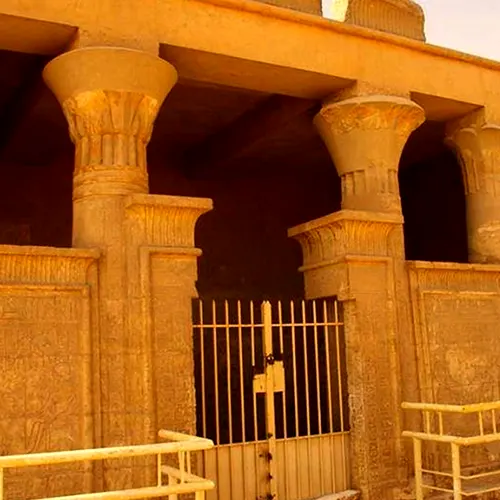
Tuna El-Gebel Necropolis is an important historical site in Al Minya Governorate. The ancient Egyptians considered it the center of worshiping the god Thoth or Djhuty, the god of wisdom and knowledge in ancient Egyptian civilization.

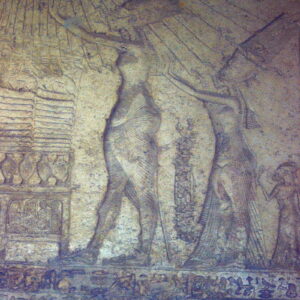
Let’s have a tour in Tuna El-Gebel Necropolis in Al Minya Governorate Firstly, you should know about the history of this city. It is believed that the first use of it was during King Akhenaten’s period, when he transferred the main capital of ancient Egypt from Thebes to Akhetaten, near Tuna El-Gebel. The evidence for that they found a boundary stele depicting King Akhenaten with his wife Nefertiti and his daughters worshipping the god Aten.

Stela of king Akhenaten- Egypt Vacation Tours
Stela of king Akhenaten

But the golden age of Tuna El-Gebel was during the Greco-Roman period, as it was the necropolis of Ashmonin city. It houses approximately 60 burial houses depicting the mixture that happened between ancient Egyptian art and Greco-Roman art.

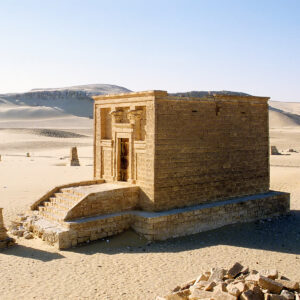
  • Tomb of Isadora is one of these tombs. Isadora has a dramatic story as she is called the first martyr of love due to her drowning in the Nile River while crossing to meet her fiancé. Her father lamented her with a poem. You can find it in the tomb.

    Tuna El-Gebel - Egypt Vacation Tours
    Tomb of Isadora

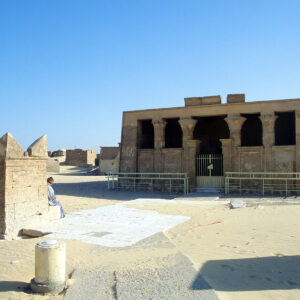
  • Tomb of Petosiris is another tomb belonging to the high priest of the god Thoth during the Ptolemaic period. What is impressive about this tomb is it was designed as a temple. You should visit it.

    Tomb of Petosiris - Egypt Vacation Tours 1
    Tomb of Petosiris

  • The third attraction in Tuna El-Gebel is the Catacombs of Ibis. As we said, Tuna El-Gebel was the center of worshiping the god Thoth, so it contains catacombs to bury its sacred animals like baboons and ibises.

Kindly submit the Egypt Vacation Tours day tours to enjoy discovering this unique necropolis with our experts.

Memphis and its Museum- Historical Site

Memphis is the first capital for united Egypt, It is considered a world heritage site by UNESCO in 1979. It lies on the west bank of the Nile River.

The history of this great city: According to the Greek historian Herodotus, Memphis city was established by King Menes, the first king of untied Egypt, to be the capital of ancient Egypt in 3100 B.C. It remained the capital of ancient Egypt from the first dynasty to the sixth dynasty.

Now, Memphis is located in Mit Rahinah – Al Badrashin in Giza Governorate. King Menes decided to build this city in this place to allow him to control Upper and Lower Egypt.

Memphis city had a great position in ancient Egypt, as it was the center for worshipping the sacred bull, Apis.

Also, this city was the center for the Memphis triad (Ptah, his wife Sekhmet, and their son Nefertem).

Memphis site distinguishes by housing the Memphis Museum, displaying the statue of Queen Hatshepsut, the second largest statue of the Sphinx after the one in Giza plateau, and the great statue of King Ramesses II. This statue of Ramesses II was discovered beside the statue of King Ramesses II, exhibited now in The Grand Egyptian Museum (GEM).

The names of Memphis 1 – The first name for this site was (Inebu-hedj), meaning the white walls, referring to the fortress of King Menes constructed by the white limestone.

2 – The second name was (Men-nefer), meaning enduring and beautiful or magnificent monument referring to the pyramid of King Pepi I from the sixth dynasty.

3 – Then this name was changed in the Greco-Roman period to be Memphis.

4 – Hence, Manf in Arabic.

5 – But now this place is known with the name (Mit Rahinah). It is another ancient Egyptian name, meaning rams road.

Visit the first capital of Egypt by submitting on our day tours and packages and enjoy discovering it with our experts.

Egypt Vacation Tours tripadvisor

Saqqara Necropolis – Historical Site

Saqqara is one of the most important cemeteries in Memphis Necropolis. It contains thousands of tombs (royal pyramids and mastabas). Among these tombs, there is the step pyramid of king Djoser, the oldest pyramid in the ancient Egyptian civilization.

Let’s take a tour in Saqqara Necropolis

1 – King Djoser Complex and The step pyramid This complex belongs to King Djoser from the third dynasty, the old kingdom. The vizier, Imhotep, designed this complex to be the first complete stone building complex in the ancient Egyptian civilization.

This complex contains the burial tomb of King Djoser, the step pyramid. The step pyramid is the most conspicuous sightseeing of Saqqara. It stands 60 meters high and was constructed with six mastabas, so the researchers believe that this pyramid refers to the architectural development of the royal mastabas in the first and second dynasties.

2 – Unas pyramid Unas pyramid is owned by King Unas, the last king in the fifth dynasty. It lies southwest of the King Djoser complex. This pyramid is famous for containing the oldest Egyptian religious texts, the pyramid texts. It exists on the wall of the tomb chamber and is written in hieroglyphs with blue pigment. These texts aim to protect the dead in the afterlife.

3 – Teti pyramid Teti pyramid belongs to King Teti, the first king in the sixth dynasty. This pyramid is located on the northeast of the King Djoser complex.

4 – High Officials Tombs Saqqara houses several tombs or mastabas belonging to the high officials from the old kingdom and the new kingdom. The old kingdom tombs are as Mereruka, Kagemni, Ptah-Hotep family, and Mehu. The new kingdom tombs are as Horemhep, Maya, Tia, and Merynieth.

These tombs distinguish by containing depictions showing the daily life activities of the ancient Egyptians. These tombs refer to the high position of those persons and the increasing of their power at that time.

5 – Serapeum of the sacred bull Apis The Serapeum is the cemetery of the sacred animal of the god Ptah, the Apis bulls. It contains rock-cut underground burial chambers to bury the mummied bulls.

Discover the great Saqqara Necropolis by submitting on Egypt Vacation Tours day tour and packages to enjoy this unique site with our experts.

Discover the Step Pyramid from inside

Finally, you can discover the step pyramid from inside. After 14 years of restoration, the step pyramid opens its doors to the public for exploring it from the inside.

Firstly, we need to take about the King Djoser Complex This complex belongs to King Djoser from the third dynasty, the old kingdom. The vizier, Imhotep, designed this complex to be the first complete stone building complex in the ancient Egyptian civilization.

This complex contains the burial tomb of King Djoser, the step pyramid. The step pyramid is the most conspicuous sightseeing of Saqqara. It stands 60 meters high and was constructed with six mastabas, so the researchers believe that this pyramid refers to the architectural development of the royal mastabas in the first and second dynasties.

Saqqara - Egypt Vacation Tours
King Djoser Complex

Let’s go on a tour inside the step pyramid We will enter the step pyramid from the southern entrance. This entrance is not the main entrance but was established in the 26th dynasty to discover what is inside this pyramid. The main entrance built during the King Djoser period is the northern one.

The southern entrance leads to tunnels taking approx. 28 meters, where you will be allowed to see the burial chamber of King Djoser from the top and his sarcophagus. Also, you will be able to go down to see the sarcophagus closely.

Discover the secrets of Saqqara, the step pyramid from inside, and its attractions with Egypt Vacation Tours experts.

Alexandria City History and its Attractions

Alexandria is the second largest city in Egypt and the largest city on the Mediterranean Sea. It is called with the Bride of the Mediterranean Sea.

The history of Alexandria This city was established by Alexander the Great in c. 331 BC. It was the center of Hellenistic civilization. He named this city Alexandria to bear his name throughout history. Unfortunately, the establishment of Alexandria city was completed, after Alexander the Great’s death.

Ptolemaic rulers and Roman emperors took it as their main capital for almost 1,000 years.

After that, in the Christian period, it became the center of the Patriarchate of Alexandria.

Also, Alexandria had a great position in the Islamic period. In the Mamluk period, Sultan Qaitbay contracted The Citadel of Qaitbay, which is one of the most landmarks in Alexandria.

Let’s take a tour in Alexandria City to see its sightseeing It is one of the most popular tourist destinations in Egypt.  It includes attractions from several times and cultures.

1 – The Lighthouse of Alexandria: It was one of the Seven Wonders of the Ancient World, but it does not exist now.

2 – The ancient library of Alexandria: It was the largest library in the ancient world.

3 – The catacomb of Alexandria

4 – Pompey’s Pillar

5 – Roman Amphitheater

6 – The Citadel of Qaitbay

7 – Montazah Palace

8 – Bibliotheca Alexandrina

9 – Eliyahu Hanavi Synagogue

10 – St. Mark Cathedral

11 – Abu Al-Abbas Al-Mursi Mosque

12 – Alexandria National Museum

13 – The Graeco-Roman Museum

14 – Royal Jewelry Museum

Visit this great city and discover its unique attractions with Egypt Vacation Tours  team. Kindly, submit on our day tours and packages to Alexandria.