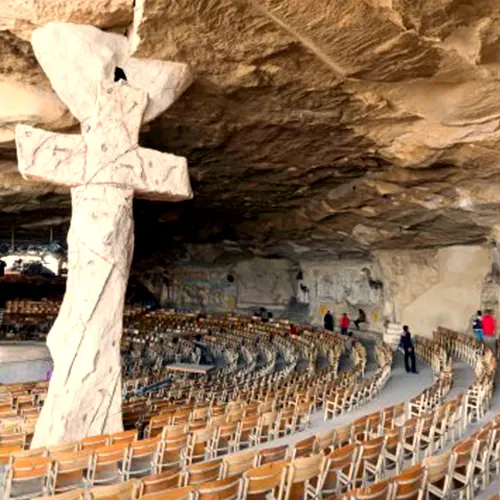
The Cave church, Saint Simon Church, or the Tanner Monastery lies in the Mokattam Mountain, near Garbage city or in Arabic language El Zabbaleen city.
This monastery is carved into the Mokattam Mountain in 1975. It houses many Coptic churches.
Saint Simon Church is one of the hidden treasures in Egypt and the Middle East. It is famous for its design, taking the shape of amphitheater. It is considered the biggest church in Egypt, as it accommodates 20 thousand people.
St. Simon
St. Simon worked as a tanner, lived at the end of the 10th century. He was in charge of the legend of the transferring the Mokattam Mountain.
The Garbage City
The garbage city or El Zabbaleen city in the Arabic language is famous for its populations are working in collecting, sorting, and recycling the garbage.
Enjoy discovering this hidden treasure with Egypt Vacation Tours team with Cairo Day Tours.
The Nilometer is founded by the Caliph Al-Mutawakkil in 861 AD. It is considered the second Islamic sightseeing built in Egypt after Amr Ibn Al-Ass Mosque.
The Nilometer was used to measure the level of the water of the Nile River to set the taxes. The water measurement occurred by a marble octagonal column 19 cubits in length standing in the middle of the building. This meter has become unused after the building of the Aswan High Dam in the 1960s.
The structure is divided into two parts. The first part is the conical dome. The second part is a flight of spiral stairs leading down, with depth markings along the walls.
Visit this amazing attraction with Egypt Vacation Tours team with Cairo Day Tours.
Also, enjoy visiting this sightseeing and Manasterly palace on a virtual tour provided by the ministry of tourism and antiquities via this link
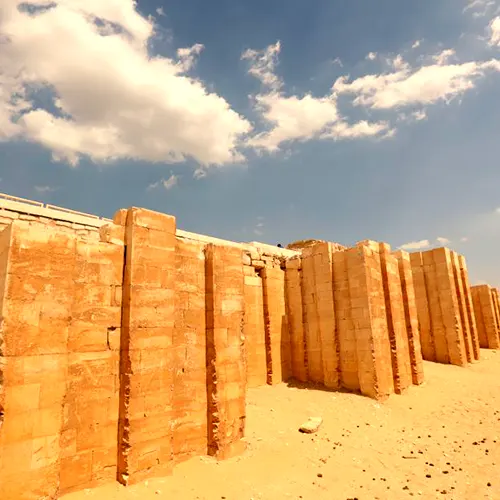
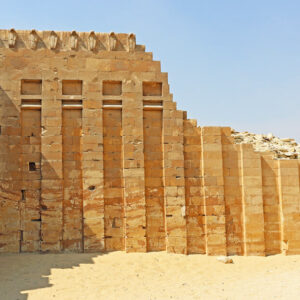
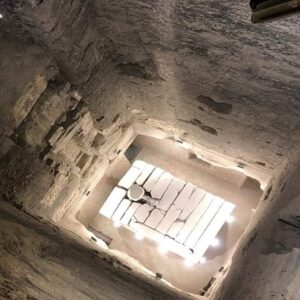
The Southern Tomb Location and dimensionsIn the southern end of the Great Court is a long building with a low, vaulted roof known as the South Tomb. The elements of the substructure are very similar to those of the pyramid (although on a reduced scale) but differ somewhat in their arrangement. The burial chamber was at the bottom of a vertical shaft, 7 x 7 metres and 28 metres deep—the same dimensions as the one under the pyramid and on more or less the same North-South axis. It was made out of the same pink granite and there is even evidence for an earlier limestone version with stars carved into the ceiling. The interior of the tomb was far less disturbed by robbers than the Step Pyramid and the ‘manoeuvre chamber’ has survived reasonably intact. Even the beam used to lower the granite plug was still in place. The walls were of limestone and the ceiling had been carved in imitation of palm logs.
The Southern Tomb Substructure: In the South Tomb at Saqqara, a descending corridor led down to the tomb—although from the west rather than the north, as was the case with the step pyramid. About halfway down was a rectangular gallery about 30 metres long, filled with pottery and stone jars. On top of them was a wooden stretcher, a wooden box and a set of poles from a canopy—still bearing traces of gold leaf. Lauer assumed the stretcher was used to carry the vessels into the tomb and then simply left behind but, given the other equipment found, transportation of a statue seems a little more plausible.
The Southern Tomb Decorations:There was a similar arrangement of galleries, including a number with the same faience decoration mimicking the appearance of reed mat panels and doorways—again, probably representing the private apartments of the royal palace. There is every reason to believe that this suit of rooms was constructed before those under the pyramid, which were far less accomplished and less complete. As was the case in the latter, the false doorways contained reliefs of the pharaoh taking part in various rituals. On the door jambs and lintels were carved the name and titles of the king. He is invariably referred to by his Horus name, Netjerykhet. Apart from much later graffiti, the name Djoser does not appear anywhere in the complex.
the Step Pyramid from inside
The king is shown wearing only a skimpy loincloth (at most), a false beard and the crown of Upper Egypt. In his right hand he is carrying a flail, an agricultural tool used in threshing grain but also an important symbol of power for the pharaoh. In his left hand he is holding a fishtailed object, presumably the flint version that figures so prominently in the predynastic archaeological record and is thought to have been used in the ‘Opening the Mouth’ ceremony to reanimate the deceased. Hovering over his head is Horus, the god of kingship, holding an ankh symbol (the hieroglyph for ‘life’) in his talons. In front of him is a standard bearing the image of a jackal (Wepwawet, the ‘Opener of the Ways’). He is striding between two pairs of horseshoe-shaped territorial markers.
The Southern Tomb Function:Secondary tombs can be found at some, but by no means all, Old Kingdom pyramids. In some cases, they are thought to belong to the pharaoh’s principal wives. but the burial chamber of the South Tomb is very small, 1.6 x 1.6 and 1.3 metres high—probably too small for an adult woman and her coffin. Various theories have been proposed for its function—to house the royal placenta that had been preserved since the pharaoh’s birth; to contain his internal organs (lungs, stomach, intestines and liver) removed during the mummification process; or to serve as a repository for the two crowns of Upper and Lower Egypt. Lauer believed that it was a cenotaph, meant to replace the royal tomb at Abydos. The most popular theory is that they were the tombs of the pharaoh’s ka, represented in the form of a statue. Shown (left) is a wooden shrine containing the ka-statue of the Dynasty XIII pharaoh Hor’ in his shrine. The arms reaching upwards on top of his head is the hieroglyph for ka.
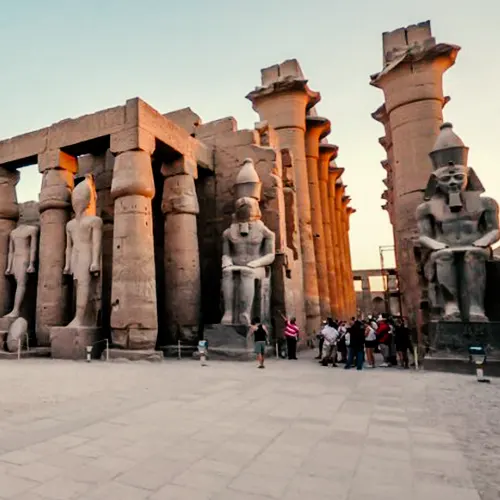
Luxor temple is one of the most beautiful remained monuments on the east bank of the Nile River in Thebes, or Luxor city now.
The history of construction of Luxor temple
King Amenhotep III of the 18th dynasty started to build this temple, but the main building of the temple was completed by King Tutankhamun and King Horemheb. Then King Ramses II added some elements to the temple.
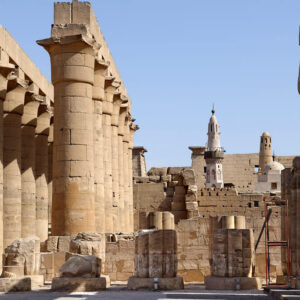
During Amenhotep III’s reign, the main entrance of the temple was on the northern side. After that, you will see the great colonnade consisting of seven pairs. It takes the shape of high open-flower papyrus columns. Then you will move to the courtyard of King Amenhotep III. Then the hypostyle hall, containing thirty-two columns.
The great colonnade of Amenhotep III
The cache of Luxor temple was discovered by the archaeologist Muhammad al-Saghir on the morning of January 22, 1989. While he was cleaning the courtyard of King Amenhotep III, he found a wonderful collection of statues for gods and kings of the New kingdom. Most of these collections are moved to be displayed at Luxor Museum.
Behind the hypostyle hall, there are four secondary rooms, the room of the Divine birth of King Amenhotep III, Alexander the Great’s shrine, and the Holy of Holies of the triad of Thebes (Amun, his wife Mut, and their son Khonsu).
The divine birth room houses depictions tell an amazing story of how the king’s true father was none other than the god Amun himself.
The King Ramses II adds:
He added a massive pylon decorated with inscriptions of the Kadesh Battle against the Hittites. This pylon was preceded by six colossal statues for King Ramses II himself and two obelisks made of granite. Now, one of these two obelisks is transferred to the Place de la Concorde in Paris.
In front of this pylon, there is the avenue of sphinxes linking between Luxor Temple and Karnak Complex. This avenue was used during the Opet Festival, as Amun used it to move from Karnak Complex to Luxor Temple.
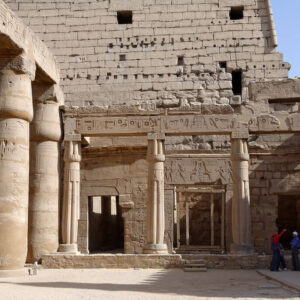
Also, King Ramses II built another courtyard in front of the great colonnade of King Amenhotep III. In this courtyard, on the right side, you will see the shrine of Queen Hatshepsut and King Thutmose III.
the shrine of Queen Hatshepsut and King Thutmose III
The temple was remained used in the Greco-Roman period. In the Christian period, the hypostyle hall of the temple was changed to be a Christian church.
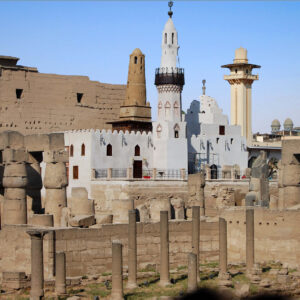
After many years, the temple was covered and hidden by sand and streets, resulting in the construction of the Yusuf Abu al-Hajjaj mosque over the Northeast side of the temple in the courtyard of King Ramses II in 640.
Colossi of Memnon are two massive statues on the west bank of the Nile River in Luxor city. They stood at the entrance of the mortuary temple of king Amenhotep III of the 18th dynasty, New kingdom. These statues are the only residual part of this temple.
These two twin statues depict King Amenhotep III, seating on the throne chair and wearing the Nemes, the royal headdress. The statues measure 20 meters tall. They are made of quartzite sandstone. The northern statue presents the king with a small statue for his mother (Mutemwiya), while the southern one presents him with his beloved wife (Tiye). Amenhotep, son of Hapu supervised the construction of these statues.
After an earthquake had occurred in 27 BC, the northern statue was deeply affected, as cracks appearing on it. These cracks resulted to when the winds were passing through the northern statue at dawn, making mysterious sounds and forming dew drops on the statue’s body.
The Greeks linked between these sounds and dewdrops and the crying of Memnon’s mother on her killing son (Memnon). Memnon was the king of Ethiopia, traveled to Asia to help in defending Trojan city, the beleaguered city under attack. But he was killed by Achilles. So they are famous for the Colossi of Memnon.
Achilles killing Memnon
Later the Roman Emperor Septimius Severus restored the northern statue that led these sounds to stop.
Karnak temple is located on the east bank of the Nile River in Thebes, or Luxor city now. It is considered as a complex, not just a temple, because its walls include several temples as the Khonsu temple, the Opet temple, and the great temple of Amun Ra.
This complex is considered one of the most important ancient Egyptian temples in Thebes, as it was the center for worshipping the god Amun. So this temple was extremely wealthy, and its priesthood held great political power during ancient Egyptian history.
As most ancient Egyptian temples, Karnak temple was constructed on an east-west axis. As in ancient Egyptian mythology, they thought that this design looking like the sun god’s trajectory through the sky. Also, Karnak temple distinguishes with another north-south axis to link between Karnak complex and Luxor temple through the avenue of rams.
Karnak Complex Elements The design of Karnak Complex is very complicated, as due to its religious importance, many kings from the middle kingdom to the Ptolemaic period added buildings to this complex, making it reach a size, complexity, and diversity.
This complex starts with an avenue of rams. In front of the 1st pylon, there are 20 rams on each side, dating back to King Nectanebo I of the 30th dynasty.
Then, the first open court, containing several elements. The column or kiosk of King Taharqa of the 25th dynasty. This is the only remained column from a colonnade that once had 10 columns. On the left, there are 3 shrines built by king Seti II for the triad of Thebes (Amun, Mut, and Khonsu). On the right, there is the Temple of King Ramses III. As well, there is the open museum court containing the white shrine of king Senusret I, the alabaster shrine of king Amenhotep I, and the red shrine of Queen Hatshepsut. These shrines were discovered into the 3rd pylon and rebuilt again.
The second pylon of king Horemheb of the 18th
The Great Hypostyle Hall containing 134 columns from the sandstone. This hall was built by King Amenhotep III and completed by kings Seti I and his son Ramses II.
Then the 3rd pylon of king Amenhotep III, where the 3 shrines in the open museum court had found.
The Court of Thutmose I, where was existing 2 obelisks standing in front of the 4th pylon. It is thought that this pylon was the main entrance for Karnak temple during king Thutmose I’s period. Unfortunately, one of these two obelisks is lost.
Another court of King Thutmose I. This court housed 2 obelisks for Queen Hatshepsut. They were made of red granite. Unfortunately, the right obelisk is lost. After the death of Queen Hatshepsut, so King Thutmose III did a mysterious thing. He founded a high wall around those two obelisks. This sparked a lot of arguments among scholars, as they are wondering what the purpose of this wall is.
The 5th pylon, which also was built by king Thutmose I, but was damaged.
The 6th pylon was built by king Thutmose III. It is the smallest pylon in this complex. This pylon leads to the Ancestral Room founded by King Thutmose III.
Then the Holy of Holies of temple.
Behind it, there is a courtyard housing remains dating back to the middle kingdom. This courtyard contains a hall called (Akh-Mnw), meaning the Feasts Hall. This hall was built by King Thutmose III. As well, there is another room called The Botanical Room, decorated with depictions of plants, animals, and birds, which King Thutmose III brought from Syria to ancient Egypt.
Now, we will go through the north-south axis that can be accessed between the 3rd and the 4th pylons to reach the 7th pylon of king Thutmose III. In this place in 1902, the French Egyptologist Georges Legrain discovered a cache. This cache contained several bronze statues. In front of the 7th pylon, there were 2 obelisks of king Thutmose III. One of them is transferred to İstanbul, as Muhammad Ali Pasha gave it to King Louis.
Karnak Complex distinguishes with its sacred lake, where priests purified themselves before performing temple rituals for the god Amun. Besides this lake, you will be able to notice the scarab is considered the biggest scarab in ancient Egypt. This is the scarab of the marriage of King Amenhotep III and his beloved wife Tiye.
the sacred lake
the scarab of marriage of King Amenhotep III
The 8th pylon was built by Queen Hatshepsut, completed by Thutmose III, and restored by Seti I. Then there is a court.
The 9th and 10th pylons. They date back to king Horemheb of the 18th dynasty. Inside these pylons, it is found the rocks of the temple of the god Aton, as king Horemheb used them for filling his pylons.
Finally, the temple finished with the avenue of rams leading to Mut temple.
The Valley of the Kings is the cemetery of the most famous kings in ancient Egyptian history of the new kingdom. It is located on the west bank of the Nile River in Thebes, or Luxor city now.
It is considered as one of the most important archaeological sites and historical destinations in the world, which motivated the archaeologists to do excavations there.
This valley is divided into two valleys, the east and the west. The east valley is more famous than the west one, as the west valley houses few tombs.
The valley contains 62 tombs and almost twenty unfinished tombs. King Thutmose I was the first King was buried in this valley, while King Ramses VVI was the last one. Then Kings of the 18th, 19th, and 20th dynasties also buried here. The most famous royal tomb in this valley is the tomb of King Tutankhamun that was discovered nearly intact.
The name of Valley of the Kings is not entirely accurate, as there are members of the royal family and a few non-royal who very high-ranking as the tomb of Yuya and Tuya were buried here.
Most of these tombs have a simple plan and are decorated with religious inscriptions as:
The Amduat depicting the journey of the sun god during the 12 hours of the night.
The Book of Caves showing the underworld divided into caves where the gods and the dead waiting for the sun god to bring them back to life.
Why did the ancient Egyptian choose this place to be the Valley of the Kings?
This site was chosen according to the ancient Egyptian beliefs in the afterlife, as they thought that the sun god (Ra) set (died) in the western horizon to be reborn and rejuvenated in the eastern one. So the ancient Egyptians considered the west as funerary associations.
This mountain takes the shape of the pyramid, the symbol of rebirth and eternal life in ancient Egyptian beliefs.
This valley is isolated what provides more Anti-theft protection for the corpses of kings buried in it.
There are a huge number of workers who were working in the construction of this great valley. So these workers needed a near home to live, so they built Deir El-Medina or the Village of Workers.
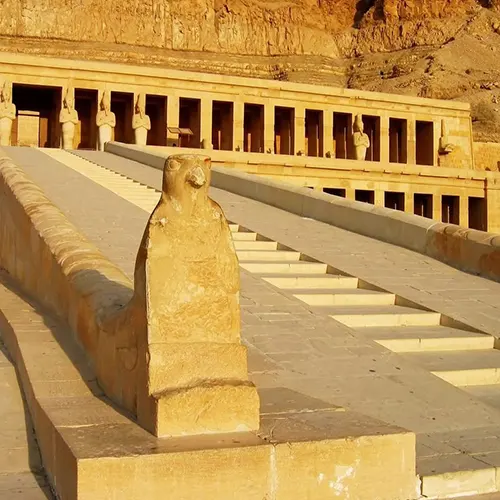
Hatshepsut, the most famous queen became a Pharaoh, and founded this temple on the west back in Luxor city, directly across the Nile River from Karnak Temple.
This temple is called Djeser-djeseru, meaning the Holy of Holies. Senenmut inspired the design of this temple from the structure of the temple of temple Mentuhotep II (Neb-Hept-Re) from the 11th dynasty, Middle Kingdom. This temple is dedicated to being the mortuary temple of Queen Hatshepsut.
This temple consists of three levels attached with ramps. On the uppermost level, an open courtyard lies just beyond the portico. There are statues of Hatshepsut in Osiris shape lean against the pillars of these porticos.
Also, the temple contains shrines for the god Anubis, the god of the dead, and the goddess Hathor, the goddess of women, fertility, and love.
The inscriptions of the templeIn the first level:
In the northern part, there is a scene depicting Queen Hatshepsut while she hunted in the bush in front of several gods like Horus, Thoth, and Amun.
While on the southern part, there is a scene depicting the transportation of obelisks from the quarry to their destination in Karnak Temple.
strong>In the second level:
In the northern part, there is a scene depicting the divine birth of Queen Hatshepsut, as she showed that his father is the god Amun himself to prove that she is the rightful king of Egypt.
While on the southern part, there is a scene depicting the expedition of Queen Hatshepsut to Punt.
The rest of the temple was carved inside the mountain.
Finally, this temple is also called Deir el-Bahari Temple, due to there was a Christian monastery built there in the 7th century. Deir is an Arabic word meaning monastery.
Philae Temple of Isis is the most prominent monument of Philae Island. Philae Island was a rocky island in the middle of the River Nile, located in Aswan.
Philae Island had a great prominence as the center for worshipping the goddess Isis, the mother of the god Horus. This island contains other monuments as the Kiosk of Trajan, Osiris Chapel, Horus Temple, Hathor Temple, The Gateway of Tiberius, the Gateway of Diocletian, and Augustus Temple.
After the construction of the Aswan Dam, the monuments of Philae Island were submerged underwater for the greater part of the year, and Philae temples were accessible only between August and December. The construction of the High Dam in 1960 threatened to engulf them for good, which resulting transferring the monuments of Philae Island to Agilkia Island in the 1960s during the UNESCO Nubia Campaign, as the temple was dismantled and transferred, stone by stone, from the submerged Philea Island to Agilkia Island. This project took over 9 years to be accomplished.
Philae flooded by Aswan Dam in 1906 Kiosk of Emperor Trajan
Philae Temple is one of the last ancient Egyptian temples to remain active, as it continued to function until the reign of the Byzantine Emperor Justinian I. On that date, the priest of Isis, Esmet-Akhom, carved the last dated hieroglyphic inscription, dating to the late 4th century AD.
The design of Philae Temple of IsisThe Temple of Isis is the most famous temple on Philae Island. It was founded in Ptolemy II’s period, then other Ptolemaic Kings contributed by adding more parts to it. This temple is built on the same style of the New Kingdom temples, with adding some other elements that appeared in the Greco-Roman period like the mamisi and the Nilometer. This temple was used during the Coptic period to be a Christian church.
It is thought that the oldest remains of Philae Temple date back to King Taharqa of the 25th Dynasty, who constructed the first shrine for the Goddess Isis.
The plan of this temple is very simple. It consists of the 1st Pylon leading to an open court, the 2nd pylon, and the Holy of Holies.
Pass through the 1st pylon to reach the main court of the temple. While you go through the gate, you will find the French inscription (“a 7 de la République”) on the right. It refers to commemorate Napoleon’s campaign and the pursuit of the Mamelukes by General Desaix in 1799.
On the right of the main court, there are rooms for Isis priests.
The Mamisi or the House of the divine birth of Horus: You can enter the mamisi from the left side of the court or by the direct gate in the western tower of the 1st pylon. It is a symbol of the birth of Horus. There is a scene in this room depicting Isis suckling her son Horus in the marshes and scenes of the birth of the God Horus.
Then 2nd Pylon leading to inner temple area with 10 columns.
Then 3 shrines leading to a sanctuary or the Holy of Holies.
Philae Temple distinguishes with its Sound and Light Show presenting a narrated storytelling the legend of God Osiris and his wife Goddess Isis and the history of Philae Temple and how it was saved by transferring its rocks to the current place.
The construction of the Aswan high dam was a great dream for President Gamal Abdel Nasser to ensure developing Egypt for all Egyptians. The high dam is fed by the River Nile from south.
The History of Aswan High Dam There are two dams in Aswan, Aswan Low Dam and Aswan High Dam. Aswan Low Dam was constructed in 1898 and completed in 1902. But it was not adequate to control the annual flooding, leading to President Gamal Abdel Nasser think in constructing a higher dam in 1952. The construction for the project began in 1960 after getting funding and was completed in 1968. It was officially inaugurated in 1971.
There is a huge reservoir behind the dam, called Lake Nasser. It was finished filling in 1979. This reservoir is with a reservoir capacity of 132km³.
Nasser Lake
The construction of this dam is considered an impressive engineering feat, as it is 360 feet tall and 12,500 feet across.
The Benefits of the Dam Although the construction of the dam led to a rise in the level of the Nile River, which led to immersion of many monuments and archeological sites as Philae Temple.
Despite this, the dam provides several benefits to Egypt, as
It provides water for around 33,600km² of irrigation land and contributes to increasing the cultivable land in Egypt.
It controls flooding that was threatening the lives of citizens.
It generates power, as it was responsible for producing around 50 % of the electricity production in Egypt and providing many villages with electricity for the first time.
ultimate guide to exploring the beauty and history of Egypt! We are passionate about creating unforgettable travel experiences, helping visitors discover the magic of this ancient land.