The Nilometer is founded by the Caliph Al-Mutawakkil in 861 AD. It is considered the second Islamic sightseeing built in Egypt after Amr Ibn Al-Ass Mosque.
The Nilometer was used to measure the level of the water of the Nile River to set the taxes. The water measurement occurred by a marble octagonal column 19 cubits in length standing in the middle of the building. This meter has become unused after the building of the Aswan High Dam in the 1960s.
The structure is divided into two parts. The first part is the conical dome. The second part is a flight of spiral stairs leading down, with depth markings along the walls.
Visit this amazing attraction with Egypt Vacation Tours team with Cairo Day Tours.
Also, enjoy visiting this sightseeing and Manasterly palace on a virtual tour provided by the ministry of tourism and antiquities via this link
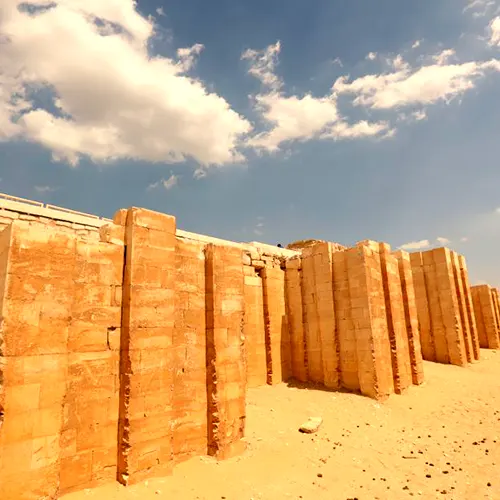
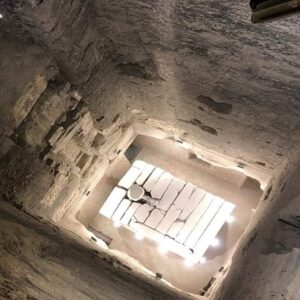
The Southern Tomb Location and dimensionsIn the southern end of the Great Court is a long building with a low, vaulted roof known as the South Tomb. The elements of the substructure are very similar to those of the pyramid (although on a reduced scale) but differ somewhat in their arrangement. The burial chamber was at the bottom of a vertical shaft, 7 x 7 metres and 28 metres deep—the same dimensions as the one under the pyramid and on more or less the same North-South axis. It was made out of the same pink granite and there is even evidence for an earlier limestone version with stars carved into the ceiling. The interior of the tomb was far less disturbed by robbers than the Step Pyramid and the ‘manoeuvre chamber’ has survived reasonably intact. Even the beam used to lower the granite plug was still in place. The walls were of limestone and the ceiling had been carved in imitation of palm logs.
The Southern Tomb Substructure: In the South Tomb at Saqqara, a descending corridor led down to the tomb—although from the west rather than the north, as was the case with the step pyramid. About halfway down was a rectangular gallery about 30 metres long, filled with pottery and stone jars. On top of them was a wooden stretcher, a wooden box and a set of poles from a canopy—still bearing traces of gold leaf. Lauer assumed the stretcher was used to carry the vessels into the tomb and then simply left behind but, given the other equipment found, transportation of a statue seems a little more plausible.
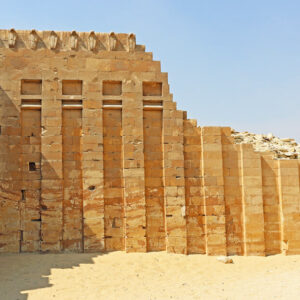
The Southern Tomb Decorations:There was a similar arrangement of galleries, including a number with the same faience decoration mimicking the appearance of reed mat panels and doorways—again, probably representing the private apartments of the royal palace. There is every reason to believe that this suit of rooms was constructed before those under the pyramid, which were far less accomplished and less complete. As was the case in the latter, the false doorways contained reliefs of the pharaoh taking part in various rituals. On the door jambs and lintels were carved the name and titles of the king. He is invariably referred to by his Horus name, Netjerykhet. Apart from much later graffiti, the name Djoser does not appear anywhere in the complex.
the Step Pyramid from inside
The king is shown wearing only a skimpy loincloth (at most), a false beard and the crown of Upper Egypt. In his right hand he is carrying a flail, an agricultural tool used in threshing grain but also an important symbol of power for the pharaoh. In his left hand he is holding a fishtailed object, presumably the flint version that figures so prominently in the predynastic archaeological record and is thought to have been used in the ‘Opening the Mouth’ ceremony to reanimate the deceased. Hovering over his head is Horus, the god of kingship, holding an ankh symbol (the hieroglyph for ‘life’) in his talons. In front of him is a standard bearing the image of a jackal (Wepwawet, the ‘Opener of the Ways’). He is striding between two pairs of horseshoe-shaped territorial markers.
The Southern Tomb Function:Secondary tombs can be found at some, but by no means all, Old Kingdom pyramids. In some cases, they are thought to belong to the pharaoh’s principal wives. but the burial chamber of the South Tomb is very small, 1.6 x 1.6 and 1.3 metres high—probably too small for an adult woman and her coffin. Various theories have been proposed for its function—to house the royal placenta that had been preserved since the pharaoh’s birth; to contain his internal organs (lungs, stomach, intestines and liver) removed during the mummification process; or to serve as a repository for the two crowns of Upper and Lower Egypt. Lauer believed that it was a cenotaph, meant to replace the royal tomb at Abydos. The most popular theory is that they were the tombs of the pharaoh’s ka, represented in the form of a statue. Shown (left) is a wooden shrine containing the ka-statue of the Dynasty XIII pharaoh Hor’ in his shrine. The arms reaching upwards on top of his head is the hieroglyph for ka.
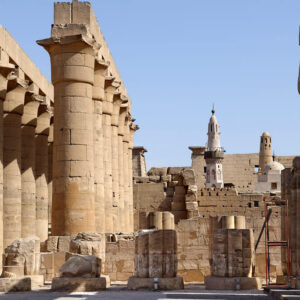
Luxor temple is one of the most beautiful remained monuments on the east bank of the Nile River in Thebes, or Luxor city now.
The history of construction of Luxor temple
King Amenhotep III of the 18th dynasty started to build this temple, but the main building of the temple was completed by King Tutankhamun and King Horemheb. Then King Ramses II added some elements to the temple.
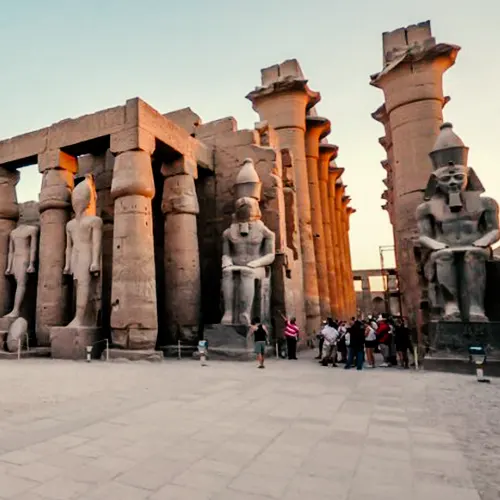
During Amenhotep III’s reign, the main entrance of the temple was on the northern side. After that, you will see the great colonnade consisting of seven pairs. It takes the shape of high open-flower papyrus columns. Then you will move to the courtyard of King Amenhotep III. Then the hypostyle hall, containing thirty-two columns.
The great colonnade of Amenhotep III
The cache of Luxor temple was discovered by the archaeologist Muhammad al-Saghir on the morning of January 22, 1989. While he was cleaning the courtyard of King Amenhotep III, he found a wonderful collection of statues for gods and kings of the New kingdom. Most of these collections are moved to be displayed at Luxor Museum.
Behind the hypostyle hall, there are four secondary rooms, the room of the Divine birth of King Amenhotep III, Alexander the Great’s shrine, and the Holy of Holies of the triad of Thebes (Amun, his wife Mut, and their son Khonsu).
The divine birth room houses depictions tell an amazing story of how the king’s true father was none other than the god Amun himself.
The King Ramses II adds:
He added a massive pylon decorated with inscriptions of the Kadesh Battle against the Hittites. This pylon was preceded by six colossal statues for King Ramses II himself and two obelisks made of granite. Now, one of these two obelisks is transferred to the Place de la Concorde in Paris.
In front of this pylon, there is the avenue of sphinxes linking between Luxor Temple and Karnak Complex. This avenue was used during the Opet Festival, as Amun used it to move from Karnak Complex to Luxor Temple.
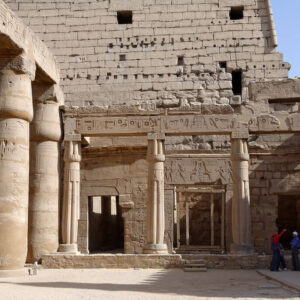
Also, King Ramses II built another courtyard in front of the great colonnade of King Amenhotep III. In this courtyard, on the right side, you will see the shrine of Queen Hatshepsut and King Thutmose III.
the shrine of Queen Hatshepsut and King Thutmose III
The temple was remained used in the Greco-Roman period. In the Christian period, the hypostyle hall of the temple was changed to be a Christian church.
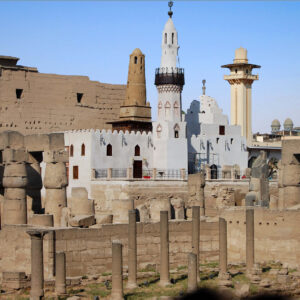
After many years, the temple was covered and hidden by sand and streets, resulting in the construction of the Yusuf Abu al-Hajjaj mosque over the Northeast side of the temple in the courtyard of King Ramses II in 640.
Colossi of Memnon are two massive statues on the west bank of the Nile River in Luxor city. They stood at the entrance of the mortuary temple of king Amenhotep III of the 18th dynasty, New kingdom. These statues are the only residual part of this temple.
These two twin statues depict King Amenhotep III, seating on the throne chair and wearing the Nemes, the royal headdress. The statues measure 20 meters tall. They are made of quartzite sandstone. The northern statue presents the king with a small statue for his mother (Mutemwiya), while the southern one presents him with his beloved wife (Tiye). Amenhotep, son of Hapu supervised the construction of these statues.
After an earthquake had occurred in 27 BC, the northern statue was deeply affected, as cracks appearing on it. These cracks resulted to when the winds were passing through the northern statue at dawn, making mysterious sounds and forming dew drops on the statue’s body.
The Greeks linked between these sounds and dewdrops and the crying of Memnon’s mother on her killing son (Memnon). Memnon was the king of Ethiopia, traveled to Asia to help in defending Trojan city, the beleaguered city under attack. But he was killed by Achilles. So they are famous for the Colossi of Memnon.
Achilles killing Memnon
Later the Roman Emperor Septimius Severus restored the northern statue that led these sounds to stop.
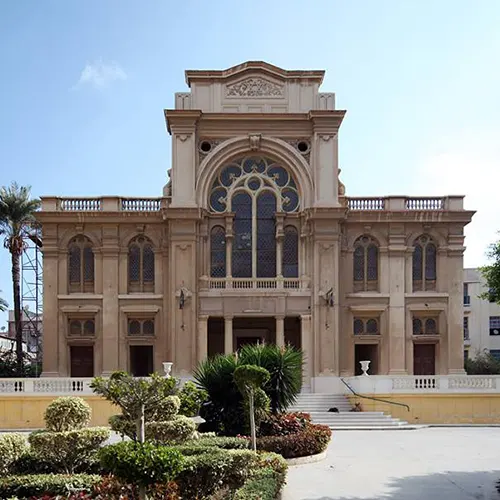
Eliyahu Hanavi Synagogue is one of the most important Jewish sightseeing in Alexandria and Egypt. Finally, it reopens its doors for the public on Jan 10th, 2020after many years of restoration.
The history of Eliyahu Hanavi Synagogue
It was established in 1881, after the Patriarch of Alexandria, gifted a plot of land that belonged to the Church for its construction. It is considered one of the largest Jewish Synagogue in the Middle East.
It was bombed by the French during their invasion of Egypt in 1798. But in 1850, the members of the Muhammad Ali family restored and reconstructed it.
In 2017 the Egyptian government announced a project to restore the synagogue in a growing movement of keeping its Jewish heritage alive. Finally, it reopens its doors for the public on Jan 10th, 2020after many years of restoration.
Let’s go on a tour inside Eliyahu Hanavi Synagogue
The structure is built in the basilical style. It consists of two floors accommodating 700 worshipers, one of them is dedicated to women. This synagogue distinguishes with housing an ancient library containing 63 leather and paper scrolls copies of the Torah (Old Testament) and unique books back to the 15th century.
There is a small platform used for sermons lies in front of the sanctuary. The marble sanctuary is situated on the east side of the synagogue.
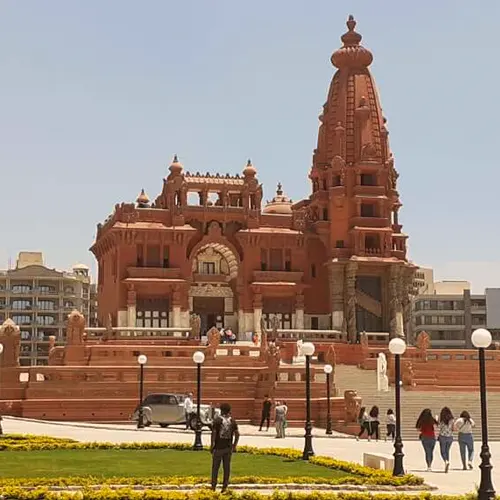
Baron Empain Palace is the most famous landmark of Heliopolis, the city of the sun. This palace suffered from neglect for many years until the Ministry of Antiquities bought, received it from its owners, and began to restore it in 2007. The restoration work finished, and the palace is opened on Jun 29, 2020.
But before talking about this great palace, we should first talk about the owner or the founder of it, Baron Edward Empain.
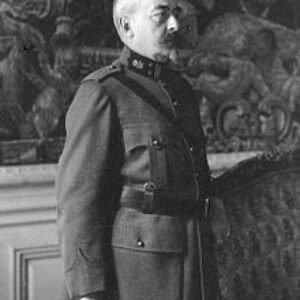
Let me introduce Baron Edward Empain to you.
He was a Belgian engineer and businessman. Empain is not a part of his name. It is a title. Baron Edward was awarded this title by the king of France due to his efforts in the establishment of the Paris metro.
Baron Edward Empain
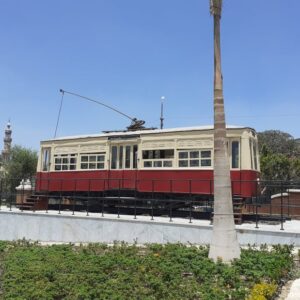
He came to Egypt in 1894 and adored it, so he decided to stay in it and asked the Egyptian government to build a new city in the desert, It became Heliopolis city. He founded this whole city with the help of Ernst Jasper, the Belgian architect. Additionally, he built the first tram in Cairo to connect between Cairo city and Heliopolis.
The tram
Baron Empain died on July 22, 1929, in Belgium, though was buried in Egypt in Basilica Church as he willed.
Now, let’s go to visit Baron Empain Palace
Baron Edward Empain got help from Alexandre Marcel, the French engineer, in the construction of this palace.
The first thing you will see is its amazing garden. It fills with several statues taking the Indian and Cambodian style. This garden houses the building founded by the reinforced concrete structure that was a new thing in Egypt at that time.
Let go inside the palace.
The palace consists of four floors:
– The basement
– The first floor contains three rooms. The middle one is decorated with the Indian and Cambodian style, but another two rooms are decorated with the European style.
– The second floor contains four bedrooms, including bathrooms.
– The roof was used in holding the concerts and parties.
Now is the time for legends
It is said that this palace has a legend in every corner of it
– One of the stories says that the palace tower rotates to offer a 360-degree view of the surrounding area to follow the sun.
– Baron Edward Empain used magical tricks during the construction of the palace.
– Baron Edward Empain killed Alexandre Marcel and buried his corpse in the garden of the palace.
All of these stories and more link with this palace due to the neglect it suffered for many years.
Salah El-Din Citadel or Cairo Citadel is built by Salah El-Din Al-Ayoubi, the founder of the Ayyubid Dynasty in 1176 to be a fortress and seat of rule for nearly 700 years. It stopped being the seat of the rule when Khedive Ismail transferred it to Abdeen Palace in 1874.
Salah El-Din Al-Ayoubi decided to construct this citadel on Mokattam hills for use this strategic position allowing him to expose the whole city and made it difficult to attack. In 1976, UNESCO considered it one of the heritage sites in Islamic Cairo.
This citadel houses several museums as the National Military Museum and the Police Museum and mosques as Sultan Al-Nasir Muhammad Mosque, Mosque of Suleiman Pasha El Khadim, and Muhammad Ali Mosque.
Al-Nasir Muhammad Mosque
It was built in the Mamluk period in 1318. It distinguishes with its green Dom.
Al-Nasir Muhammad Mosque
Muhammad Ali Mosque
Muhammad Ali Pasha began its construction in 1830, but it was completed in 1857 by Said Pasha, son of Muhammad Ali Pasha. Muhammad Ali Pasha willed to be buried in this mosque so you can see his cemetery inside the mosque.
Mosque of Muhammad Ali
Muhammad Ali Mosque is also known as the Alabaster Mosque due to its walls are coated with alabaster. It was established in the Turkish style, as the mosque is divided into two parts. The first part is the courtyard, while the second is the house of prayer. Also, it distinguishes with its domes and minarets taking the pencil shape. Some opinions believe that this mosque is similar to the blue mosque belonging to Sultan Ahmed in Turkey.
Enjoy visiting Salah El-Din Citadel and Islamic Cairo sightseeing with Egypt Vacation Tours experts.
Khan El khalili Bazaar is the most famous souq, It was built in the Mamluk period as a center of trade.
Also, it includes workshops for the Egyptian artisans, who create and produce traditional crafts and souvenirs.
Let’s know about the history of this bazaar
When the Fatimids founded Cairo city, they divided it into two sections. The first one contained the eastern royal palace, while the second houses the western royal palace. Today, the location of Khan El-Khalili Bazaar is the southern end of the eastern Fatimid Palace.
Dajaharks Al-Khalili founded this bazaar in the 14th century, so it is called El khalili Bazaar.
The design of the bazaar was multi-storied structures. The bazaar centered around an inner peristyle courtyard, where traders could store their merchandise, while the upper levels were used for housing.
The bazaar contains several coffeehouses, shops, and restaurants. The most famous traditional Arabic coffee there is El Fishawi. In this coffee, the Egyptian author Naguib Mahfouz spent a lot of time.
Enjoy your time in this fabulous bazaar and buy a unique souvenir making you do not forget this unique tour with Egypt Vacation Tours team.
El Moez Street or El Moez li-Din Allah al-Fatimi Street is one of the oldest streets in Cairo city. It was founded within the construction of Cairo city during the Fatimid period under the caliph Al-Mu’izz li-Din Allah.
El Moez St. runs from the north, where the gate of Bab al-Futuh to the south, where the gate of Bab Zuweila. Both entrances were established by the vizier Badr al-Jamali in the 11th century when he rebuilt some buildings in Cairo city, including its walls. Its length is approx. one kilometer long, which makes it considered one of the longest streets in the walled city.
The vital role of this street made people were building in it souqs as Khan El khalili Bazaar, religious buildings as Al-Hakim Mosque, and charitable buildings as Madrasa of Barquq. These buildings date back to different Islamic periods such as the Abbasid, Fatimid, Mamluk, and Ottoman periods.
Let’s go on a tour in El Moez Street to see some of its sightseeing
Madrasa of Barquq: This complex contains a mosque, a mausoleum, and a school. This school or madrasa (in the Arabic language) was for teaching the four Islamic schools.
Al-Hakim Mosque:It lies beside the gate of Bab al-Futuh in the north of Cairo city. This mosque originally built by Al-Aziz, the father of Al-Hakim, but Al-Hakim completed it, so the mosque is called Al-Hakim Mosque.
Al-Hakim Mosque
Sabil of Sulayman Agha al-Silahdar: This sabil is a good example for displaying how people used to drink in old times while walking around the street.
Sabil of Sulayman Agha al-Silahdar
Discover more attractions of El Moez St. with Egypt Vacation Tours experts by submitting on our day tours.
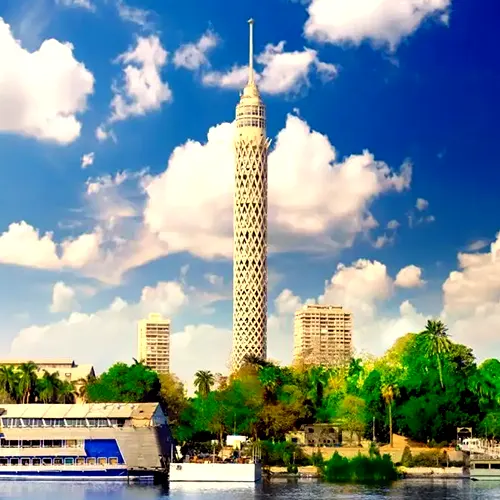
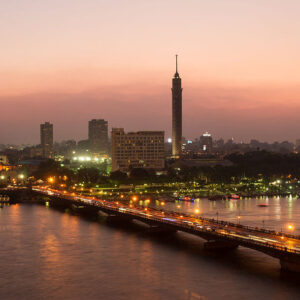
Cairo Tower lies on Gezira Island in the River Nile. It is considered one of the most famous modern monuments in Cairo, Egypt.
It was founded in 1961 during the Gamal Abdel Nasser period and was designed by the Egyptian architect Naoum Shebib. This design is inspired by the lotus plant, one of the most important plants in ancient Egyptian civilization. Its tall is 187 M, which makes it considered the tallest building in Egypt.
Let take a tour inside the tower
The tower consists of 16 floors. Take the elevator to reach the last floor at 45 seconds. It is advised to go up to the tower, where you will find a circular observation deck and a revolving restaurant allowing you to see the attractions of Cairo, the city of the thousand minarets, and enjoy taking photos during fabulous sunset.
Cairo Tower Today
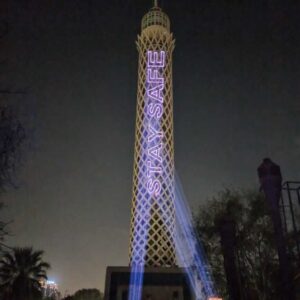
The Ministry of Tourism and Antiquities and the Egyptian government launched the initiative to illuminate the Egyptian sightseeing as the great pyramid of Cheops in Giza plateau and Cairo Tower to send a message for the whole world. This message contains (Stay Home – Stay Save). This message aims to urge people to stay at their homes to reduce the spread of Coronavirus COVID-19 and protect themselves from it.
Visit Cairo Tower and enjoy seeing Cairo sightseeing from the above with Egypt Vacation Tours
ultimate guide to exploring the beauty and history of Egypt! We are passionate about creating unforgettable travel experiences, helping visitors discover the magic of this ancient land.