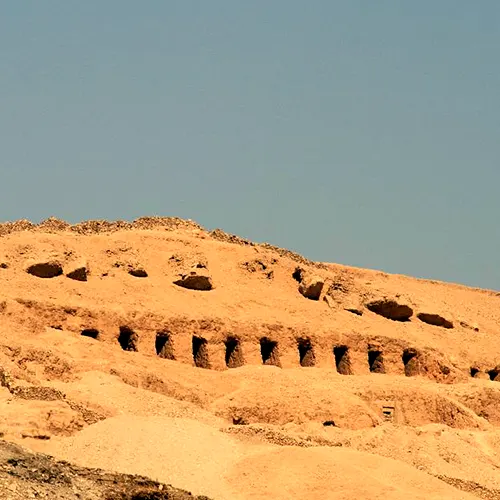
The Red Pyramid of Dahshur

The Red Pyramid of Dahshur was the third one constructed by King Snefru, after the Bent Pyramid and Meidum pyramid. It is the highest pyramid in Dahshur.

King Snefru King Snefru is the founder of the 4th dynasty, the old kingdom. Also, he is the father of King Khufu, who owns the Great Pyramid of Giza Plateau. His main wife was queen Hetepheres I, who also is the mother of King Khufu.

The construction of the Red Pyramid The establishment of this pyramid might begin in the 13th year of King Sneferu’s reign and took 10 years to be completed. The Red Pyramid is called red due to using a red stone in its construction.

The Red Pyramid is the first true or complete pyramid in ancient Egyptian history, as after the failure in the construction of the Bent pyramid and Meidum pyramid to be complete pyramids, the ancient Egyptian engineers corrected their mistakes and be aware of the correct angle to reach the true pyramid, what is 43 degrees.

It is thought that 43 degrees were the angle that was used by the ancient Egyptian engineers in building the top part of the Bent pyramid; also it was approved by those engineers for building the later pyramids in the ancient Egyptian civilization.

The Red Pyramid is 341 feet tall, so it is considered the third-largest ancient Egyptian pyramid after the pyramids of Kings Khufu and Khafre at Giza Plateau.

The plan of this Red Pyramid The entrance of the pyramid is located on the northern side. This entrance leads to a passageway. Then there is a gallery, leading into a chamber with a corbelled roof, Then there is another passage leading to a second chamber, This chamber houses another passageway leading to the third chamber, which is believed that it is the burial chamber.

Royal Jewelry Museum in Alexandria

Royal Jewelry Museum reflects how rich the family of Muhammad Ali Pasha and their extravagant living. This family ruled Egypt for 150 years, from 1805 to the Egyptian Revolution in 1952, from Muhammad Ali Pasha until Faruq I.

The history of Royal Jewelry Museum This building was the former palace owned by Princess Fatma El Zahraa, the granddaughter of the brother of Khedive Ismail and one of the descendants of Mohamed Ali Pasha. It was built in 1919 at 27 Ahmed Yahya Basha Street – Zezenia – Alexandria Governorate.

The palace is turned to be a museum in 1986. It is divided into ten halls displaying more than 11 thousand precious objects like gifts, pieces of jewelry owned by the royal family.

Royal Jewelry Museum - Egypt Vacation Tours
Royal Jewelry Museum

The design of this building The design of the building merges between the European and Islamic styles. Also, it distinguishes by the oil paintings, gilded and hand-painted ceilings, and glass panels drawn with scenes of Greek mythology that decorate many rooms of the palace.

The painted ceilings - Royal Jewelry Museum - Egypt Vacation Tours
The painted ceilings

The collection of the museum The museum displays possessions owned by members of family of Muhammad Ali Pasha.

The masterpieces in the museum

    • A diamond and emerald inlaid collar belongs to Mohamed Ali Pasha. This collar consists of 16 decorative motives, eight having the inscription “Mohammed Ali” while eight in the shape of a gold flower with diamonds.
A collar of Mohamed Ali Pasha - Royal Jewelry Museum - Egypt Vacation Tours
A collar of Mohamed Ali Pasha
    • A gold chessboard and the chess consisting of 32 pieces inlaid with 425 stones from diamonds and decorated with colored enamel. This collection belongs to King Farouk.
The golden chess of King Farouk - Royal Jewelry Museum - Egypt Vacation Tours
The golden chess of King Farouk 
    • A gold binocular encrusted with diamonds, rubies, and emeralds.
    • A collection of pocket watches belonging to members of family of Muhammad Ali Pasha.

Dazzling pieces of jewelry were designed and made especially by the greatest designers in Europe for the queens and princesses of family of Muhammad Ali Pasha.

    • A platinum tiara fixed with over 2.000 diamonds and white pearls belonging to Princess Shivakiar, wife of King Fuad I.
A tiara of Princess Shivakiar - Royal Jewelry Museum - Egypt Vacation Tours
A tiara of Princess Shivakiar 
    • A platinum crown of Queen Farida, the wife of King Farouk, is inlaid with white and yellow diamonds.
The crown of Queen Farida - Royal Jewelry Museum - Egypt Vacation Tours
The crown of Queen Farida
  • A brooch of princess Fawzia, the daughter of Fouad I and sister of King Farouk, from diamonds and gold.

Mohamed Ali family built a lot of palaces in Egypt:

  • Some of it used as the headquarters of rule as Al Gawhara Palace in Citadel of Saladin, Abdeen Palace, and Ras Al-Teen Palace.
  • Some were used for housing for the family members as Muhammad Ali Palace in Manial and Montazah Palace.

Abu Al Abbas Al Mursi Mosque

Abu Al Abbas Al Mursi, or Al Mursi Abu Al Abbas Mosque as the people of Alexandria use to call it, is one of the most famous mosques and Islamic monuments in Alexandria. The mosque is located in the Anfushi neighborhood of Alexandria, close to the Citadel of Qaitbay.

Abu Al Abbas Al Mursi Abu Al Abbas Al Mursi was a Andalusi Sufi. He lived during the 13th century in the Andalusia region of Spain and was born to a wealthy family. In 1242, he traveled with his family to Tunisia.

Then he moved to Alexandria in Egypt to study jurisprudence and religion, as it was a popular destination of many Muslim scholars at the time, and lived almost 43 years there. He lived in Alexandria as a scholar and teacher till his death in 1286. He was buried in a small building there.

There is an annual festival held in Alexandria on the 5th of July for celebrating the birth of Al Mursi Abu Al Abbas.

The history of the mosque The mosque was constructed in 1307 when El Sheikh Zein El Din, one of the richest traders of Alexandria, visited the building where Abu Al Abbas Al Mursi was buried and wanted to develop this mausoleum in honor of Abu Al Abbas Al Mursi.

The current building was redesigned and reconstructed in 1929 by Eugenio Valzania and Mario Rossi as it appears very influenced by the architecture of old Cairo buildings. Then, King Farouq I built the Midan el Masged or Mosque Square.

The mosque has two entrances in the north and the east. Also, it has a minaret with Ayoubids design standing on the southern side. As well, the ceiling is decorated with arabesque and has four unique domes.

The mosque is built on the tomb of Abu Al Abbas Al Mursi as he was buried there.

Abu Al Abbas Al Mursi’s tomb became one of the destinations of many Muslims during their pilgrimage to Mecca as they pass in Alexandria on their way from Egypt and Morocco.

The Mummification Museum

The Mummification Museum is located on the east of Luxor city, in the north of Luxor Temple, It is opened in 1997, It is one of the most important museums in Egypt.

The Mummification museum concept: The concept of the Mummification museum mainly explains the mummification process and how the ancient Egyptians have preserved their dead bodies for many years.

In ancient Egyptian believes, the god Anubis was the god who was responsible for the mummification of the dead. As well, in ancient Egyptian believes, they thought that they have to save the body by mummification in order for the soul return to it again.

In addition, the ancient Egyptians mummified human bodies; they mummified the corpses of animals and birds, especially those belonging to the sacred ones. Like there are the Serapeum of the calf of the god Apis at Saqqara and the Catacombs of Ibis and the baboons of the god Thoth in Tuna El-Gebel. As well, there are mummies for dogs, cats, and crocodiles.

The museum collections are the mummification tools, some of Canopic jars, coffins, and amulets.

Some masterpieces of the museum:

  • The Mummy of Masaharti: he was the General of the Army and high priest of Amun at Thebes during his father’s reign, king piedjem I, in the 21st dynasty. His mummy was discovered in the royal cache of Deir El Bahari in 1881.
  • Many statues for the ancient Egyptian gods as the god Anubis, the goddess Isis, the god Osiris, and the goddess Nephthys.

The Mummification process:

    The mummification process took almost 70 days inside the mummification tent.

  • Firstly, the organs of the corpse were extracted through a small incision in the left side of the body, and these organs were mummified and preserved in the Canopic jars.
  • Then the body would be submerged into natron salt brought from Wadi El Natron to be dried for about 40 days.
  • Then the body would be wrapped in bandages of linen.
  • Finally, the priests put magical amulets beside the body for protection in the coffin to move it to its tomb for burial.

The Coptic Museum in Coptic Cairo

The Coptic Museum contains the largest collection of Coptic collections in the whole world. It is located in the Coptic Cairo inside the Babylon Fortress and beside the hanging church, the Cave Church, and Ben Ezra Synagogue.

The history of The Museum This museum was opened to the public in 1910 by the efforts of Marcus Simaika Pasha, as he was interested in the preservation of Coptic heritage. He collected these collections by himself by buying the Coptic artifacts and architectural elements from older churches.

In 1939, the Service of Antiquities decided to transfer the Christian collection exhibited in the Egyptian Museum in Tahrir Square to be displayed in the Coptic Museum. Automatically, all discovered Christian artifacts are transferred to the Coptic Museum.

This museum consists of two buildings linked by a bridge. The first building was established by Marcus Simaika Pasha in 1910, while the second was added later in 1947.

It can be noticed that the facade of the Coptic Museum is identical to the facade of Al Aqmar Mosque in Moez St.

The museum collection: The building of the museum contains two floors housing various Coptic collections. These collections display the Coptic history in Egypt, as Christianity began in Egypt by Saint Mark when he visited Alexandria in the 1st Century AD. As well, these collections show how the Christian community lived in Egypt.

The museum objects reflects the merger that happened between Coptic art and the art in other civilizations as the ancient Egyptian art (as the collection of Kom Abou Billou site), Greco-Roman art, Byzantine art, and Ottoman art.

The museum display is divided into:

  • Stones and frescoes section:this section houses religious scenes and stone drawings from monasteries and churches. These scenes were drawn by tempra style.
  • The development of Coptic writing and manuscripts section: This section exhibits bibles written on deerskin in the Coptic and Arabic languages from the 11th to the 13th Century.
  • Fabrics and textiles section: it contains the clothes of monks decorated with crosses and drawings of the Virgin and the Christ.
  • Icons section:this section has a wide collection of Coptic icons from different periods with different themes and decorations. Icon is a Greek word meaning a picture that may be a drawing of saints or other religious scenes.
  • Wooden works section: this section contains several wooden works as doors and chairs brought from churches.
  • Metal section: it displays a large amount of silver and gold Coptic coins.
  • Pottery and glass section: it displays a lot of pottery and glass objects reflecting the Coptic community and history in Egypt.

For a quick visit to the Coptic Museum, the Ministry of Tourism and Antiquities launched a virtual tour for the Coptic Museum, You will be able to check it via this link.  The Coptic Museum virtual tour

The Bent Pyramid of Dahshur

The Bent Pyramid of Dahshur was the second of three pyramids constructed by King Snefru, the red Pyramid and Meidum pyramid. It is considered an important step in the development of the construction of pyramids in ancient Egypt.

King Snefru King Snefru is the founder of the 4th dynasty, the old kingdom. Also, he is the father of King Khufu, who owns the Great Pyramid of Giza Plateau. His main wife was queen Hetepheres I, who also is the mother of King Khufu.

The Bent Pyramid It is called the bent pyramid because of its broken lines due to a change of angle during the construction. It was an engineering issue in the design of the pyramid, as the construction of the pyramid started with an angle of 55 degrees, but in the middle of the pyramid, this angle had to be changed to be 43 degrees due to an overload in stones resulting in instability that posing a danger to the inner chambers of the pyramid.

The Bent Pyramid can be considered as a transition phase between the step pyramid of King Djoser at Saqqara and reaching the true pyramid as the red pyramid.

This angle of 43 degrees became the used angle in the construction of later pyramids as the red pyramid and the Great Pyramid of King Khufu at Giza Plateau.

The bent pyramid still has remains of its limestone casing that referring to how the pyramids looked like with their limestone casing.

The plan of The Bent Pyramid This pyramid has two entrances, the first entrance on the north side, while the second one on the west side. There are wooden stairs newly added for the northern entrance.

Both of those entrances lead to chambers with a corbelled roof. The chamber of the northern entrance is built below ground level, while the chamber of the western entrance is built at a higher level in the body of the pyramid.

Esna Temple of the god Khnum

Esna city was one of the most prestigious cities in ancient Egyptian history and the Greco-Roman period. Esna city houses many historical destinations, but the most important temple there is Esna Temple.

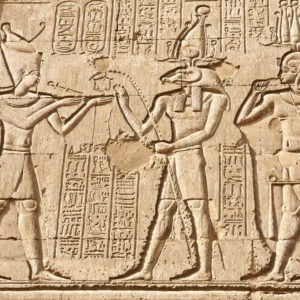
Who is the god Khnum? The god Khnum is one the most major gods in ancient Egyptian myths, as it is believed that he is the god of creation. Khnum appears in ram-headed with a human body or a lion body, as the avenue of rams in Karnak Complex.

The god Khnum of Esna Temple - Egypt Vacation Tours
The god Khnum of Esna Temple

The history of Esna Temple The establishment of the temple started from King Tuthmosis III reign in the 18th dynasty, New kingdom. The construction of the temple was completed during the Greco-Roman period.

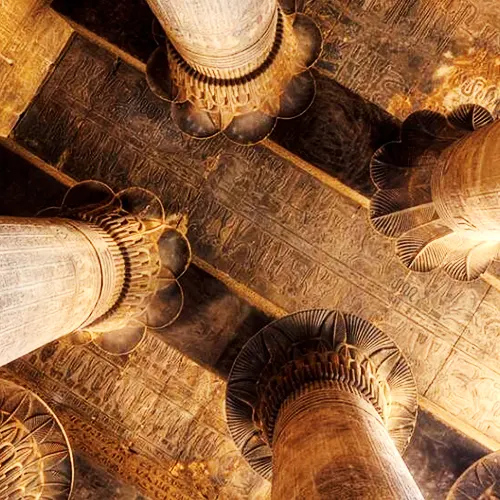
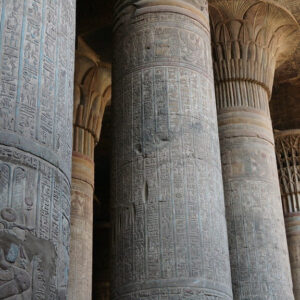
The temple appears in a hall of columns with 24 pillars taking the shape of lotus floral and palm. On both sides of the entrance of the temple, there are chambers by the priests of the temple as storerooms.

Pillars of Esna Temple - Egypt Vacation Tours
Pillars of Esna Temple

Most of the depictions in the temple show the Roman Emperors giving offerings to the god Khnum and other gods and goddess of the temple, as Neith, Heka, Satet, and Menheyet.

This temple was considered a sacred place in ancient Egyptian civilization, as there were strict rules for entering the temple like dressing linen clothes, washing the hands with natron salt, and cutting the fingernails and toenails.

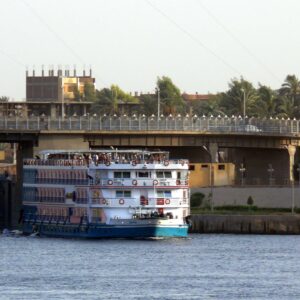
In addition, Esna city is famous for its barrage bridges and Esna lock that was built on the Nile River by the British in 1906.

Esna lock - Egypt Vacation Tours
Esna lock

Tunis Village in Faiyum Oasis

Faiyum Governorate is considered one of the most significant and diverse tourist destinations in Egypt. It distinguishes with its natural beauty, historical, and cultural importance at the same time. Faiyum contains most of the tourism types, as it houses historical attractions dating back to the pre-dynastic period, ancient Egyptian civilization, Ptolemaic, and Roman times. Besides, its scenic nature reserves as Wadi El Rayan and the Valley of the Whales or Wadi El Hitan. Also, it includes rare types of flora and fauna.  In addition, the Heritage attractions like Tunis Village.

Tunis Village or Izbat Tunis lies in the western-most part of the Faiyum Governorate. It overlooks the southwestern part of Qarun Lake. It is considered one of the most important heritage tourism destinations and fabulous sightseeing in Egypt. This village is famous for pottery making, reflecting the Tunis community.

The role of Evelyne Porret in changing the lifestyle of the community of Izbat Tunis The history of this village started with a small house built on a hill. This house is owned by Mohammed Ibrahim Wali and his Tunisian wife. It was a small community depending on farming.

In 1962, the Egyptian poet Sayed Hegab and his wife, Evelyne Porret came to Tunis Village. Evelyne Porret was a Swiss potter. She noticed that this village is populated by farmers. Those farmers saw the potteries of Evelyne Porret and admired them. So in the 1960s, she decided to collaborate with the Egyptian architect Wissa Wassef, who has trusted the artistic of Tunis village.

Then in the 1980s, she established a Pottery School for advancement in this community, satisfying their desire and developing their skills. As a result of community efforts and Evelyne Porret, this village became a heritage tourism destination.

Over the last thirty years, Tunis Village attracts many famous foreign and Egyptian artists, painters, and architects to live in it and build their own houses there. No doubt that the surrounding environment has an essential effect on this success, as the village surrounds by wonderful green gardens along the shores of Lake Qarun providing tranquility. This makes many tourists visiting Tunis Village for relaxing and enjoying this natural beauty. That leads to establish hotels and restaurants in the village to accommodate those tourists.

The Festival of Pottery For encouraging community production, Tunis Village holds a social occasion every year by the Egyptian Minister of Tourism and the Fayoum Tourism Authority for pulling in tourists, especially those interested in cultural and human heritage. This fest is called Tunis Pottery Festival. This celebration of pottery and handcrafts began in December 2011.

The pottery of Tunis Village - Egypt Vacation Tours (1)
The pottery of Tunis Village

Through the fest, there are some habits is occurred as desert safaris and horse riding, and watching a bird on the shores of Lake Qarun joined by guides.

The pottery of Tunis Village - Egypt Vacation Tours (3)
The pottery of Tunis Village 

The success of the Pottery School gained fame until Evelyne Porret founded several exhibitions in Cairo and abroad of Egypt, in the Gulf Area, and Europe.

The Valley of the Queens of Luxor

The Valley of the Queens is located on the western bank of Luxor city. This valley was dedicated for burying the wives of kings, who were buried in the Valley of the Kings.

This valley was discovered by Schiaparelli in 1904. It houses almost 81 tombs for queens, princes, princesses, and several members of the nobility of the new kingdom, the 18th, 19th, and 20th dynasties.  It was known in ancient Egyptian language with Ta-Set-Neferu, meaning “the place of beauty”.

The first queen buried in the valley was the princess Ahmose, the daughter of Queen Sitdjehuti and King Seqenenre Tao, who was killed in the wars of liberation against the Hyksos.

The main reason for choosing this place to be the Valley of Queens is unknown, but there are some opinions said that:

  • Because this place is close to the Valley of the Kings, as in previous dynasties, queens were buried inside the royal complex, but in the Valley of the Queens, the tombs are separated.
  • Also, it is close to Deir el-Medina or the village of workers, who work in the Valley of the Kings.
  • There is a chamber dedicated to the goddess Hathor in this place.

The design of these tombs begins with a small chamber, a long narrow corridor with several side rooms, then the burial chamber at the end of the tomb. Its tombs were decorated with religious scenes and books of the other world, which are still impressively preserved.

Tomb of Queen Nefertari The tomb of Queen Nefertari or the tomb QV66 is one of the most fabulous tombs in the valley.  Nefertari was the beloved wife of Ramesses II. It was discovered by Ernesto Schiaparelli in 1904. This tomb distinguishes with its well-preserved depictions. When you visit this tomb, you will see poetry written by king Ramesses II for queen Nefertari in the burial chamber.

Tomb of Queen Nefertari - Egypt Vacation Tours
Tomb of Queen Nefertari 

The tomb of the prince Khaemwaset Also, the tomb of the prince Khaemwaset is one of the most beautiful tombs in the Valley of Queens. Khaemwaset is the son of king Ramesses III. In this tomb, you will be able to notice the father’s care for his son, as king Ramesses III depicted while he is helping his son in crossing the gates and skipping the obstacles of the afterworld due to the young age of his son in front of several gods.

The tomb of the prince Khaemwaset - Egypt Vacation Tours
The tomb of the prince Khaemwaset 

The Cost of Trips to Egypt in 2021/2022

Egypt is an incredible destination and its visit is often the vacation of a lifetime for many people. If you arrange to travel to Egypt and plan your itinerary, you will definitely think about the cost of this trip in 2021/2022.

In this article Egypt Vacation Tours team will answer your question (How much does it cost or the average of the trip to Egypt?) Egypt is one of the cheaper, affordable, and more rewarding destinations as you will be able to see several of its attractions and do a lot of activities in Egypt without spending a lot of money.

When you calculate the cost of your trip to Egypt, you have to know the different aspects of this trip:

Airfare Airfare may be the most expensive fee during your tour in Egypt. In addition, you have to be aware that the airfare cost during the main holidays as Christmas, Easter, and New Year will be more expensive.

Some hotels offer a pick-up and drop-off service from and to the airport, This service usually costs around $10.

    AccommodationHotel

  • In Egypt, you will be able to find several choices for your hotel accommodation. It is ranging between hostels, 3 stars hotels, 4 stars hotels, 5 stars hotels, and Luxury hotels.
  • As we said, some hotels offer a pick-up and drop-off service from and to the airport. This service usually costs around $10.
    Nile Cruise

  • The Nile Cruise has a schedule, so it leaves and arrives on certain days. So it is better to arrange your itinerary around your cruise schedule.
  • The Nile Cruise fees range from cheap feluccas as you will spend your accommodation on a deck to a luxury Nile Cruise, where you will enjoy more privacy and comfort.
    Sleeper Train

  • It is another type of accommodation for a single night. It is one of the transportation from Cairo to Luxor or Aswan.
  • You have to be aware that there are tourist seasons, as the prices can be changed like hotels, cruises, and flights.
    Tour Guide

  • When you visit some cities around the world like Paris, you will not need a tour guide, it is better to discover it alone. Unlike in Egypt, you will need to a guide accompany you throughout your tour to explain to you the great history of this country and add value to your experience.
  • Also, the tour guide will help you in your local transportation as he/she will pick you up and drop you off at your accommodation, whether Hotel or Nile Cruise.
    Personal Spending

  • There are some places in Egypt as Khan El Khalili Bazaar and Luxor market that will attract you to buy some souvenirs and gifts, like papyrus, figurines, or accessories.
  • Also, there is common spending in Egypt that is always be expected. It is the tipping.