The Luxor Museum – Luxor City

The Luxor Museum is located on the east bank of the Nile River on the Nile Corniche between Luxor Temple and Karnak Complex in Luxor City, and facing the Ramesseum on the west bank . The museum is constructed to display the wealth of rare and valuable antiquities discovered in Luxor and opened to the public on 12 December 1975.

Generally, most of the museum collections were came from the excavations of the Luxor or returned from the Egyptian Museum to their original home. The collections of the  museum cover the time from the prehistoric period to the Islamic period.

Collections of Luxor Museum - Egypt Vacation Tours
Collections of Museum 

The museum consists of 2 floors displaying well-carved statues for ancient Egyptian gods and kings, the bulk of it dating back to the New kingdom. In 1989, the cache hall was added to the museum to display the statues discovered in the cache of Luxor Temple. Also, there are statues exhibiting in the garden of the museum.

The museum display distinguishes with its artificial lighting system that highlights the artistic beauty of the objects.

Some master pieces of the Luxor museum:

  • The statue of the god Sobek, brought from his temple in Kom Ombo.
  • The statue of goddess Hathor
The statue of goddess Hathor - Egypt Vacation Tours
The statue of goddess Hathor
  • The mummy of King Ahmose I, who evicted the Hyksos
  • A statue of King Thutmose III, the 18th dynasty, New kingdom
A statue of King Thutmose III - Egypt Vacation Tours
A statue of King Thutmose III 

Esna Temple of the god Khnum

Esna city was one of the most prestigious cities in ancient Egyptian history and the Greco-Roman period. Esna city houses many historical destinations, but the most important temple there is Esna Temple.

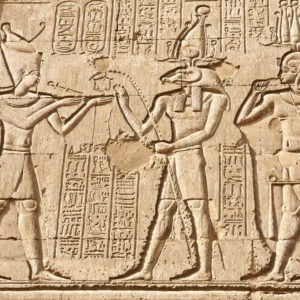
Who is the god Khnum? The god Khnum is one the most major gods in ancient Egyptian myths, as it is believed that he is the god of creation. Khnum appears in ram-headed with a human body or a lion body, as the avenue of rams in Karnak Complex.

The god Khnum of Esna Temple - Egypt Vacation Tours
The god Khnum of Esna Temple

The history of Esna Temple The establishment of the temple started from King Tuthmosis III reign in the 18th dynasty, New kingdom. The construction of the temple was completed during the Greco-Roman period.

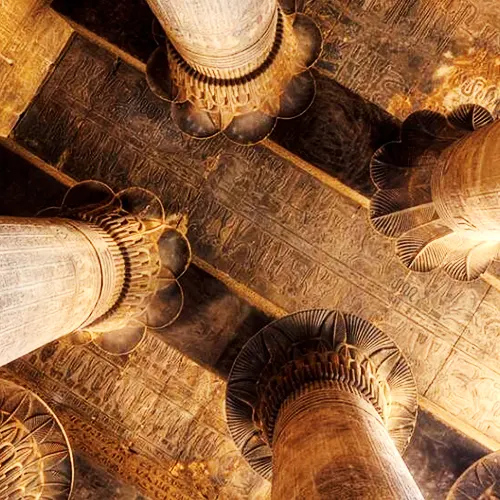
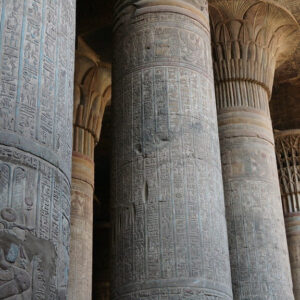
The temple appears in a hall of columns with 24 pillars taking the shape of lotus floral and palm. On both sides of the entrance of the temple, there are chambers by the priests of the temple as storerooms.

Pillars of Esna Temple - Egypt Vacation Tours
Pillars of Esna Temple

Most of the depictions in the temple show the Roman Emperors giving offerings to the god Khnum and other gods and goddess of the temple, as Neith, Heka, Satet, and Menheyet.

This temple was considered a sacred place in ancient Egyptian civilization, as there were strict rules for entering the temple like dressing linen clothes, washing the hands with natron salt, and cutting the fingernails and toenails.

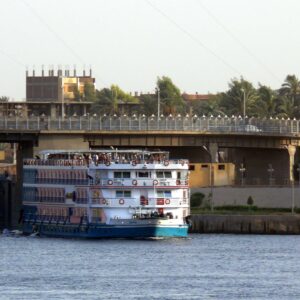
In addition, Esna city is famous for its barrage bridges and Esna lock that was built on the Nile River by the British in 1906.

Esna lock - Egypt Vacation Tours
Esna lock

Al Minya City – Upper Egypt

Al Minya is one of the most important governorates of the upper of Egypt as its location between northern and southern Egypt. As well, it houses many historical sites and destinations dating back to different historical times.

During the ancient Egyptian history This city was once one of the great capitals of ancient Egypt. Also, it houses three of the most famous historical sites in Egypt. These sites are Beni Hassan, Tell El-Amarna, and Tuna El-Gebel.

  • Beni Hassan was a necropolis during the middle kingdom in ancient Egyptian civilization, as local rulers and military ‎leaders built their tombs there. It houses approx. 39 carved tombs in a limestone hill. These tombs reflect the power of the high officials at that time.
  • Tell El-Amarna: It is also called Akhetaten. It was the capital of ancient Egypt during king Akhenaten or Amenhotep IV period in the eighteenth dynasty, the New Kingdom. Also, it was the center for worshipping the god Aten.
  • Tuna El-Gebel was a necropolis during the Greco-Roman period. The ancient Egyptians considered it the center of worshiping the god Thoth or Djhuty, the god of wisdom and knowledge in ancient Egyptian civilization.

The significance of Al Minya during the Coptic period It was one of the stages of the Holy Family during their holy journey in Egypt.

The significance of Al Minya during the Islamic period Al Minya is proud that a number of companions of the Prophet Muhammad’s (peace be upon him) visited it and were buried there, as Khaled Ibn El Walid. As well, it was the home of one of the Prophet Muhammad’s (peace be upon him) wives, who Marya the Copt.

Museums of Al Minya city

  • Mallawi Museum: It opened for the first time on July 23, 1962, but it was closed after being vandalized in August 2013. Then it reopened in September 2016 after restoration for the building and collections. The museum displays the history of Al Minya through different historical periods.
  • Akhenaton Museum: when the Akhenaton Museum will be opened, it will be the largest in Upper Egypt. The concept of this museum will expose the religious thought of King Akhenaten and the reunification period.
Akhenaton Museum - Egypt Vacation Tours
Akhenaton Museum

The Royal Carriages Museum

Among the events of the Ministry of Tourism and Antiquities for opening new museums in Egypt, the Ministry opened three museums in one day, on October 31, 2020. These museums are The Royal Carriages Museum, Kafr El-Sheikh Museum, and Sharm El Sheikh Museum. The Royal Carriages Museum is located in Boulaq.

This museum is one of the most important four museums in the whole world, as there are just three museums with the same concept in Russia, England, and Austria.

This museum is considered a unique museum, as it distinguishes itself with its collections and building that reflect the authenticity of the Muhammad Ali family.

The history of the royal carriages museum: Khedive Ismail was the first one thought to construct this building for housing the royal carriages and horses.

At the first, this building was named (the Khedivial Carriages Service), but later, in 1922, during king Fouad’s reign, this name was changed to be (Royal Stables Department (Royal Mews)).

Like other royal buildings that belong to the Muhammad Ali family period, this building became owned by the Egyptian government after the revolution of 1952 and was converted into a museum in 1978.

The museum collections: The museum contains unique collections, all of them dating back to the Muhammad Ali family period. These collections are royal carriages of various sizes and types, as this museum is characterized by housing around 78 historically valuable royal carriages, among them the grand Alay Carriage.

This grand Alay Carriage was a gift given to Khedive Ismail during the occasion of the Suez Canal inauguration in 1869 by the wife of Emperor Napoleon III, Empress Eugenie. In return, Khedive Ismail gave her a golden bedroom. This carriage was used by Khedive Ismail during his wedding ceremony. King Farouk ordered to restore it and reused it on the inauguration of the Parliament in 1942.

As well, the museum houses oil paintings, several designs of uniforms of the Carriages Service employees, and horse riding equipment.

Some masterpieces in the museum

  • The Tonneau Carriage was used for driving his highness Prince Farouk, Prince of Upper Egypt, from 1922 to 1936.
  • Oil painting for king Fouad’s favorite donkey with a royal palace in the background.
  • The Caravan was used for transferring the big things like furniture.

Aswan City – History & Destinations

Aswan is one of the Egyptian cities in the upper of Egypt. It is located in the north of Nasser Lake. Aswan city distinguishes with its natural beauty, as it has the most beautiful views of the Nile River in Egypt ever. In addition, it houses unparalleled monuments dating back to several historical times as ancient Egyptian history, the Greco-Roman period, the Christian period, the Islamic period, and modern history. So it is considered an attractive tourist destination in Egypt.

Aswan city consist of 5 islands are Philea or Elephantine, Seheil, Agilkia, Bigeh, Kitchener’s islands.

The meaning of Aswan: Aswan is derived from the ancient word swan, meaning the market, as this city is located in an important commercial site linking Egypt and the southern lands.

The history of Aswan city: During ancient Egyptian history, Aswan houses several quarries for different types of rocks as granite, sandstone, and quartzite. These quarries were used by the ancient Egyptians to establish their temples and buildings. Also, it was the starting point of the military and commercial campaigns to the south to African countries.

During ancient times, Aswan was the center for many gods of ancient Egyptian beliefs, as the god Khnum, the god of the source of the Nile, and the goddess Isis.

One of the great historical events occurring in Aswan was the project of UNESCO for saving the Nubian monuments after the building of the High Dam.

The monuments of Aswan:

    Aswan contains monuments dating back to several historical times, as:

  • The monuments dating back to ancient Egyptian history are the Unfinished Obelisk and Abu Simbel Temples
  • The monuments dating back to the Greco-Roman period are Philae Temple, Kom Ombo Temple, and Temple Of Edfu
  • The monuments dating back to modern history are the High Dam, Nasser Lake, Mausoleum of the Aga Khan, the Nubian Museum, Botanical Garden, and The Nubian Village.

The Best Tour Company for Egypt

In this article, Egypt Vacation Tours team selected the best tour companies allowing you to make your trip to Egypt more successful, enjoyable, and offer you the best experience ever.

You believe that it is easy to visit Egypt and plan your itinerary alone, but once when you arrive, you will realize that it was better to book with a specialized travel agency.

Egypt is a so vast country and has several tourist destinations, so it is not easy to be visited alone. You will definitely need to tour guide or representative at least, and this will be arranged with a tour company. The tour guide or representative will provide you more experience during your visit to Egypt, more enjoyment, and more luxury.

These are the best tour companies will offer to you more valuable tour in Egypt:

1 – Friendly Planet Travel Friendly Planet Travel offers you a reasonably priced, comfortable, and small-group tour to Egypt. As well, it has its own specialist tour guides.

It is good to mention that Friendly Planet Travel making International flights and King Tut Tomb in the valley of Kings included in your trip.

2 – Intrepid Intrepid travel distinguishes offering a variety of prices. With Intrepid travel, you will enjoy having a new experience, as you will travel from Cairo to Aswan via overnight sleeper train.

3 – Overseas Adventure Travel Overseas Adventure Travel has a great history in arranging tours to Egypt and distinguishes with its good guides. They make Abu Simbel temple tour included in your itinerary. It is good to mention that Overseas Adventure Travel team offers its Nile cruise tours on Dahabya Nile Cruise.

4 – Memphis Tours Memphis Tours, as Overseas Adventure Travel, has a great history in arranging tours to Egypt. They offer basic tours at affordable prices and cover the most of major attractions of Egypt.

5 – Explore Egypt Tours Explore Egypt Tours is one of the most famous travel agencies in Egypt, as it is one of the first companies in Egypt arranging tours to the Grand Egyptian Museum (the GEM), as was mentioned by CNN.

6 – Egypt Vacation Tours Egypt Vacation Tours is one of the most active travel agencies in Egypt, as they are famous for arranging tours to new destinations in Egypt like the Grand Egyptian Museum (the GEM). In addition, they are specialized in offering special permits tours.

The Ramesseum of King Ramesses II

The Ramesseum is located on the west bank of the Nile River in Luxor city. Although the rest of the temple is considered remains, it is one of the most important destinations for lovers of King Ramesses II. This temple is dedicated to King Ramesses II as his funerary temple and the god Amun-Ra.

The Ramesseum plan: Unlike the other well-preserved structures of King Ramesses II in other temples as Karnak Complex and Luxor temple, most of his funerary temple, the Ramesseum temple, is in ruins today.

  • Like other temples in ancient Egypt, the entrance of this temple began with the pylon, but it was collapsed. This pylon was decorated with the inscription for the Kadesh battle.
  • Then there is the first open courtyard that has nothing remains but a colonnaded hall. This hall houses the remains of a colossal statue to King Ramesses II. This statue has an exciting story, which we will tell you later.
  • Then the great hypostyle hall, there are 29 columns that are still standing.
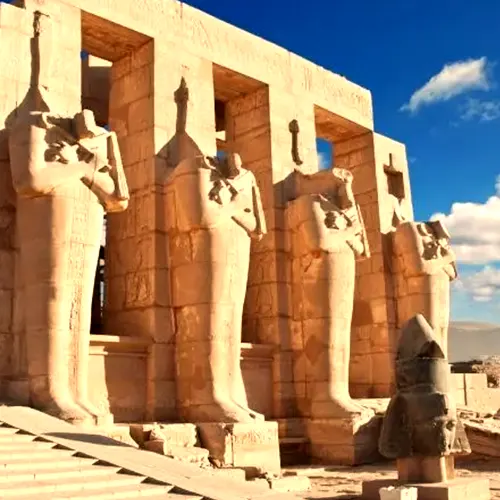
  • Then the second courtyard. It is in better condition, as you will be able to recognize two rows of statues for king Ramesses II representing him in Osiris form.
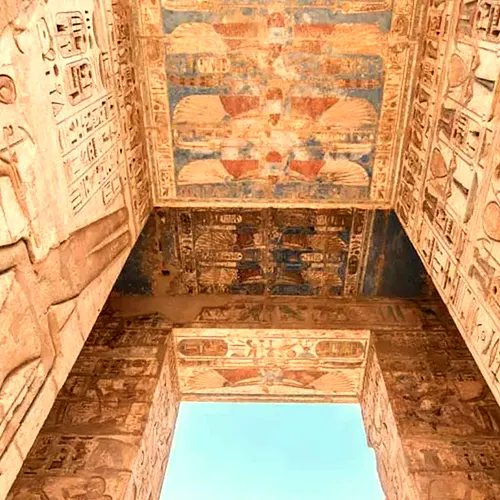
  • Then there is the second hypostyle hall. It contains 8 columns in the form of papyrus. This hall distinguishes with a special inscription that represents astronomical scenes.

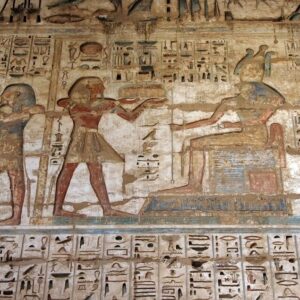
Also, there are depictions of giving offerings to several gods and the sacred boat of Amon Ra. In addition, a unique scene, as king Ramesses II appears sitting in front of the god Thoth and the goddess Seshat and they are writing his name on the leaves of the tree of life to wish him a long life.

In addition, there is a scene for king Ramesses II sitting in front of the Triad of Thebes. Below this scene, there is a depiction for the sons of the king.

King Ramesses II in front of the Triad of Thebes - The Ramesseum - Egypt Vacation Tours
King Ramesses II in front of the Triad of Thebes
  • Finally, at the end of the temple, there are many rooms. Among these rooms, there are the library, the storerooms of the temple, and the sanctuary or the holy of holies, that is dedicated to the god Amun-Ra and King Ramesses II.

The names of the Ramesseum:

  • The first name was given to this temple was during the Greek period when they linked between the northern statue of king Amenhotep III and their hero Memnon, They considered the Ramesseum as Memnonium or the tomb of Memnon.
  • Nowadays, the temple is known by the name of Ramesseum that is given to the temple by Champollion, who deciphered hieroglyphics through the Rosetta stone.

There is a legend linked with the remains of the fallen colossal statue of King Ramesses II, which in the first open courtyard, as classical visitors called it Ozymandias. These fallen remains inspired the English poet Percy Bysshe Shelley to write a poem and linked in it between the statue and their hero Ozymandias.

Ozymandias Statue - the Ramesseum - Egypt Vacation Tours
Ozymandias Statue

Deir El Medina – the Valley of Workers

Deir El Medina is one of the most famous sightseeing on the west bank of Luxor city, as it is a city for the locals located inside a royal site. Here, you will see another kind of tombs; they are not royal tombs but belong to ordinary citizens who built the royal tombs.

The history of Deir el-Medina Bernard Bruyère discovered this site in the 90s, after the discovery of Howard Carter to the tomb of Tutankhamun, Bernard Bruyère considered this is a unique discovery, as there were many of ostraca are discovered on this site. These ostraca documented the lifestyle and community of ancient Egypt meticulously, as they refer to the Women’s lifestyle, the Law, and the medical care in this community.

This place was the village where the ancient Egyptian workers and artisans of the 18th, 19th, and 20th dynasties of the New Kingdom were lived. Those workers and artisans worked in the Valley of Kings and the Valley of Queens, as they carved the tombs, which dazzle the whole world, in the mountain and decorated them.

Perhaps, the Egyptian authorities ordered to establish this city apart to keep what was happening inside the Valley of Kings and the Valley of Queens secret for avoiding being stolen.

It is believed that the first usage of Deir el-Medina was during King Thutmose I reign, while it was abandoned during the Ramesside Period.

The city housed approx. 70 families and sixty-eight houses varying in their size. The style of these houses was the same, as the walls were made of mud brick. Houses consisted of four to five rooms, comprising an entrance, main room, two smaller rooms, kitchen with cellar, and staircase leading to the roof.

Deir El Medina - Egypt Vacation Tours 1
Deir El Medina 

Also, this place contains the tombs of those workmen. These tombs appear in one room decorated with reliefs depicting the owner of this tomb with his family and during his journey to the other world.  You can imagine how amazing the decorations of these tombs are, as it was ornamented by the artisans who decorated the wonderful tombs in Valley of the Kings. For example, these tombs are Inerkhau and Sennedjem tombs.

Sennedjem Tomb - Deir El Medina - Egypt Vacation Tours
Sennedjem Tomb – Deir El Medina

The names of Deir el-Medina The ancient Egyptian name of this site was (Set maat), which means the place of truth. Also, the habitants were named servants in the place of truth. Deir el-Medina, the most famous name for this site now, is an Arabic word meaning the monastery of the city, as there was a temple for goddess Hathor beside the city. This temple was built during the Ptolemaic period, but it is changed to be a Christian monastery.

Luxor City – History & Destinations

Luxor city is the most famous city in Egypt and the whole world housing destinations and attracting tourists, as it is considered the world’s greatest open-air museum because it contains two-thirds of the landmarks of the world. It contains sightseeing dating back to ancient Egyptian history, the Greco-Roman period, the Christian period, and the Islamic period.

Luxor city is also known as the city of a Hundred Gates because it contains several gates of temples. These temples are like Luxor Temple and Karnak Complex.

The Nile River divides Luxor city into two parts, the east bank of Luxor, containing the temples of gods, and the west bank of Luxor that houses the mortuary temples and tombs of kings.

In Luxor, you will be able to see the mummy of King Tut, the temple of Queen Hatshepsut at Deir el-Bahari, the Valley of Kings, the Valley of Queens, Colossi of Memnon, Habu Temple, the avenue of Sphinxes, and the Luxor Museum.

The ancient history of Luxor city Luxor is the modern city, where the ancient Egyptian city, Thebes or Waset in the ancient Egyptian language. Thebes was the capital of ancient Egypt twice; the first time was during the 11th dynasty, the Middle Kingdom, while the second time was during the New kingdom.

From Thebes city, kings who reunified ancient Egypt after the First Intermediate Period hailed from, king Thutmose III went out on his campaigns, and Queen Hatshepsut planned her expedition to Punt Land.

After the New Kingdom, the significance of Thebes city remained as a religious capital of ancient Egypt, as its triad was (the god Amun Ra, the goddess Mut, and their son Khonsu).

This city is called Luxor, as when the Arabs entered this city, they thought that the remains of its temples are palaces, so they called it Luxor or al-uqsur.  Luxor or al-uqsur is the plural form of the Arabic word meaning the palace.

The temple of Madinat Habu

The Madinat Habu is the place where king Ramesses III decided to build his funerary temple. It is located on the western bank of the Nile River in Luxor city.

We know from inscriptions at sandstone quarries in Jabal Al-Silsila (north of Kom Ombo) that King Ramesses III ordered 300 workers to cut stones for constructed Habu temple from this quarry.

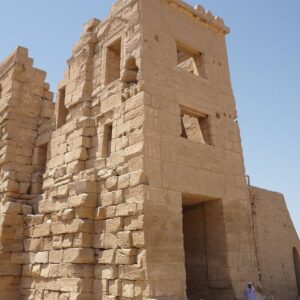
The design of Habu temple 1 – There is a massive wall surrounding the temple complex. This wall has an unusual gate called the pavilion gate. This gate distinguishes with its unique style, as it takes the style of the Syrian migdol fortresses. On this gate, there are depictions showing king Ramesses III in his wars in Syria.

The Syrian migdol tower of Habu temple - Egypt Vacation Tours
The Syrian migdol tower of Habu temple

2 – After passing through the open court, you will reach the pylon of the temple. Also, on the pylon, there are scenes for king Ramesses III in battles, as he appears smiting his enemies in front of the ancient Egyptian gods.

On the back of one of the two towers of the pylon, the king is depicted while he was in his journey and hunted the oxen.

3 – Then you will enter the first open court. The walls of this court are decorated with scenes depicting the wars against Syria and Libya.

the First Courtyard of Habu Temple - Egypt Vacation Tours
the First Courtyard of Habu Temple

4 – Then the second open court. It houses scenes depicting religious feasts, as the feasts of the gods Sokker (the god of the underworld) and the god Min (the god of fertility). In these festivals, the king appears giving offerings to the ancient Egyptian gods.  Later in the Christian times, this court was transferred to be a church.

The Feasts of Habu Temple - Egypt Vacation Tours
The Feasts of Habu Temple

5 – The first Hypostyle: there was an earthquake that occurred in 27 B.C. that caused damage to this court. This court is surrounded by 16 shrines.

  • The first shrine is dedicated to King Ramesses III.
  • The second shrine is dedicated to the god Ptah.
  • The fourth shrine is dedicated to the boat of the god Sokker.
  • The seventh shrine is dedicated to the sacred boat of the god Amon Ra.
  • The fourteenth shrine is dedicated to the sacred boat of King Ramesses II.
  • The fifteenth shrine is dedicated to the divine boat of the god Montho.
  • While the other shrines are used as a store for the temple supplies.

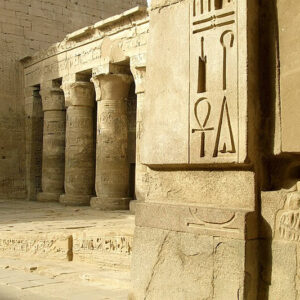
The second and the third Hypostyle halls are similar, as they contain 8 papyrus columns in 2 rows.

At the end of the third hypostyle hall, there is the holy of the holies of the temple, as there are three gates leads to the main god of Thebes (Amon Ra – Mut – Khonso).