The Valley of the Queens of Luxor

The Valley of the Queens is located on the western bank of Luxor city. This valley was dedicated for burying the wives of kings, who were buried in the Valley of the Kings.

This valley was discovered by Schiaparelli in 1904. It houses almost 81 tombs for queens, princes, princesses, and several members of the nobility of the new kingdom, the 18th, 19th, and 20th dynasties.  It was known in ancient Egyptian language with Ta-Set-Neferu, meaning “the place of beauty”.

The first queen buried in the valley was the princess Ahmose, the daughter of Queen Sitdjehuti and King Seqenenre Tao, who was killed in the wars of liberation against the Hyksos.

The main reason for choosing this place to be the Valley of Queens is unknown, but there are some opinions said that:

  • Because this place is close to the Valley of the Kings, as in previous dynasties, queens were buried inside the royal complex, but in the Valley of the Queens, the tombs are separated.
  • Also, it is close to Deir el-Medina or the village of workers, who work in the Valley of the Kings.
  • There is a chamber dedicated to the goddess Hathor in this place.

The design of these tombs begins with a small chamber, a long narrow corridor with several side rooms, then the burial chamber at the end of the tomb. Its tombs were decorated with religious scenes and books of the other world, which are still impressively preserved.

Tomb of Queen Nefertari The tomb of Queen Nefertari or the tomb QV66 is one of the most fabulous tombs in the valley.  Nefertari was the beloved wife of Ramesses II. It was discovered by Ernesto Schiaparelli in 1904. This tomb distinguishes with its well-preserved depictions. When you visit this tomb, you will see poetry written by king Ramesses II for queen Nefertari in the burial chamber.

Tomb of Queen Nefertari - Egypt Vacation Tours
Tomb of Queen Nefertari 

The tomb of the prince Khaemwaset Also, the tomb of the prince Khaemwaset is one of the most beautiful tombs in the Valley of Queens. Khaemwaset is the son of king Ramesses III. In this tomb, you will be able to notice the father’s care for his son, as king Ramesses III depicted while he is helping his son in crossing the gates and skipping the obstacles of the afterworld due to the young age of his son in front of several gods.

The tomb of the prince Khaemwaset - Egypt Vacation Tours
The tomb of the prince Khaemwaset 

Siwa Oasis – The Western Desert

Egypt distinguishes with housing six oases located in its western desert. These oases are EL Fayoum Oasis, Bahariya Oasis, Farafra Oasis, Kharga Oasis, Dakhla Oasis, and Siwa Oasis. All of these oases characterize by having a unique history and natural and charming beauty.

Siwa Oasis Siwa oasis is described as a green space sitting among a huge ocean of yellow sand, as it distinguishes with its breathtaking sceneries. It is located on the west of Egypt, on the Egyptian-Libyan border.

Generally, Siwa has a good climate throughout the year, but it is better to be visited from October to April to avoid the heat of the summer.

Siwa has its own style, as when you visit it, you will be able to recognize the ancient history, enjoy breathtaking sceneries, and do healing activities.

Siwa Oasis - Egypt Vacation Tours
Siwa Oasis

The attractions of Siwa Oasis

1 – The Temple of the Oracle The Temple of the Oracle is one of the most famous landmarks in Siwa oasis in ancient history and nowadays. It was built during the 26th dynasty by King Ahmose II. The most famous event associated with the Temple of Oracle is the visit of Alexander the Great to the temple for asking the oracle of Amun god about his fate and who is his father?

The Temple of the Oracle - Siwa Oasis - Egypt Vacation Tours
The Temple of the Oracle

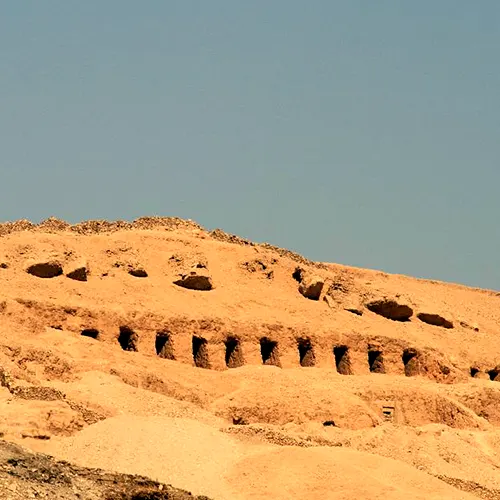
2 – Mountain of the Dead The Mountain of the Dead is a rocky hill housing more than 1500 tombs dating back to the late period of the ancient Egyptian civilization and the Greco-Roman period.

Mountain of the Dead - Siwa Oasis - Egypt Vacation Tours
Mountain of the Dead 

3 – Shali Village Shali is a Siwi word meaning city. Shali village is famous for its own style of construction, as their houses were built from clay saturated with salt, which when drying up, becomes similar to cement in its hardness.

When you visit Shali village, you will enjoy climbing up its hills, where you will be able to see a fabulous view of palm trees, as Shali contains dates and olives groves.

Shali Village - Siwa Oasis - Egypt Vacation Tours
Shali Village 

4 – Spring of Cleopatra Cleopatra’s spring is a natural pool the locals and tourists swimming in it for its healing benefits.

Spring of Cleopatra - Siwa Oasis - Egypt Vacation Tours
Spring of Cleopatra 

5 – Fatnas Island Fatnas Island, as Cleopatra’s spring, distinguishes with its hot springs, where you will be able to swim to enjoy its healing benefits.

Fatnas Island - Siwa Oasis - Egypt Vacation Tours
Fatnas Island

6 – Siwa House Museum Siwa House Museum displays the traditions and customs of the Siwan, for example, the museum exhibits their traditions at the wedding, as you will be able to see the wore of the bride.

Siwa House Museum - Siwa Oasis - Egypt Vacation Tours
Siwa House Museum 

7 – Dakrour Mountain Additionally, Siwa Oasis is famous for therapeutic tourism, whereas it has Dakrour Mountain or Gebel Dakrur, containing hot sulfurous wells for curing a lot of diseases such as arthritis, back pain, spinal pain, and rheumatism.

There is a tourist festival occurring every October or November in Gebel Dakrour. It takes three days. In this festival, Siwan are celebrating with the harvest, their friendships, and settle quarrels.

The community of Siwa Oasis The community of Siwa distinguishes having its own cultures till now, as the local inhabitants of Siwa have their own language, looking like the Berber language.

Sharm El Sheikh and its Museum

Lately, the Ministry of Tourism and Antiquities is caring in opening museums in coastal cities as Sharm El Sheikh Museum and Hurghada Museum for more entertainment for tourists and adding cultural value for this city besides the beach tourism.

In Sharm El Sheikh, you can enjoy doing several activities as soak up the sun on the beaches, diving to see its coral reefs, snorkeling, visiting Naama Bay, and exploring Ras Mohammed National Park.

Sharm El-Sheikh - Egypt Vacation Tours
Sharm El-Sheikh

Also, Sharm El Sheikh is a city in the Sinai Peninsula, so you will be able to do safari trips in the Sinai desert and discover St Catherine Monastery and Moses mount.

Saint Catherine’s Monastery - Egypt Vacation Tours 2
Saint Catherine’s Monastery

Sharm El Sheikh Museum Sharm El Sheikh Museum is opened in October 2020 to be the first museum to be opened in Sharm El-Sheikh and Sinai.

The concept of displaying in this Museum is reflecting the different aspects of human civilization and culture in the ancient Egyptian and the Greco-Roman civilizations and Muhammad Ali Pasha’s family. The display in the museum is divided into:

  • The Grand Hall exhibits the history of humans and wildlife in ancient Egypt and highlights the achievements of the ancient Egyptians in science, mathematics, industry, crafts, family life, and mummies and statues for gods in the ancient Egyptian beliefs. Those gods are like Thoth, Sobek, Hathor, and Horus.
  • The Civilization Hall displays the funeral collection of Isetemheb, the wife of the high-priest of Amun Panedjem II, and the priestess of Isis, Min, and Horus in Akhmim, like the inner and outer coffins, Canopic jars, cosmetics, and perfume vessels.
  • Then there is a hall displaying types of ships and boats used by the ancient Egyptians in several aspects of life as hunting, trade, and sun boats.
  • Finally, the hall of the cultural heritage of the Sinai community and Bedouins.

This museum distinguished with its facilities, as it contains theater, traditional crafts shops, and restaurants.

The Great Sphinx of Giza Plateau

The Great Sphinx of Giza Plateau is one of the landmarks of Giza Plateau. It belongs to king Chephren or Khafre, the founder of the second pyramid at Giza Plateau. The Great Sphinx was carved directly out of the bedrock and was made of one single piece of limestone in Giza Plateau. It dates back to the fourth dynasty, the old kingdom. There is a temple in front of the statue called the Sphinx Temple.

There are many questions about who destroyed the nose of the sphinx. There was opinions said that Napoleon who destroyed during his campaign in Egypt, but the researches proved that the Egyptian historian al-Maqrīzī wrote in the 15th century that the nose was destroyed by Sa’im al-Dahr.

What does the word of sphinx mean? The Sphinx is a mythical creature taking the shape of the human head and lion’s body. The word Sphinx is a Greek word derived from the ancient Egyptian word (Ssp Ankh), meaning the living image. So we can say that the Sphinx statues are a metaphor for the physical and mental power of the living king, as the physical power can be noticed in the lion’s body, while the mental power can be noticed in the human head of the king himself who wearing the royal headdress.

While in the Arabic language, it is called Abu Al Hol. It is thought that it is derived from the ancient Egyptian word (Pr hol), meaning the house of the lion, or it is called by the Arab, meaning father of terror.

The Dream Stela The Great Sphinx has captured the imagination of travelers and explorers for millennia, even in ancient Egyptian times, as it became a symbol of the sun god.

There is a Stela was discovered in front of the Great Sphinx is called the dream Stela belonging to king Tuthmosis IV dating back to the 18th dynasty, New kingdom.  It is an inscribed granite slab.

King Thutmose IV put this Stela between its front paws of the Great Sphinx due to a sacred deal between him and the Sphinx when he was a prince; as he claimed that he saw the god in his dream and the god said to him if he removed the sand buried the Sphinx up to its shoulders, he would be the king. That was political propaganda for the king, and he documented that on this Stela.

The Dream Stela - Egypt Vacation Tours
The Dream Stela

The Luxor Museum – Luxor City

The Luxor Museum is located on the east bank of the Nile River on the Nile Corniche between Luxor Temple and Karnak Complex in Luxor City, and facing the Ramesseum on the west bank . The museum is constructed to display the wealth of rare and valuable antiquities discovered in Luxor and opened to the public on 12 December 1975.

Generally, most of the museum collections were came from the excavations of the Luxor or returned from the Egyptian Museum to their original home. The collections of the  museum cover the time from the prehistoric period to the Islamic period.

Collections of Luxor Museum - Egypt Vacation Tours
Collections of Museum 

The museum consists of 2 floors displaying well-carved statues for ancient Egyptian gods and kings, the bulk of it dating back to the New kingdom. In 1989, the cache hall was added to the museum to display the statues discovered in the cache of Luxor Temple. Also, there are statues exhibiting in the garden of the museum.

The museum display distinguishes with its artificial lighting system that highlights the artistic beauty of the objects.

Some master pieces of the Luxor museum:

  • The statue of the god Sobek, brought from his temple in Kom Ombo.
  • The statue of goddess Hathor
The statue of goddess Hathor - Egypt Vacation Tours
The statue of goddess Hathor
  • The mummy of King Ahmose I, who evicted the Hyksos
  • A statue of King Thutmose III, the 18th dynasty, New kingdom
A statue of King Thutmose III - Egypt Vacation Tours
A statue of King Thutmose III 

Tunis Village in Faiyum Oasis

Faiyum Governorate is considered one of the most significant and diverse tourist destinations in Egypt. It distinguishes with its natural beauty, historical, and cultural importance at the same time. Faiyum contains most of the tourism types, as it houses historical attractions dating back to the pre-dynastic period, ancient Egyptian civilization, Ptolemaic, and Roman times. Besides, its scenic nature reserves as Wadi El Rayan and the Valley of the Whales or Wadi El Hitan. Also, it includes rare types of flora and fauna.  In addition, the Heritage attractions like Tunis Village.

Tunis Village or Izbat Tunis lies in the western-most part of the Faiyum Governorate. It overlooks the southwestern part of Qarun Lake. It is considered one of the most important heritage tourism destinations and fabulous sightseeing in Egypt. This village is famous for pottery making, reflecting the Tunis community.

The role of Evelyne Porret in changing the lifestyle of the community of Izbat Tunis The history of this village started with a small house built on a hill. This house is owned by Mohammed Ibrahim Wali and his Tunisian wife. It was a small community depending on farming.

In 1962, the Egyptian poet Sayed Hegab and his wife, Evelyne Porret came to Tunis Village. Evelyne Porret was a Swiss potter. She noticed that this village is populated by farmers. Those farmers saw the potteries of Evelyne Porret and admired them. So in the 1960s, she decided to collaborate with the Egyptian architect Wissa Wassef, who has trusted the artistic of Tunis village.

Then in the 1980s, she established a Pottery School for advancement in this community, satisfying their desire and developing their skills. As a result of community efforts and Evelyne Porret, this village became a heritage tourism destination.

Over the last thirty years, Tunis Village attracts many famous foreign and Egyptian artists, painters, and architects to live in it and build their own houses there. No doubt that the surrounding environment has an essential effect on this success, as the village surrounds by wonderful green gardens along the shores of Lake Qarun providing tranquility. This makes many tourists visiting Tunis Village for relaxing and enjoying this natural beauty. That leads to establish hotels and restaurants in the village to accommodate those tourists.

The Festival of Pottery For encouraging community production, Tunis Village holds a social occasion every year by the Egyptian Minister of Tourism and the Fayoum Tourism Authority for pulling in tourists, especially those interested in cultural and human heritage. This fest is called Tunis Pottery Festival. This celebration of pottery and handcrafts began in December 2011.

The pottery of Tunis Village - Egypt Vacation Tours (1)
The pottery of Tunis Village

Through the fest, there are some habits is occurred as desert safaris and horse riding, and watching a bird on the shores of Lake Qarun joined by guides.

The pottery of Tunis Village - Egypt Vacation Tours (3)
The pottery of Tunis Village 

The success of the Pottery School gained fame until Evelyne Porret founded several exhibitions in Cairo and abroad of Egypt, in the Gulf Area, and Europe.

Is it safe to visit Egypt in 2021?

Many people dream of visiting Egypt, as it is the cradle of civilization and comes at the top in containing wonders for ancient history. But due to the current issues in the whole world (COVID-19), they always ask that (Is it safe to visit Egypt in 2021?).

If you are asking (Is it safe to visit Egypt?) due to the current COVID-19 situation, we will answer you? Egypt, like the rest of the countries around the world, had a hard time as tourism took a nosedive. But now, things are looking up due to adherence to safety and security precautions in several sectors of the country.

Additionally, World Health Organization (WHO) praises procedures taking by Egypt for reducing the outbreak of coronavirus.  WHO published that Egypt is one of the least countries with cases infected with coronavirus until now.

So do not be hesitant to travel to Egypt right now. We will tell why you should get this chance.

  • If you visited Egypt before, of course, you found some attractions are stack with tourists. But now, you will be more enjoying these places as they will not be over-packed with tourists.
  • Travel agencies are desperate for you, making the prices incredibly cheap.
  • The security is at an all-time high as it pledges to implement precautionary measures and discourage any attacks.

Egypt is perfectly safe for visiting, but taking a bit of precaution is never wrong. You have to stick to the rules, do not look for trouble, respect the culture, stay aware of your surroundings, and keep an eye on your belongings to have an enjoyable visit.

    Egypt Vacation Tours team will give you some tips to make your tour in Egypt safer.
  • Make sure that the travel company planning your itinerary in Egypt is reputable and will offer you all amenities and safety.
  • Keep a copy of your identification.
  • Get a SIM card.
  • Stay away from any crowds in general.
  • Stay out of the sun, use your sunscreen, and Keep a water bottle on you.

Egypt Vacation Tours team always hope you be safe and enjoying during your tour in Egypt.

What is the best time to visit Egypt?

Many tourists come to Egypt every year to visit its magnificent attractions. The beautiful and diverse weather of Egypt considers being one of the top reasons to travel to it at any time round all year. However, they are always asking themselves that (What is the best time to visit Egypt?)

Despite Egypt’s beautiful variety of temperatures through its several governorates, you should know the nature of the climate of Egypt. It has a hot summer and cool and mild winter.

1 – Spring Season – from March to June Spring Season is the best time to visit Egypt and discover its major sightseeing as the temperature is moderate. At spring, there is a festival called (Sham El Nessim). It falls on the day after the Eastern Christian Easter.

2 – Summer Season – from June to September Summer Season is sometimes hot, especially in the Upper of Egypt, allowing you to explore a different side of Egypt. You will be able to enjoy the Egyptian coastal beaches and resorts as Hurghada, Sharm El-Sheikh, and Dahab. Also, you may enjoy a traditional felucca boat in the Nile River.

3 – Autumn Season – from September to December Autumn Season is as spring season. It is a good time to visit Egypt, as prices become so reasonable. You will be able to discover upper and lower Egypt and visit their major historical and heritage sites.

On October 22nd, you can attend a unique phenomenon occurring in Egypt, as the sun illuminates the Holy of Holies of the great Abu Simbel Temple in Aswan.

4 – Winter Season – from December to March Winter Season is the ideal time so it is the highest tourist season, as the weather is a nice. Also, you can enjoy your Christmas holiday in Egypt while you are visiting the historical and heritage attractions.

On February 22nd, you can attend a unique phenomenon occurring in Egypt, as the sun illuminates the Holy of Holies of the great Abu Simbel Temple in Aswan.

Enjoy visiting Egypt at any time you prefer with Egypt Vacation Tours team.

History of Luxor Temple of Luxor City

Luxor temple is one of the most beautiful remained monuments on the east bank of the Nile River in Thebes, or Luxor city now.

The history of construction of Luxor temple King Amenhotep III of the 18th dynasty started to build this temple, but the main building of the temple was completed by King Tutankhamun and King Horemheb. Then King Ramses II added some elements to the temple.

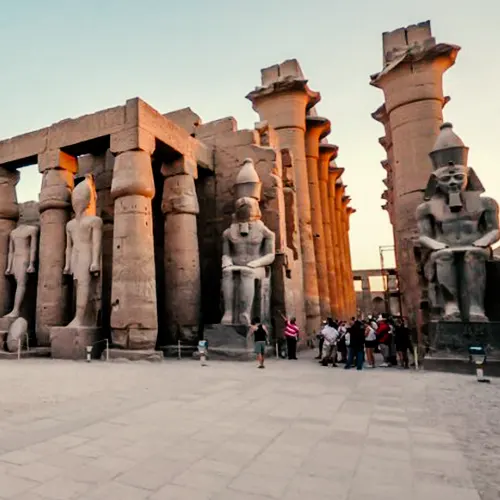
During Amenhotep III’s reign, the main entrance of the temple was on the northern side. After that, you will see the great colonnade consisting of seven pairs. It takes the shape of high open-flower papyrus columns. Then you will move to the courtyard of King Amenhotep III. Then the hypostyle hall, containing thirty-two columns.

the great colonnade of Amenhotep III - Egypt Vacation Tours
The great colonnade of Amenhotep III

The cache of Luxor temple was discovered by the archaeologist Muhammad al-Saghir on the morning of January 22, 1989.  While he was cleaning the courtyard of King Amenhotep III, he found a wonderful collection of statues for gods and kings of the New kingdom. Most of these collections are moved to be displayed at Luxor Museum.

Behind the hypostyle hall, there are four secondary rooms, the room of the Divine birth of King Amenhotep III, Alexander the Great’s shrine, and the Holy of Holies of the triad of Thebes (Amun, his wife Mut, and their son Khonsu).

The divine birth room houses depictions tell an amazing story of how the king’s true father was none other than the god Amun himself.

    The King Ramses II adds:
  • He added a massive pylon decorated with inscriptions of the Kadesh Battle against the Hittites. This pylon was preceded by six colossal statues for King Ramses II himself and two obelisks made of granite. Now, one of these two obelisks is transferred to the Place de la Concorde in Paris.

In front of this pylon, there is the avenue of sphinxes linking between Luxor Temple and Karnak Complex. This avenue was used during the Opet Festival, as Amun used it to move from Karnak Complex to Luxor Temple.

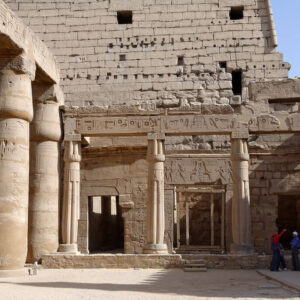
  • Also, King Ramses II built another courtyard in front of the great colonnade of King Amenhotep III. In this courtyard, on the right side, you will see the shrine of Queen Hatshepsut and King Thutmose III.

    the shrine of Queen Hatshepsut and King Thutmose III - Egypt Vacation Tours
    the shrine of Queen Hatshepsut and King Thutmose III

The temple was remained used in the Greco-Roman period. In the Christian period, the hypostyle hall of the temple was changed to be a Christian church.

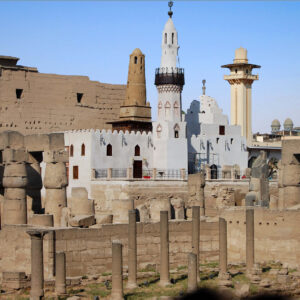
After many years, the temple was covered and hidden by sand and streets, resulting in the construction of the Yusuf Abu al-Hajjaj mosque over the Northeast side of the temple in the courtyard of King Ramses II in 640.

Yusuf Abu al-Hajjaj mosque - Egypt Vacation Tours
Yusuf Abu al-Hajjaj mosque

Legends of Colossi of Memnon

Colossi of Memnon are two massive statues on the west bank of the Nile River in Luxor city. They stood at the entrance of the mortuary temple of king Amenhotep III of the 18th dynasty, New kingdom. These statues are the only residual part of this temple.

These two twin statues depict King Amenhotep III, seating on the throne chair and wearing the Nemes, the royal headdress. The statues measure 20 meters tall. They are made of quartzite sandstone. The northern statue presents the king with a small statue for his mother (Mutemwiya), while the southern one presents him with his beloved wife (Tiye). Amenhotep, son of Hapu supervised the construction of these statues.

After an earthquake had occurred in 27 BC, the northern statue was deeply affected, as cracks appearing on it. These cracks resulted to when the winds were passing through the northern statue at dawn, making mysterious sounds and forming dew drops on the statue’s body.

The Greeks linked between these sounds and dewdrops and the crying of Memnon’s mother on her killing son (Memnon). Memnon was the king of Ethiopia, traveled to Asia to help in defending Trojan city, the beleaguered city under attack. But he was killed by Achilles. So they are famous for the Colossi of Memnon.

Achilles killing Memnon - Egypt Vacation Tours
Achilles killing Memnon

Later the Roman Emperor Septimius Severus restored the northern statue that led these sounds to stop.

Read more about sightseeing of Egypt with Egypt Vacation Tours articles.