Pompey Pillar and Serapeum

Pompey Pillar is one of the most famous attractions in Alexandria. It is considered the longest column in Egypt, as it is about 27 meters long. It was constructed in 292 AD by the trustee of Alexandria, Postumus.

This pillar or column is divided into 3 parts. The first part is its base that has inscriptions of names of ancient Egyptian Kings, referring to that this stone was reused. The second one is the body of the column taking a circular cylindrical shape and made of red granite from Aswan. Then the crown. Al-Maqrizi wrote about this crown that he heard the Alexandrians said that this crown allowing 22 persons to sit on it and having their food.

Pompey Pillar - Egypt Vacation Tours (2)
Pompey Pillar

Different Names to This Pillar Pompey’s Pillar is a misleading name. It is believed that when the Roman General Pompey fled to Alexandria from Rome, Ptolemy XII murdered him and his head was put on the top of the column, but that is not true and this pillar has nothing to do with Pompey.

Arab called it masts pillar because they thought that it looks like the masts of the ships.

The closest to the right name, according to an inscription written beside the column, is Diocletian Pillar. This text refers to the trustee of Alexandria, Postumus, who built this pillar in gratitude for the Roman Emperor Diocletian as there was a famine in the city so Diocletian ordered that a portion of the wheat be sent to Rome annually be given to the Alexandrians. As well, he exempted them from paying taxes during these hard times.

Besides the pillar, there are two sphinxes and an open museum displaying what was discovered in the Serapeum, dedicated to Alexandria’s patron god, Serapis.

The serapeum - Egypt Vacation Tours
The Serapeum 

The God Serapis - Egypt Vacation Tours
The God Serapis

Library of Alexandria – Bibliotheca Alexandrina

Throughout ancient history, Alexandria was known as a center for learning and melting different cultures because it houses the library of Alexandria or Bibliotheca Alexandrina the most famous destination for students in the ancient world.

It is important to be referred that there are two libraries of Alexandria libraries (the ancient library of Alexandria – the modern library of Alexandria).

The ancient Bibliotheca Alexandrina During the Ptolemaic period, Ptolemy II built the ancient Alexandria Library. This library contained many books in different specialties, so it became the main destination of many science students in the ancient world. It is said that it houses about 700,000 books, as it contained books from the ancient Egyptian and Greek civilizations, as well as, the library obligated its scholars to leave a copy of their writings in the library. This led to making this library very rich with books in several specialties and from different cultures.

Ancient Library of Alexandria - Egypt Vacation Tours
Ancient Library of Alexandria

Some of its students were Euclid and Archimedes. This library was divided into three parts the original library or the Muses, the smaller library, and the book store.

It was a public library, in contrast to the libraries of temples at that time, which were accessed only for priests of temples.

Unfortunately, the ancient Library of Alexandria was destroyed during the attack of Julius Caesar and Cleopatra VII against Ptolemy XIII in 48 BC, where the ships in Alexandria port were burned by Caesar and this fire spread to the library.

The modern Bibliotheca Alexandrina The modern Bibliotheca Alexandrina was built on the 16th of October 2002 when Lotfy Dowidar and the Egyptian Government asked UNESCO to revive the ancient Library of Alexandria.

The library is surrounded by a great wall, decorated with the letters and signs of 120 languages, referring to the wealth of knowledge in that building.  This wall is made of the granite of Aswan.

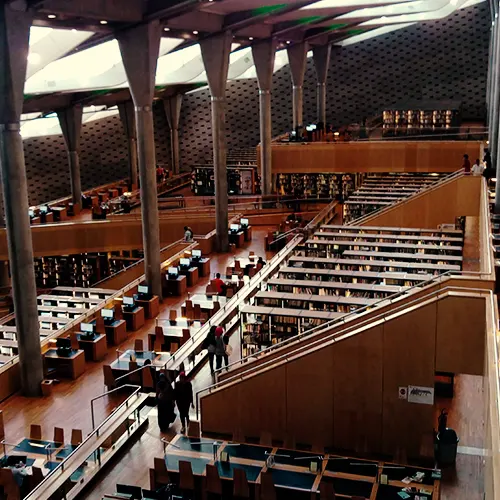
the modern library of Alexandria - Egypt Vacation Tours
the modern library of Alexandria
    This library is much more than a library, as it houses:Four Museums:
  • The Antiquities Museum
    It is considered the first archeological museum to be situated within a library. The museum collection displays the ancient history of Egypt from the ancient Egyptian civilization to the Roman period. Part of the museum collection is displayed under the water of the Mediterranean Sea.
    The museum texts are written in three languages (English, Arabic, and French).
  • The Manuscripts Museum
    This museum distinguishes with housing the largest collection of digital manuscripts in the whole world. It provides digital access to more than 6,000 rare books, maps, and documents.
  • The Sadat Museum
    This museum contains many personal belongings of the Egyptian president Anwar Al Sadat, as his Nobel Prize medal and his military robe stained with blood, which he wore on the day of his assassination.
  • The History of Science Museum
    Also, six specialized libraries:
  • The Arts and Multimedia Library/li>
  • The Taha Hussein Library for the visually-impaired

    This library is named with Taha Hussein Library because its materials are specially designed for blind and visually impaired people. These materials enable them to read books.

  • The Children’s Library
  • The Young People’s Library
  • The Exchange and Archive Section
  • The Rare Books and Special Collections Library
    Also it contains:
  • The Planetarium Science Center
  • Culturama: It is a patented nine-screen interactive technology created by the Egyptian Center for Documentation of Cultural and Natural Heritage (CULTNAT) in 2007. Culturama allows the library to inform information that could never have been displayed by traditional displaying methods. Culturama exhibits three times from Egyptian history (Ancient Egyptian Period – Highlights of Islamic Civilization – Modern Egypt).

The new library of Alexandria seeks to revive the old library approach, as it is dedicated to recapturing the spirit of openness, spreading culture, and acting as a public research center.

Philae Temple of Isis in Aswan

Philae Temple of Isis is the most prominent monument of Philae Island. Philae Island was a rocky island in the middle of the River Nile, located in Aswan.

Philae Island had a great prominence as the center for worshipping the goddess Isis, the mother of the god Horus. This island contains other monuments as the Kiosk of Trajan, Osiris Chapel, Horus Temple, Hathor Temple, The Gateway of Tiberius, the Gateway of Diocletian, and Augustus Temple.

After the construction of the Aswan Dam, the monuments of Philae Island were submerged underwater for the greater part of the year, and Philae temples were accessible only between August and December. The construction of the High Dam in 1960 threatened to engulf them for good, which resulting transferring the monuments of Philae Island to Agilkia Island in the 1960s during the UNESCO Nubia Campaign, as the temple was dismantled and transferred, stone by stone, from the submerged Philea Island to Agilkia Island. This project took over 9 years to be accomplished.

Philae flooded by Aswan Dam in 1906 - Egypt Vacation Tours
Philae flooded by Aswan Dam in 1906 
Kiosk of Emperor Trajan - Egypt Vacation Tours
Kiosk of Emperor Trajan

Philae Temple is one of the last ancient Egyptian temples to remain active, as it continued to function until the reign of the Byzantine Emperor Justinian I. On that date, the priest of Isis, Esmet-Akhom, carved the last dated hieroglyphic inscription, dating to the late 4th century AD.

The design of Philae Temple of IsisThe Temple of Isis is the most famous temple on Philae Island. It was founded in Ptolemy II’s period, then other Ptolemaic Kings contributed by adding more parts to it. This temple is built on the same style of the New Kingdom temples, with adding some other elements that appeared in the Greco-Roman period like the mamisi and the Nilometer. This temple was used during the Coptic period to be a Christian church.

It is thought that the oldest remains of Philae Temple date back to King Taharqa of the 25th Dynasty, who constructed the first shrine for the Goddess Isis.

The plan of this temple is very simple. It consists of the 1st Pylon leading to an open court, the 2nd pylon, and the Holy of Holies.

Pass through the 1st pylon to reach the main court of the temple. While you go through the gate, you will find the French inscription (“a 7 de la République”) on the right. It refers to commemorate Napoleon’s campaign and the pursuit of the Mamelukes by General Desaix in 1799.

On the right of the main court, there are rooms for Isis priests.

The Mamisi or the House of the divine birth of Horus: You can enter the mamisi from the left side of the court or by the direct gate in the western tower of the 1st pylon. It is a symbol of the birth of Horus. There is a scene in this room depicting Isis suckling her son Horus in the marshes and scenes of the birth of the God Horus.

Then 2nd Pylon leading to inner temple area with 10 columns.

Then 3 shrines leading to a sanctuary or the Holy of Holies.

Philae Temple distinguishes with its Sound and Light Show presenting a narrated storytelling the legend of God Osiris and his wife Goddess Isis and the history of Philae Temple and how it was saved by transferring its rocks to the current place.

Hatshepsut Temple – Deir el-Bahari Temple

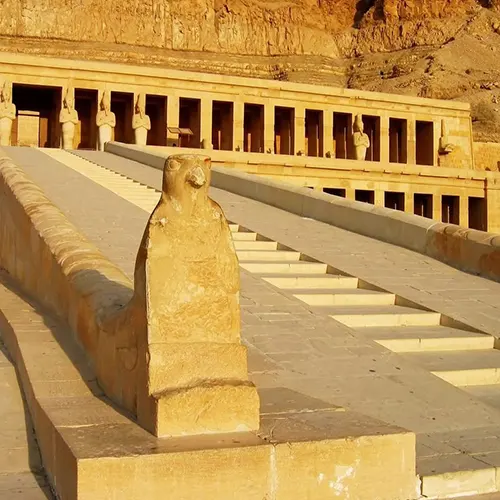
Hatshepsut, the most famous queen became a Pharaoh, and founded this temple on the west back in Luxor city, directly across the Nile River from Karnak Temple.

This temple is called Djeser-djeseru, meaning the Holy of Holies. Senenmut inspired the design of this temple from the structure of the temple of temple Mentuhotep II (Neb-Hept-Re) from the 11th dynasty, Middle Kingdom. This temple is dedicated to being the mortuary temple of Queen Hatshepsut.

This temple consists of three levels attached with ramps. On the uppermost level, an open courtyard lies just beyond the portico. There are statues of Hatshepsut in Osiris shape lean against the pillars of these porticos.

Also, the temple contains shrines for the god Anubis, the god of the dead, and the goddess Hathor, the goddess of women, fertility, and love.

    The inscriptions of the templeIn the first level:
  • In the northern part, there is a scene depicting Queen Hatshepsut while she hunted in the bush in front of several gods like Horus, Thoth, and Amun.
  • While on the southern part, there is a scene depicting the transportation of obelisks from the quarry to their destination in Karnak Temple.
    strong>In the second level:
  • In the northern part, there is a scene depicting the divine birth of Queen Hatshepsut, as she showed that his father is the god Amun himself to prove that she is the rightful king of Egypt.
  • While on the southern part, there is a scene depicting the expedition of Queen Hatshepsut to Punt.

The rest of the temple was carved inside the mountain.

Finally, this temple is also called Deir el-Bahari Temple, due to there was a Christian monastery built there in the 7th century. Deir is an Arabic word meaning monastery.

The Valley of the Kings of Luxor City

The Valley of the Kings is the cemetery of the most famous kings in ancient Egyptian history of the new kingdom. It is located on the west bank of the Nile River in Thebes, or Luxor city now.

It is considered as one of the most important archaeological sites and historical destinations in the world, which motivated the archaeologists to do excavations there.

This valley is divided into two valleys, the east and the west. The east valley is more famous than the west one, as the west valley houses few tombs.

The valley contains 62 tombs and almost twenty unfinished tombs. King Thutmose I was the first King was buried in this valley, while King Ramses VVI was the last one. Then Kings of the 18th, 19th, and 20th dynasties also buried here. The most famous royal tomb in this valley is the tomb of King Tutankhamun that was discovered nearly intact.

The name of Valley of the Kings is not entirely accurate, as there are members of the royal family and a few non-royal who very high-ranking as the tomb of Yuya and Tuya were buried here.

    Most of these tombs have a simple plan and are decorated with religious inscriptions as:
  • The Amduat depicting the journey of the sun god during the 12 hours of the night.
  • The Book of Caves showing the underworld divided into caves where the gods and the dead waiting for the sun god to bring them back to life.

The Valley of the Kings - Egypt Vacation Tours

    Why did the ancient Egyptian choose this place to be the Valley of the Kings?
  • This site was chosen according to the ancient Egyptian beliefs in the afterlife, as they thought that the sun god (Ra) set (died) in the western horizon to be reborn and rejuvenated in the eastern one. So the ancient Egyptians considered the west as funerary associations.
  • This mountain takes the shape of the pyramid, the symbol of rebirth and eternal life in ancient Egyptian beliefs.
  • This valley is isolated what provides more Anti-theft protection for the corpses of kings buried in it.

There are a huge number of workers who were working in the construction of this great valley. So these workers needed a near home to live, so they built Deir El-Medina or the Village of Workers.

History of Karnak Temple of Luxor City

Karnak temple is located on the east bank of the Nile River in Thebes, or Luxor city now. It is considered as a complex, not just a temple, because its walls include several temples as the Khonsu temple, the Opet temple, and the great temple of Amun Ra.

This complex is considered one of the most important ancient Egyptian temples in Thebes, as it was the center for worshipping the god Amun. So this temple was extremely wealthy, and its priesthood held great political power during ancient Egyptian history.

As most ancient Egyptian temples, Karnak temple was constructed on an east-west axis. As in ancient Egyptian mythology, they thought that this design looking like the sun god’s trajectory through the sky. Also, Karnak temple distinguishes with another north-south axis to link between Karnak complex and Luxor temple through the avenue of rams.

Karnak Complex Elements The design of Karnak Complex is very complicated, as due to its religious importance, many kings from the middle kingdom to the Ptolemaic period added buildings to this complex, making it reach a size, complexity, and diversity.

  • This complex starts with an avenue of rams. In front of the 1st pylon, there are 20 rams on each side, dating back to King Nectanebo I of the 30th dynasty.

Avenue of Sphinxes - Egypt Vacation Tours

  • Then, the first open court, containing several elements. The column or kiosk of King Taharqa of the 25th dynasty. This is the only remained column from a colonnade that once had 10 columns. On the left, there are 3 shrines built by king Seti II for the triad of Thebes (Amun, Mut, and Khonsu). On the right, there is the Temple of King Ramses III. As well, there is the open museum court containing the white shrine of king Senusret I, the alabaster shrine of king Amenhotep I, and the red shrine of Queen Hatshepsut. These shrines were discovered into the 3rd pylon and rebuilt again.
  • The second pylon of king Horemheb of the 18th
  • The Great Hypostyle Hall containing 134 columns from the sandstone. This hall was built by King Amenhotep III and completed by kings Seti I and his son Ramses II.
  • Then the 3rd pylon of king Amenhotep III, where the 3 shrines in the open museum court had found.
  • The Court of Thutmose I, where was existing 2 obelisks standing in front of the 4th pylon. It is thought that this pylon was the main entrance for Karnak temple during king Thutmose I’s period. Unfortunately, one of these two obelisks is lost.
  • Another court of King Thutmose I. This court housed 2 obelisks for Queen Hatshepsut. They were made of red granite. Unfortunately, the right obelisk is lost. After the death of Queen Hatshepsut, so King Thutmose III did a mysterious thing. He founded a high wall around those two obelisks. This sparked a lot of arguments among scholars, as they are wondering what the purpose of this wall is.
  • The 5th pylon, which also was built by king Thutmose I, but was damaged.
  • The 6th pylon was built by king Thutmose III. It is the smallest pylon in this complex. This pylon leads to the Ancestral Room founded by King Thutmose III.
  • Then the Holy of Holies of temple.
  • Behind it, there is a courtyard housing remains dating back to the middle kingdom. This courtyard contains a hall called (Akh-Mnw), meaning the Feasts Hall. This hall was built by King Thutmose III. As well, there is another room called The Botanical Room, decorated with depictions of plants, animals, and birds, which King Thutmose III brought from Syria to ancient Egypt.
  • Now, we will go through the north-south axis that can be accessed between the 3rd and the 4th pylons to reach the 7th pylon of king Thutmose III. In this place in 1902, the French Egyptologist Georges Legrain discovered a cache. This cache contained several bronze statues. In front of the 7th pylon, there were 2 obelisks of king Thutmose III. One of them is transferred to İstanbul, as Muhammad Ali Pasha gave it to King Louis.
  • Karnak Complex distinguishes with its sacred lake, where priests purified themselves before performing temple rituals for the god Amun. Besides this lake, you will be able to notice the scarab is considered the biggest scarab in ancient Egypt. This is the scarab of the marriage of King Amenhotep III and his beloved wife Tiye.

the sacred lake - Egypt Vacation Tours
the sacred lake

the scarab of marriage of King Amenhotep III - Egypt Vacation Tours
the scarab of marriage of King Amenhotep III 

  • The 8th pylon was built by Queen Hatshepsut, completed by Thutmose III, and restored by Seti I. Then there is a court.
  • The 9th and 10th pylons. They date back to king Horemheb of the 18th dynasty. Inside these pylons, it is found the rocks of the temple of the god Aton, as king Horemheb used them for filling his pylons.
  • Finally, the temple finished with the avenue of rams leading to Mut temple.

Legends of Colossi of Memnon

Colossi of Memnon are two massive statues on the west bank of the Nile River in Luxor city. They stood at the entrance of the mortuary temple of king Amenhotep III of the 18th dynasty, New kingdom. These statues are the only residual part of this temple.

These two twin statues depict King Amenhotep III, seating on the throne chair and wearing the Nemes, the royal headdress. The statues measure 20 meters tall. They are made of quartzite sandstone. The northern statue presents the king with a small statue for his mother (Mutemwiya), while the southern one presents him with his beloved wife (Tiye). Amenhotep, son of Hapu supervised the construction of these statues.

After an earthquake had occurred in 27 BC, the northern statue was deeply affected, as cracks appearing on it. These cracks resulted to when the winds were passing through the northern statue at dawn, making mysterious sounds and forming dew drops on the statue’s body.

The Greeks linked between these sounds and dewdrops and the crying of Memnon’s mother on her killing son (Memnon). Memnon was the king of Ethiopia, traveled to Asia to help in defending Trojan city, the beleaguered city under attack. But he was killed by Achilles. So they are famous for the Colossi of Memnon.

Achilles killing Memnon - Egypt Vacation Tours
Achilles killing Memnon

Later the Roman Emperor Septimius Severus restored the northern statue that led these sounds to stop.

Read more about sightseeing of Egypt with Egypt Vacation Tours articles.

History of Luxor Temple of Luxor City

Luxor temple is one of the most beautiful remained monuments on the east bank of the Nile River in Thebes, or Luxor city now.

The history of construction of Luxor temple King Amenhotep III of the 18th dynasty started to build this temple, but the main building of the temple was completed by King Tutankhamun and King Horemheb. Then King Ramses II added some elements to the temple.

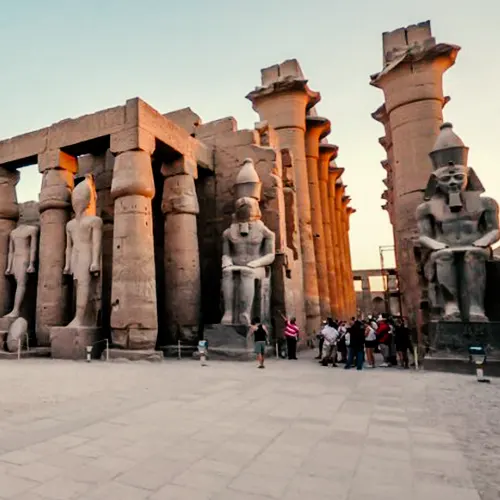
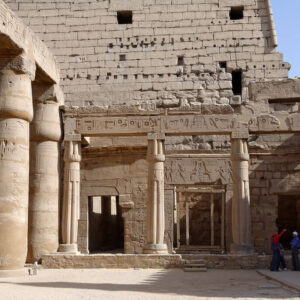
During Amenhotep III’s reign, the main entrance of the temple was on the northern side. After that, you will see the great colonnade consisting of seven pairs. It takes the shape of high open-flower papyrus columns. Then you will move to the courtyard of King Amenhotep III. Then the hypostyle hall, containing thirty-two columns.

the great colonnade of Amenhotep III - Egypt Vacation Tours
The great colonnade of Amenhotep III

The cache of Luxor temple was discovered by the archaeologist Muhammad al-Saghir on the morning of January 22, 1989.  While he was cleaning the courtyard of King Amenhotep III, he found a wonderful collection of statues for gods and kings of the New kingdom. Most of these collections are moved to be displayed at Luxor Museum.

Behind the hypostyle hall, there are four secondary rooms, the room of the Divine birth of King Amenhotep III, Alexander the Great’s shrine, and the Holy of Holies of the triad of Thebes (Amun, his wife Mut, and their son Khonsu).

The divine birth room houses depictions tell an amazing story of how the king’s true father was none other than the god Amun himself.

    The King Ramses II adds:
  • He added a massive pylon decorated with inscriptions of the Kadesh Battle against the Hittites. This pylon was preceded by six colossal statues for King Ramses II himself and two obelisks made of granite. Now, one of these two obelisks is transferred to the Place de la Concorde in Paris.

In front of this pylon, there is the avenue of sphinxes linking between Luxor Temple and Karnak Complex. This avenue was used during the Opet Festival, as Amun used it to move from Karnak Complex to Luxor Temple.

  • Also, King Ramses II built another courtyard in front of the great colonnade of King Amenhotep III. In this courtyard, on the right side, you will see the shrine of Queen Hatshepsut and King Thutmose III.

    the shrine of Queen Hatshepsut and King Thutmose III - Egypt Vacation Tours
    the shrine of Queen Hatshepsut and King Thutmose III

The temple was remained used in the Greco-Roman period. In the Christian period, the hypostyle hall of the temple was changed to be a Christian church.

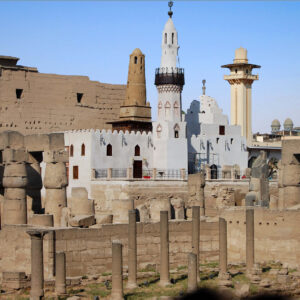
After many years, the temple was covered and hidden by sand and streets, resulting in the construction of the Yusuf Abu al-Hajjaj mosque over the Northeast side of the temple in the courtyard of King Ramses II in 640.

Yusuf Abu al-Hajjaj mosque - Egypt Vacation Tours
Yusuf Abu al-Hajjaj mosque

What is the best time to visit Egypt?

Many tourists come to Egypt every year to visit its magnificent attractions. The beautiful and diverse weather of Egypt considers being one of the top reasons to travel to it at any time round all year. However, they are always asking themselves that (What is the best time to visit Egypt?)

Despite Egypt’s beautiful variety of temperatures through its several governorates, you should know the nature of the climate of Egypt. It has a hot summer and cool and mild winter.

1 – Spring Season – from March to June Spring Season is the best time to visit Egypt and discover its major sightseeing as the temperature is moderate. At spring, there is a festival called (Sham El Nessim). It falls on the day after the Eastern Christian Easter.

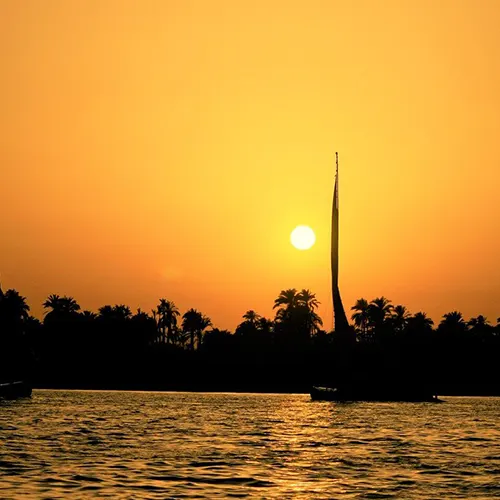
2 – Summer Season – from June to September Summer Season is sometimes hot, especially in the Upper of Egypt, allowing you to explore a different side of Egypt. You will be able to enjoy the Egyptian coastal beaches and resorts as Hurghada, Sharm El-Sheikh, and Dahab. Also, you may enjoy a traditional felucca boat in the Nile River.

3 – Autumn Season – from September to December Autumn Season is as spring season. It is a good time to visit Egypt, as prices become so reasonable. You will be able to discover upper and lower Egypt and visit their major historical and heritage sites.

On October 22nd, you can attend a unique phenomenon occurring in Egypt, as the sun illuminates the Holy of Holies of the great Abu Simbel Temple in Aswan.

4 – Winter Season – from December to March Winter Season is the ideal time so it is the highest tourist season, as the weather is a nice. Also, you can enjoy your Christmas holiday in Egypt while you are visiting the historical and heritage attractions.

On February 22nd, you can attend a unique phenomenon occurring in Egypt, as the sun illuminates the Holy of Holies of the great Abu Simbel Temple in Aswan.

Enjoy visiting Egypt at any time you prefer with Egypt Vacation Tours team.

The Reviving of the Grand Avenue of Sphinxes

As Egypt grabbed the attention of the whole world to Cairo during the royal Mummies parade when they were transferred from the Egyptian Museum in Tahrir Square to their final destination to the National Museum of Egyptian Civilization. Egypt will grab the attention of the whole world again, but this time will be in Luxor, especially in the east bank of Luxor city. Luxor city is preparing for a celebration for reviving of the grand avenue of sphinxes at the end of June after its development and restoration.

The correct name of this road is the road of the great parades or the road of the religious celebrations and parades.

The history of the grand avenue of sphinxes The excavations in this avenue started on the 18th of March 1949 by the archaeologist Zakaria Ghoneim. The work continued till it stopped in 2011 due to the revolution of the 25th of January 2011, and it has been resumed again in 2017.

The reviving of the Grand Avenue of Sphinxes in Luxor - Egypt Vacation Tours (1)

We knew about this avenue from a depiction in the red chamber of Queen Hatshepsut at Karnak Complex, as Hatshepsut said that she constructed a road for her father the god Amun-Ra to pass through it during his feasts as Opet feast from Luxor Temple to Karnak Complex, vice versa.

Also, she mentioned that she decorated this road with statues and 6 chambers for a break to the Holy boats of the triad of Thebes (Amun, Mut, and Khonsu).

Throughout ancient Egyptian history, several kings added statues to this road either headed with human head or ram head. It is thought that the construction of the avenue started during the New Kingdom and was completed in the 30th Dynasty during the rule of King Nectanebo I.

This avenue is divided into two parts. The first part is in front of Luxor Temple containing sphinxes statues with a human head and lion body, while the second part is in front of Karnak Complex headed with rams. All these statues were made from one block of sandstone.

The reviving of the Grand Avenue of Sphinxes in Luxor - Egypt Vacation Tours (5)

The reviving of the Grand Avenue of Sphinxes in Luxor - Egypt Vacation Tours (4)

This avenue connects Karnak Complex with Luxor Temple, passing by the domain of Mut. The statues are about 1200 statues on both sides. They look like that they guard those who using this avenue between the two temples.

The celebration of reviving of the avenue of sphinxes The avenue of sphinxes is an archaeological site belonging to Thebes as World Heritage Site and considered as one of the most important attractions in the east bank of Luxor city.

The reviving of this avenue will turn the east bank of Luxor into an open-air museum, as the tourist will be able to visit Luxor Temple from Karnak Complex via walking through the avenue of sphinxes, which makes this site considered the world’s largest ancient site.

In this event, the grand avenue of sphinxes will be completely opened. It is about 2,700 meters long and about 7 meters wide, with 1200 statue on both sides.

How can you visit the avenue of sphinxes? You will be able to visit it from Karnak Complex, or Luxor Temple, or through three side entrances. On the side of the avenue, there is a museum that will be existed to display the collection discovered during the excavations in the avenue of sphinxes. Additionally, you will see some wine presses, baths, and Nilometer.

The avenue of sphinxes will be lighted at night for visiting for more enjoyment with the ancient Egyptian magic.