Quick Answer: What are ancient Egyptian amulets?
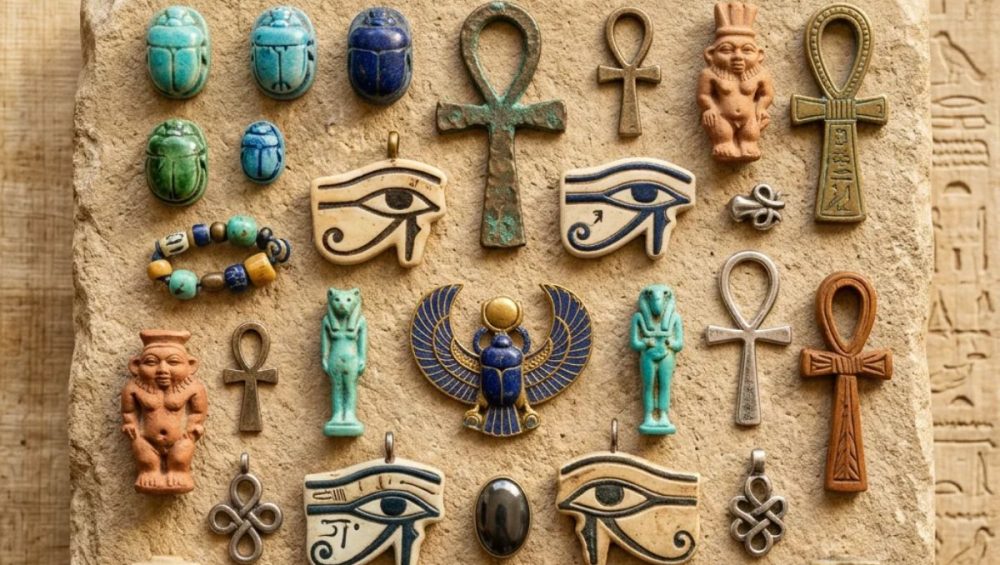
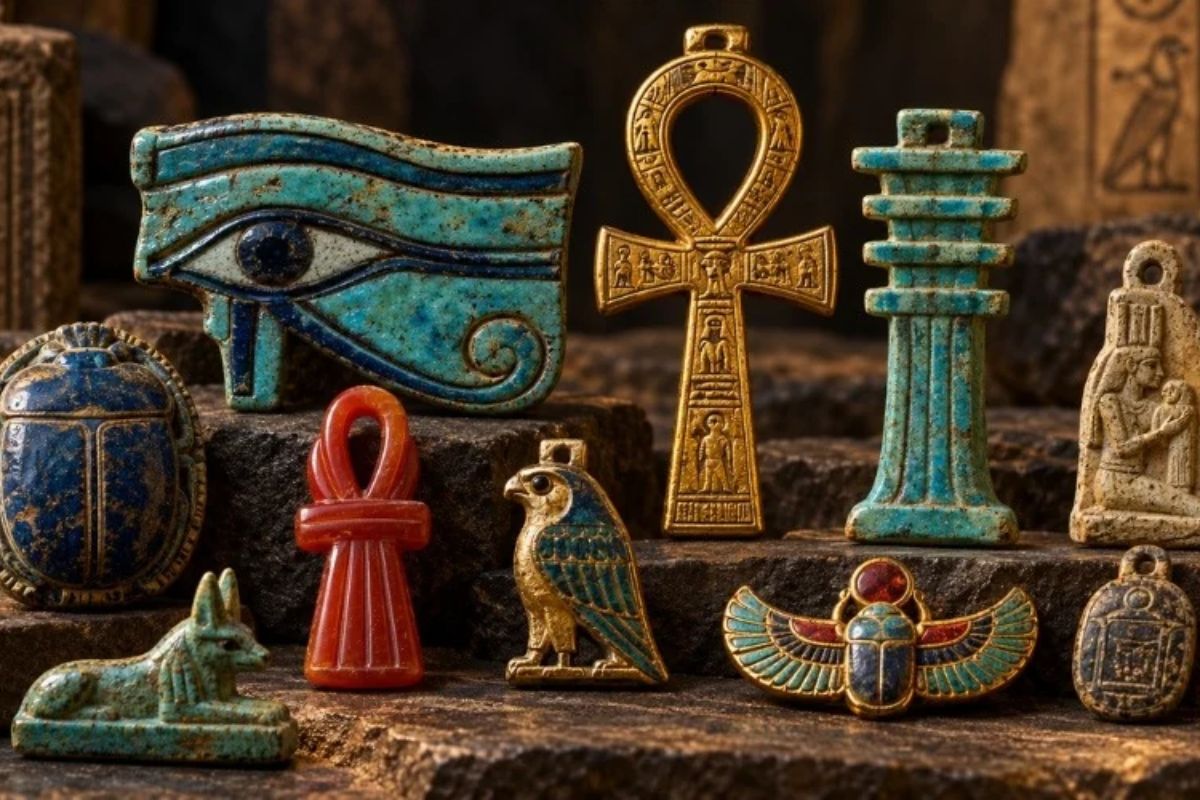
Ancient Egyptian amulets were small objects believed to provide magical protection, health, strength, good fortune, and renewal after death. Egyptians wore them as jewelry, carried them as protective charms, and placed them inside mummy wrappings. Popular examples included the ankh for life, the Eye of Horus for protection and healing, the scarab beetle for rebirth, and the djed pillar for stability.
A tiny blue eye, a carved beetle, or a miniature pillar might seem like ordinary jewelry today. For ancient Egyptians, these objects could carry profound religious meaning. Their shapes, colors, materials, and associated rituals were thought to connect human beings with the protective powers of the gods.
Some amulets were worn throughout life. Others were created specifically for burial, where they helped protect the deceased and support their journey into the afterlife.
These objects also tell us something personal about ancient Egypt. Beyond monumental pyramids, temples, and royal statues, they reveal the everyday hopes and fears of people concerned about illness, childbirth, dangerous forces, family well-being, and death.
Understanding ancient Egyptian amulets and their meanings adds another dimension to visiting Egypt’s museums and archaeological sites in 2027. A small object displayed behind glass can reveal as much about ancient beliefs as a monumental temple wall.
What Are Ancient Egyptian Amulets?
An ancient Egyptian amulet was a small object believed to possess beneficial supernatural properties. Its purpose was generally to protect the person who wore or possessed it, or to transfer a desirable quality such as life, strength, stability, or regeneration.
Ancient Egyptian amulets could take the form of animals, deities, hieroglyphic signs, plants, body parts, and familiar objects. Their importance came from what they represented rather than their physical size.
Many were made with suspension holes or loops so they could be attached to necklaces, bracelets, rings, or cords. Others were sewn into cloth or positioned within mummy wrappings.
The same symbol might appear on a pendant, a coffin, a temple wall, and a funerary object, but its precise function depended on the context.
What Does an Egyptian Amulet Mean?
The meaning of an Egyptian amulet was closely connected to its shape, religious associations, material, color, and intended use.
An ankh represented life. A djed pillar expressed stability. A scarab beetle symbolized regeneration because of its association with the rising sun and the god Khepri.
The Eye of Horus represented healing and restored wholeness through the myth of Horus’s injured eye.
These meanings were not always exclusive. A single amulet could serve several purposes at once, including divine protection, personal well-being, and preparation for the afterlife.
For this reason, simple lists of Egyptian amulet symbols and their meanings are useful starting points, but historical context provides a more accurate understanding.
Amulets, Talismans, and Ancient Egyptian Charms
The terms amulet, talisman, and charm are often used interchangeably today.
An amulet generally refers to an object believed to protect its owner or provide a supernatural benefit. A talisman is commonly understood as an object associated with magical influence, a desired result, or a particular power.
In ancient Egypt, however, these modern distinctions were not always clearly separated.
An Egyptian talisman could also be a protective amulet. A piece of jewelry could be both decorative and religious. A scarab-shaped seal could function as an administrative object and a magical symbol.
The meaning of an ancient Egyptian charm depended on how it was used and what its owner believed it could accomplish.
Were Egyptian Amulets Just Good-Luck Charms?
No. Describing Egyptian amulets simply as good-luck charms overlooks their religious significance.
Ancient Egyptian good-luck charms were often associated with protective deities, healing, fertility, regeneration, and cosmic order.
They formed part of a worldview in which divine power could influence everyday experiences.
An Egyptian protection amulet was therefore more than a decorative symbol of optimism. Its owner might believe it offered genuine spiritual protection against illness, misfortune, dangerous animals, or supernatural threats.
Why Did Ancient Egyptians Wear Amulets?
Ancient Egyptians wore amulets because they believed the visible and invisible worlds were connected.
The gods influenced life, nature, health, kingship, death, and the afterlife. Amulets provided a way to seek divine assistance through objects that could be carried or worn.
These beliefs were closely connected to heka, the ancient Egyptian concept of magical power.
Magic was not necessarily understood as something separate from religion. Protective words, ritual actions, sacred images, and the powers of deities could work together.
An amulet might be valuable because of its symbolism, but it could also gain significance from an inscription or ritual performed in connection with it.
What Did Ancient Egyptian Amulets Protect Against?
Protective amulets in ancient Egypt were intended to address several concerns.
- Illness and injury: Amulets associated with healing and restoration offered symbolic protection from physical suffering.
- Dangerous forces: Protective eyes, deities, and sacred signs were used against threatening supernatural influences.
- Childbirth risks: Images connected with protective deities were particularly important in beliefs about pregnancy, childbirth, and children.
- Misfortune: Certain charms expressed wishes for safety, prosperity, and well-being.
- Death and decay: Funerary amulets helped preserve the body and support the deceased’s regeneration.
- Judgment in the afterlife: Special amulets, particularly heart scarabs, were connected with the deceased’s hope of receiving a favorable judgment.
Different amulets addressed different concerns, although their functions frequently overlapped.
Who Wore Amulets in Ancient Egypt?
Amulets were not reserved exclusively for pharaohs or priests.
Men, women, and children could wear them, and relatively inexpensive materials made many types accessible beyond the elite.
The materials and craftsmanship varied considerably.
A royal amulet might be made from gold and precious stones, while another person’s amulet might be fashioned from faience, shell, or an inexpensive stone.
Social status influenced the quality and quantity of possessions, but the desire for protection extended across Egyptian society.
Amulets also accompanied people after death. Wealthier burials might contain elaborate arrangements of protective objects, while simpler burials could include much more modest examples.
15 Types of Ancient Egyptian Amulets and Their Meanings
Ancient Egyptian amulets appeared in numerous forms over thousands of years. Some symbols remained popular across different periods, while others became especially important in funerary practices.
The following comparison identifies 15 significant types and their principal associations.
| Ancient Egyptian amulet | Main meaning | Associated deity or concept | Typical use |
| Ankh | Life and vitality | Life, divine power | Jewelry and religious symbolism |
| Eye of Horus (Wedjat) | Protection, healing, restoration | Horus and Thoth | Jewelry and burial protection |
| Eye of Ra | Solar power and divine defense | Ra and protective goddesses | Protective religious imagery |
| Scarab beetle | Rebirth and renewal | Khepri | Pendants, seals, and funerary objects |
| Heart scarab | Protection during afterlife judgment | Osiris and Ma’at | Mummy and burial protection |
| Djed pillar | Stability and endurance | Osiris | Jewelry and funerary amulets |
| Tyet knot | Protection and regeneration | Isis | Primarily protective and funerary use |
| Cat or Bastet | Divine protection and well-being | Bastet | Personal amulets and offerings |
| Frog | Fertility and birth | Heqet | Protective and fertility-related charms |
| Two fingers | Protective or ritual assistance | Funerary symbolism | Primarily funerary use |
| Heart | Life, thought, and identity | Heart symbolism and judgment | Funerary protection |
| Shen ring | Eternity and encompassing protection | Solar and royal symbolism | Amulets and religious imagery |
| Bes | Household and childbirth protection | Bes | Personal and domestic protection |
| Taweret | Pregnancy and childbirth protection | Taweret | Household and personal charms |
| Papyrus column | Freshness, renewal, and flourishing | Papyrus and regeneration | Jewelry and funerary objects |
These are principal associations, not universal definitions. An amulet’s date, archaeological context, inscriptions, and material can change how it should be interpreted.
1. Ankh Amulet: The Ancient Egyptian Symbol of Life
The ankh is among the most recognizable symbols of ancient Egyptian civilization.
Its shape resembles a cross with a loop at the top. In ancient Egyptian writing, the ankh represented life and the verb “to live.”
As an amulet, it expressed a wish for life, vitality, and continued existence.
What Is the Meaning of an Ankh Amulet?
The central ankh amulet meaning is life.
For ancient Egyptians, however, life was not limited to physical existence.
Life could refer to divine vitality, well-being, and the continuation of existence after death. Egyptian religion placed enormous importance on renewal and the possibility of life beyond the grave.
An ankh talisman could therefore represent both earthly vitality and the hope of enduring life.
The Ankh and the Egyptian Gods
Images of Egyptian deities frequently show them holding an ankhlike sign by its loop.
In some representations, a god presents an ankh toward a king’s nose or face, expressing the gift of life.
The symbol appears throughout Egyptian religious art because life was understood as a divine gift.
The association between gods and the ankh also helps explain why this sign became an important protective and symbolic object.
Ancient Egyptian Ankh Amulets as Jewelry
An ancient Egyptian ankh amulet could be made from faience, stone, metal, or other available materials.
Small examples could be worn as pendants, incorporated into necklaces, or included among objects intended for burial.
The ankh’s popularity continued into later Egyptian periods, and its form eventually became associated with other cultural and religious traditions.
Today, ankh pendants are common Egyptian-inspired souvenirs.
Their continued popularity reflects the symbol’s visual simplicity and its enduring association with life.
What to look for in a museum: Compare a small ankh amulet with an ankh carved into a temple relief. Both use the same sign, but the object and the larger religious image may have served different purposes.
2. Eye of Horus Amulet: Protection, Health, and Restoration
The Eye of Horus amulet, also known as the wedjat or udjat eye, was one of the most widely used protective symbols in ancient Egypt.
Its distinctive design combines features of a human eye with markings associated with a falcon.
Horus was an important Egyptian deity connected with kingship and the sky, and the falcon was one of his principal forms.
What Does the Eye of Horus Amulet Mean?
The Eye of Horus amulet meaning centers on protection, healing, and restoration.
According to an important Egyptian myth, Horus suffered damage to his eye during his conflict with Seth.
The eye was subsequently restored, often through the intervention of Thoth.
Because the eye had been injured and made whole again, it became a powerful representation of recovery and regeneration.
An ancient Egyptian Eye of Horus amulet was believed to extend these beneficial qualities to its owner.
Why Was the Wedjat Eye Considered Protective?
The word wedjat is associated with an eye that has been restored to wholeness.
This gives the symbol a deeper meaning than simply being an eye that watches for danger.
It represents the transformation of injury into healing.
A wedjat eye amulet could offer protection to the living, but it was also suitable for funerary use because recovery and renewal were central concerns in Egyptian beliefs about death.
The Eye of Horus for Health, Strength, and Protection
The Eye of Horus is often marketed today as an amulet for health, strength, and protection.
Protection and healing are particularly well-supported traditional associations. Strength may be understood more broadly through the symbol’s links with divine power and restoration.
Not every surviving amulet had exactly the same purpose.
The circumstances in which an object was discovered can help distinguish personal jewelry from funerary protection.
Wedjat, Wadjet, and the Egyptian Eye Amulet
Modern descriptions sometimes use the spellings wedjat, udjat, and wadjet.
The first two commonly refer to the restored protective eye.
Wadjet can also refer to the cobra goddess associated with Lower Egypt and royal protection.
These related names are easy to confuse, so museum labels and archaeological descriptions should be read carefully.
Is the Eye of Horus the Same as the Hamsa?
No. The Eye of Horus and the hamsa are different symbols with different cultural histories.
The Egyptian Eye of Horus comes from ancient Egyptian religious traditions involving Horus, Seth, and Thoth.
The hamsa is a hand-shaped protective symbol associated with later religious and cultural traditions, particularly across North Africa and the Middle East.
Both may be used as protective symbols, but they should not be treated as historically identical.
3. Eye of Ra Amulet: Solar Protection and Divine Power
The Eye of Ra is another significant Egyptian protective symbol.
Although it is sometimes confused with the Eye of Horus, its mythology emphasizes the power of the sun god Ra and the divine force associated with his eye.
The Eye of Ra could be personified through goddesses such as Hathor or Sekhmet, depending on the myth and historical context.
What Does the Eye of Ra Represent?
The Eye of Ra represents solar power, divine authority, and the capacity to defend against hostile forces.
Its protective function could be fierce rather than gentle.
In Egyptian mythology, the Eye of Ra might act as a dangerous force against enemies, expressing the destructive side of divine protection.
This was not contradictory within ancient Egyptian belief. A power capable of destroying a threat could also protect the person or community it defended.
Eye of Ra vs. Eye of Horus
| Feature | Eye of Horus | Eye of Ra |
| Principal association | Horus | Ra |
| Central theme | Healing and restored wholeness | Solar power and divine defense |
| Mythological context | Injury and restoration of Horus’s eye | The active power of the sun god |
| Protective character | Healing and safeguarding | Defense against threatening forces |
| Visual appearance | Stylized Egyptian eye | Can share related eye imagery |
Their visual representations can overlap, and there is no universally reliable modern rule that identifies every ancient eye image simply by whether it faces left or right.
For accurate identification, consider the inscription, accompanying deity, date, and archaeological context.
Travelers interested in Egypt’s solar and divine imagery can explore the religious symbolism associated with the Temple of Hathor at Dendera.
4. Scarab Beetle Amulet: Rebirth and Regeneration
The ancient Egyptian scarab amulet is one of the best-known examples of religious symbolism inspired by the natural world.
Its shape comes from a dung beetle, an insect whose behavior attracted the attention of ancient Egyptian observers.
Some species roll balls of dung across the ground and use them in reproduction.
The ancient Egyptians associated this behavior with the sun’s movement across the sky.
What Is the Egyptian Scarab Amulet Meaning?
The Egyptian scarab amulet meaning is primarily rebirth, regeneration, transformation, and renewed existence.
The scarab became closely connected to Khepri, a form of the sun god associated with the morning sun and its daily emergence.
Every sunrise symbolized renewal.
The beetle therefore provided an appropriate image for the continuous regeneration of life.
Ancient Egyptians also connected the scarab with the idea of coming into being.
Why Did Egyptians Use a Beetle as an Amulet?
The beetle’s apparent emergence from the earth contributed to its symbolic importance.
Ancient observers did not understand insect reproduction in the same scientific terms used today.
For them, the scarab could seem to demonstrate the spontaneous appearance of life.
Combined with its relationship to the rising sun, the beetle became an especially powerful symbol of transformation.
This explains why an Egyptian amulet representing rebirth frequently takes the form of a scarab.
Egyptian Scarab Amulets as Jewelry
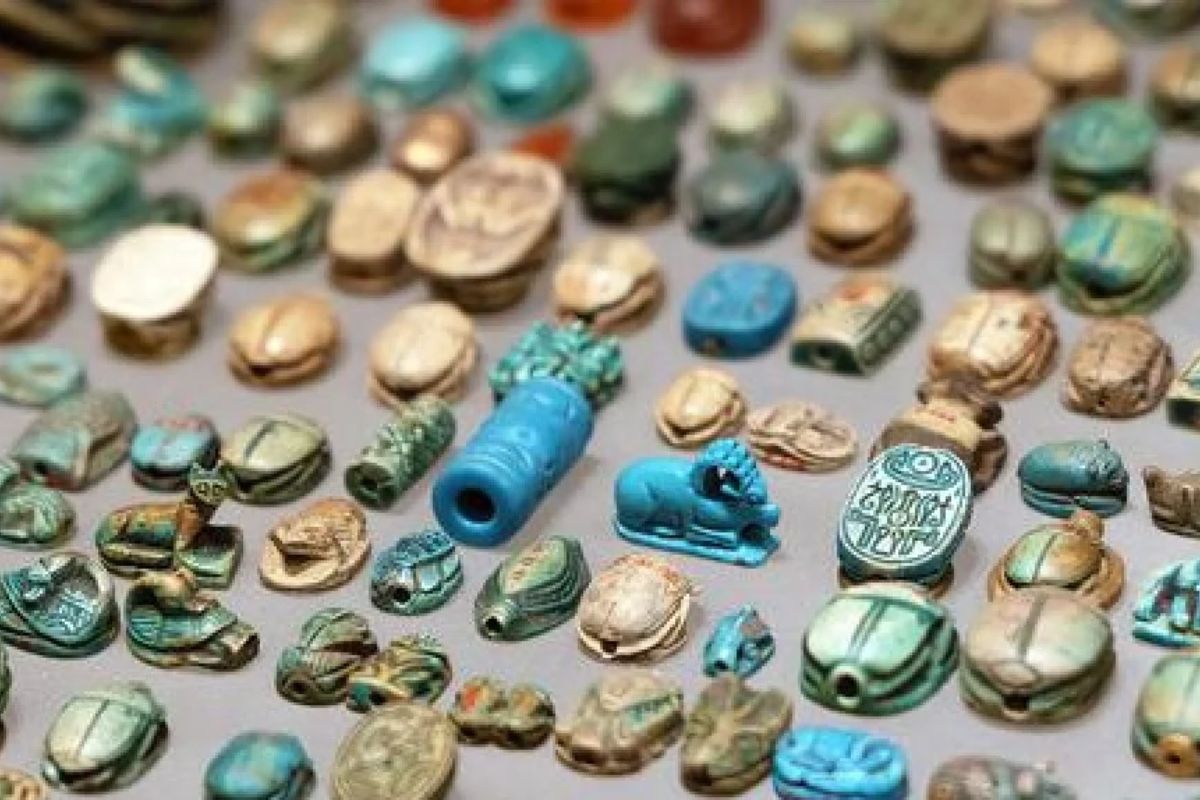
Scarab beetle amulets appeared in necklaces, bracelets, rings, and other forms of personal ornament.
They were made using materials such as faience, glazed steatite, and various stones.
The upper surface typically represented the beetle’s body.
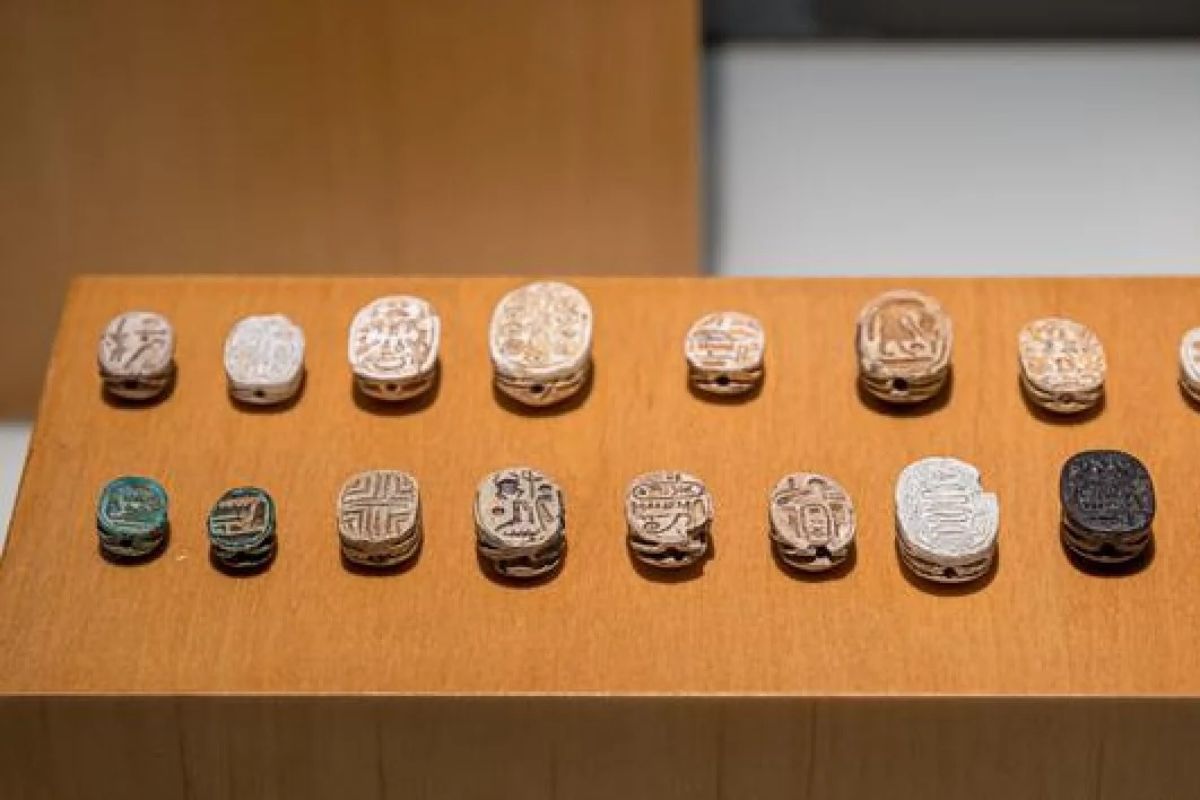
The underside could be plain or engraved with images, symbols, personal names, and inscriptions.
Some scarabs were used as seals. The engraved surface could be pressed into clay to leave an impression.
This combination of practical and magical functions is one reason scarabs are particularly interesting archaeological artifacts.
Were All Scarab Amulets the Same?
No.
A small ancient Egyptian scarab amulet might serve as personal jewelry or a seal.
A larger winged scarab could have a funerary function.
A heart scarab had a more specialized purpose connected with judgment after death.
Although these objects shared the beetle’s general symbolism, their individual functions were not interchangeable.
When examining an Egyptian beetle amulet, look at its size, material, underside, and suspension method.
These details can reveal far more than its appearance alone.
5. Heart Scarab Amulet: Protection During the Judgment of the Dead
The Egyptian heart scarab is a particularly important type of funerary amulet.
Unlike an ordinary scarab pendant, it was closely associated with the deceased person’s heart and the judgment believed to take place after death.
Heart scarabs were often relatively large and positioned on the chest of the mummy.
What Was the Purpose of a Heart Scarab?
The heart scarab was intended to protect the deceased during the judgment of the dead.
In ancient Egyptian belief, the heart was closely associated with memory, thought, moral character, and personal identity.
After death, the deceased’s heart could be weighed against the feather associated with Ma’at, the principle of truth, justice, and cosmic order.
A favorable judgment was essential for continued existence in the afterlife.
The deceased therefore needed the heart to support rather than condemn its owner.
Heart Scarabs and the Book of the Dead
Many heart scarabs were inscribed with a spell corresponding to Chapter 30B of the Book of the Dead.
This text sought to prevent the heart from speaking against the deceased during judgment.
The inscription makes the difference between a decorative beetle and a specialized heart scarab particularly significant.
The object was not simply a symbol of luck. It formed part of a larger system of funerary beliefs, texts, rituals, and protective equipment.
Egyptian Heart Amulets vs. Heart Scarabs
A heart-shaped amulet and a heart scarab were related but distinct types of objects.
A heart amulet represented the heart itself and could be connected with preserving the deceased’s identity and vital essence.
A heart scarab used the beetle’s regenerative symbolism in a funerary object associated with the judgment of the dead.
Not every heart-shaped object was a scarab, and not every scarab had the function of a heart scarab.
Were Golden Heart Scarabs Common?
Gold was used in elite Egyptian funerary jewelry, and surviving heart scarabs sometimes feature gold settings or decorative elements.
However, many heart scarabs were made primarily from stone rather than solid gold.
The phrase golden heart scarab can describe a particular object’s material or decoration, but it should not be treated as a separate universal category of Egyptian amulet.
Visitors exploring the Valley of the Kings in Luxor can better understand these objects by studying the tomb decorations, funerary texts, and beliefs surrounding royal burial.
6. Djed Pillar Amulet: Stability and Eternal Endurance
The djed pillar is another major symbol in ancient Egyptian religion.
It resembles an upright column with several horizontal bars near the top.
Although interpretations of its earliest origins have varied, the djed became firmly associated with stability and the god Osiris.
What Does the Djed Pillar Mean?
The principal meaning of the djed pillar is stability, permanence, and endurance.
The Egyptian word represented by the djed sign was associated with being stable or enduring.
As a religious symbol, it expressed the hope that life and existence could continue despite the destructive effects of death.
The Djed Pillar and Osiris
Osiris was one of the principal Egyptian gods connected with death, regeneration, and the afterlife.
The djed was associated with his backbone or enduring bodily strength.
This relationship became particularly important in funerary symbolism.
The myth of Osiris involved death and restoration, making his stability a powerful model for the regeneration of the deceased.
What Was a Djed Pillar Amulet Used For?
A djed amulet could provide symbolic stability and help connect the deceased with the regenerative power of Osiris.
Djed pillar amulets appeared in funerary settings and could be placed among mummy wrappings.
Their purpose was to support the deceased’s continued existence.
The djed’s symbolism also extended beyond burial.
Images of the pillar appeared in religious architecture and ritual contexts, including ceremonies associated with the raising of the djed.
Djed Pillar and Ankh: What’s the Difference?
The ankh and djed pillar are sometimes displayed together because both concern life and enduring existence.
Their meanings are different.
The ankh primarily represents life.
The djed pillar emphasizes stability and permanence.
When these symbols appear together, their combined message can express a wish for life that is sustained and secure.
At the Temple of Seti I at Abydos, visitors can explore a major religious setting connected with Osiris and ancient Egyptian beliefs about regeneration.
7. Tyet Amulet: The Protective Knot of Isis
The tyet, also spelled tjet, tit, or tet, is an ancient Egyptian symbol strongly associated with the goddess Isis.
It resembles an ankh in certain respects but has downward-curving arms or loops.
The symbol is sometimes called the Knot of Isis or the Girdle of Isis.
What Is the Tyet Amulet Meaning?
The tyet amulet meaning is closely connected with the protection of Isis, regeneration, and funerary well-being.
Isis was an important goddess associated with motherhood, protective magic, and the restoration of Osiris.
Her role in protecting Horus and restoring Osiris made her especially significant in Egyptian religious beliefs.
The tyet expressed aspects of this divine protective power.
Why Were Some Tyet Amulets Red?
Some surviving tyet amulets were made from red jasper or other red materials.
The association with Isis and references to protective funerary rituals help explain the importance of certain red examples.
Color was meaningful in ancient Egyptian magic.
Red could refer to dangerous forces but could also express the power required to confront and control them.
It would therefore be misleading to assume that red always represented evil.
The Tyet and the Djed Pillar
The tyet and djed pillar frequently appear as complementary symbols.
The tyet is connected with Isis.
The djed is connected with Osiris.
Their combination expresses the protective and regenerative relationships between these deities.
They are particularly appropriate in funerary contexts because Isis and Osiris occupied central places in Egyptian beliefs about death and renewed life.
For travelers, recognizing these symbols provides a useful way to interpret religious imagery without needing to read every hieroglyph.
8. Egyptian Cat Amulet: Bastet and Divine Protection
Cats were closely associated with the goddess Bastet, one of the most recognizable deities of ancient Egyptian religion.
Bastet was especially important in Lower Egypt and was connected with protection, prosperity, and other beneficial divine qualities.
Her representations included feline forms.
What Did an Ancient Egyptian Cat Amulet Symbolize?
An ancient Egyptian cat amulet could invoke the protective associations of Bastet.
Depending on the object and its context, it might reflect wishes for divine favor, domestic well-being, or protection.
However, cat imagery did not always serve the same purpose.
A small personal amulet, a temple offering, and a larger bronze cat statue could have different functions.
It is important not to classify every Egyptian cat artifact as jewelry or a good-luck charm.
Were Cats Sacred in Ancient Egypt?
Cats were important in Egyptian religious culture, especially through their association with Bastet.
Their significance was not simply that Egyptians appreciated cats as household animals.
Feline imagery connected ordinary animals with powerful divine characteristics.
Cats also became important in votive practices, when people dedicated objects or animal mummies in religious contexts.
Why Do Egyptian Cat Amulets Remain Popular?
Modern cat amulets combine a recognizable animal form with the historical associations of Bastet.
They are common examples of Egyptian-inspired jewelry and souvenirs.
A contemporary cat pendant may reference these ancient traditions without reproducing the function of a specific archaeological object.
When visiting museums, compare small cat amulets with larger votive statues to understand the range of religious uses.
9. Egyptian Frog Amulet: Heqet, Fertility, and Birth
The Egyptian frog amulet is less immediately recognizable than the ankh or scarab, but it held important symbolic associations.
Frogs were connected with fertility, reproduction, and the renewal of life.
Their relationship with water and their abundance around the Nile helped establish this symbolism.
What Did the Frog Represent?
The frog was associated with fertility, birth, and the emergence of life.
The goddess Heqet, sometimes spelled Heket, could be represented in frog form or as a woman with a frog’s head.
She was connected with childbirth and the creation or beginning of life.
A heqet amulet could therefore refer to the protective powers associated with birth.
Why Were Frogs Appropriate Symbols of Fertility?
The annual Nile flood was central to Egypt’s agricultural and ecological environment.
Frogs and other aquatic creatures were familiar parts of the landscape.
Their abundance and reproductive behavior made them appropriate natural symbols of life and fertility.
The connection between the frog and Heqet strengthened these associations.
Were Frog Amulets Only for Pregnant Women?
There is no reason to assume that every Egyptian frog amulet belonged to a pregnant woman or had exactly the same intended function.
Its symbolism could extend to fertility, regeneration, and renewed existence more broadly.
The owner’s identity and the archaeological context are important.
When an object is discovered without reliable contextual information, its precise individual purpose may remain uncertain.
10. Two-Finger Amulet: A Mysterious Funerary Symbol
The ancient Egyptian two-finger amulet depicts two extended fingers, usually resembling the index and middle fingers of a hand.
It is particularly associated with later Egyptian funerary practices.
Compared with the ankh or scarab, its symbolism is less straightforward.
What Did the Egyptian Two-Finger Amulet Mean?
Two-finger amulets are generally interpreted as protective funerary objects.
Some traditional interpretations associate the fingers with divine assistance, including rituals connected with Osiris and the restoration of the deceased.
Other interpretations emphasize protective gestures or the role of the fingers in funerary ritual.
The precise meaning of individual examples is not always certain.
Why Is This Amulet Interesting?
The two-finger amulet demonstrates an important limitation of modern explanations of Egyptian religion.
Not every artifact has a single meaning that can be stated confidently.
Egyptologists use archaeological context, inscriptions, material, and comparisons with related objects to develop interpretations.
Some interpretations remain open to debate.
For museum visitors, this makes the two-finger amulet a useful reminder that ancient Egyptian artifacts are evidence of complex beliefs rather than a fixed dictionary of magical symbols.
11. Heart Amulet: Life, Memory, and Personal Identity
The heart occupied an especially important position in Egyptian religious thought.
It was associated not only with physical life but also with a person’s memory, intentions, understanding, and moral character.
Ancient Egyptians did not organize all aspects of the human body and mind according to modern medical concepts.
The heart had religious and intellectual significance that extended beyond circulation.
What Was an Egyptian Heart Amulet For?
A heart amulet could be connected with protecting the heart and preserving qualities essential to the deceased’s continued existence.
The heart’s role in afterlife judgment made it a particularly important concern in funerary practices.
A heart-shaped object could therefore express protection for the person’s identity and moral existence.
Why Was the Heart Important After Death?
The deceased hoped to pass judgment and achieve continued existence in the afterlife.
The heart played a central role in that process.
It represented a connection between the person’s actions during life and the outcome expected after death.
Amulets associated with the heart were consequently part of a wider religious response to the uncertainties of death.
12. Shen Ring Amulet: Eternity and Encircling Protection
The shen is a circular sign, often represented as a loop of rope with its ends joined or bound.
Its shape is associated with enclosure and continuity.
The circle became an appropriate expression of an enduring or encompassing protective force.
What Does the Shen Symbol Mean?
The shen symbol is associated with eternity, continuity, and protection.
Its circular form helps communicate the idea of something complete or without an obvious beginning or end.
In Egyptian royal imagery, related enclosing forms helped express protection for royal names and identities.
Is the Shen the Same as a Cartouche?
No.
A cartouche is an elongated enclosure used around certain royal names.
Its shape developed within the broader tradition of protective enclosing signs.
The shen and cartouche are therefore related, but they are not identical in function or appearance.
A small shen amulet could express enduring protection, while a cartouche had a specific role in identifying royalty.
13. Bes Amulet: Protection of the Home and Family
Bes was a protective deity especially associated with the household, childbirth, and family life.
Unlike many Egyptian gods who were frequently represented in formal profile, Bes was often shown facing forward.
His appearance could include a broad face, distinctive facial features, and a powerful or intimidating expression.
What Did a Bes Amulet Protect?
Bes amulets were connected with protection from harmful forces, particularly in domestic settings.
His image was associated with safeguarding women and children and providing protection during vulnerable moments.
A Bes amulet might be worn, while larger images of the deity could appear on household objects or other items.
Why Did Bes Look So Different?
The unusual appearance of Bes helped express his protective character.
His fierce or striking features were appropriate for a deity believed to confront danger.
In Egyptian religious thinking, a frightening appearance did not necessarily indicate a threatening deity.
It could represent a powerful protector.
Bes illustrates how Egyptian religious imagery adapted to everyday concerns rather than serving only the interests of kings and temples.
14. Taweret Amulet: Protection During Pregnancy and Childbirth
Taweret was an important protective goddess associated with pregnancy, childbirth, and the family.
Her appearance combined features of powerful animals, especially the hippopotamus, with other protective animal characteristics.
The resulting image was visually distinctive.
What Did Taweret Symbolize?
Taweret represented protective divine power associated with childbirth and family well-being.
Pregnancy and childbirth involved substantial risks in the ancient world.
People sought protection through religious beliefs, household rituals, and images of protective deities.
Taweret was particularly relevant to these concerns.
Taweret and Heqet: What Is the Difference?
Both goddesses were connected with birth and new life, but their imagery and religious associations differed.
Heqet was associated with the frog and the creation or emergence of life.
Taweret was represented through a formidable composite animal form and emphasized protective power around pregnancy and childbirth.
The presence of both figures demonstrates that ancient Egyptian religious protection could involve several deities addressing related concerns.
15. Papyrus Column Amulet: Freshness and Renewal
Papyrus was one of the most familiar and important plants in ancient Egypt.
It grew in the Nile environment and appeared extensively in Egyptian art, writing materials, decorative design, and religious symbolism.
Miniature papyrus columns were also made as amulets.
What Did the Papyrus Column Symbolize?
The papyrus column was associated with freshness, flourishing, renewal, and vitality.
These meanings reflected the connection between plant growth and the continuing cycles of life.
The plant’s presence in the Nile environment also linked it with Egyptian ideas of fertility and regeneration.
Why Did Egyptians Wear Plant-Shaped Amulets?
Egyptian religious symbolism often transformed familiar natural forms into meaningful objects.
Plants, animals, and everyday objects could represent desirable qualities.
A papyrus-shaped amulet allowed the wearer to express a connection with vitality and renewal.
Its meaning also demonstrates that Egyptian amulets were not restricted to images of gods.
A plant could carry religious significance through its natural characteristics and symbolic associations.
Other Ancient Egyptian Amulets Worth Knowing
The 15 types above are only a selection of the many forms found in Egyptian archaeology.
Other significant objects include the following.
Sa Amulet
The sa sign was associated with protection.
Small amulets of this form could express a wish for safeguarding and security.
The sign is especially relevant when studying Egyptian protective symbolism because it communicates protection directly rather than depicting a specific animal.
Was-Scepter Amulet
The was scepter was a sign of power and authority, frequently carried by gods in Egyptian art.
Miniature versions could express the strength or authority associated with the symbol.
The was, ankh, and djed sometimes appear together in religious imagery, combining ideas of power, life, and stability.
Falcon Amulet
Falcon amulets were connected with the symbolism of Horus and other divine falcon forms.
Their protective or religious meanings depended on the identity of the deity represented.
The falcon also carried associations with kingship and the sky.
Cobra Amulet
Cobras were closely connected with protective divine power and royal symbolism.
The raised cobra, known as the uraeus in royal contexts, was an important protective image.
Cobra amulets could invoke associations with powerful divine defenders.
Headrest Amulet
The headrest is one of the more unusual types of Egyptian funerary amulet.
A full-size headrest supported a person’s head during sleep, but miniature funerary versions had additional religious meanings.
They could express protection of the deceased’s head and the hope of rising again.
The connection between lifting the head and the image of the rising sun made the headrest appropriate for beliefs about rebirth.
Isis, Anubis, and Other Divine Amulets
Small figures of gods and goddesses could also function as amulets.
An Isis amulet invoked associations with the goddess’s protective and restorative powers.
Anubis imagery connected the wearer or deceased with a deity closely associated with embalming and funerary protection.
A figure of Horus the Child could emphasize divine protection, particularly in contexts involving children.
The identity and function of each object should be considered individually rather than treating all deity-shaped amulets as interchangeable.
How Did Ancient Egyptian Amulets Work?
Ancient Egyptians believed that amulets could possess or transmit protective and beneficial powers.
The effectiveness of an amulet was not necessarily understood to come from its shape alone.
Different factors could contribute to its religious significance, including its material, color, inscription, relationship with a deity, and association with particular rituals.
The Role of Heka in Egyptian Magic
The ancient Egyptian concept of heka is central to understanding magical practice.
Heka was a divine power that could be used through words, rituals, and religious actions.
It was not simply a form of entertainment or supernatural trickery. It was part of the religious understanding of how the world operated.
Amulets belonged to this larger system.
An object could embody the qualities of the symbol it represented, while spoken words or rituals might strengthen its intended function.
This explains why similar-looking artifacts might have different ritual purposes.
Could Words Make an Amulet More Powerful?
In Egyptian religious practice, words and inscriptions could play an important role.
Some objects carried divine names, protective signs, royal names, or short religious texts.
Other protective objects were associated with spells spoken during rituals.
Ancient Egyptian religious texts often treated correctly performed words and actions as meaningful parts of magical practice.
However, not every amulet had an inscription, and it would be incorrect to assume that every surviving charm underwent a specific ritual known to archaeologists.
Did Ancient Egyptians Believe Amulets Were Alive?
Not necessarily in the ordinary sense of a living creature.
Rather, they believed objects could participate in divine power or possess beneficial properties.
A scarab amulet did not need to be a living beetle to symbolize regeneration.
An image of Isis could invoke the goddess’s protective associations without being understood as a literal human figure.
The relationship between an object and the power it represented was central to its religious significance.
What Materials Were Ancient Egyptian Amulets Made From?
Ancient Egyptian amulets were produced from many materials, including faience, stone, glass, gold, silver, and other substances.
Material selection influenced appearance, durability, value, and symbolic meaning.
It could also reflect the resources available to the wearer.
Some materials were relatively inexpensive, while others required considerable wealth and skilled craftsmanship.
Egyptian Faience: The Famous Blue and Green Material
Faience was one of the most important materials used for Egyptian amulets.
It is often mistaken for glazed pottery, but Egyptian faience differs from ordinary clay ceramics.
It was generally made from a silica-rich body and developed a bright glazed surface during production.
Copper-containing compounds could produce the distinctive blue or turquoise appearance.
Faience was especially suitable for small objects, including scarabs, protective eyes, deities, beads, and figurines.
Its bright blue and green colors carried associations with life, freshness, and regeneration.
A small faience amulet could therefore combine the symbolic importance of its shape with the significance of its color.
What Did Amulet Colors Mean?
Ancient Egyptian color symbolism was complex.
The meaning of a color could vary according to the object, deity, material, and religious context.
| Color | Common symbolic associations | Possible amulet context |
| Blue | Divinity, celestial associations, renewal | Protective eyes and deity amulets |
| Green | Growth, freshness, regeneration | Scarabs and plant-shaped objects |
| Red | Vitality, powerful forces, protection | Certain protective and tyet amulets |
| Gold | Divine radiance, endurance, solar associations | Elite and royal jewelry |
| Black | Fertility, regeneration, the fertile Nile soil | Certain funerary and regenerative objects |
| White | Purity and sacredness | Some ritual objects and protective forms |
These associations should not be treated as fixed rules.
For example, red could be associated with dangerous forces but also used in protective magic.
Similarly, a green scarab was not necessarily identical in function to every other green amulet.
Were All Egyptian Amulets Made of Gold?
No.
Gold was especially significant in elite religious and funerary jewelry, but many Egyptian amulets were made from less expensive materials.
Faience was widespread.
Stone and glazed steatite were also common, depending on the period and object type.
The availability of different materials meant that amulets could be owned by people from varying social backgrounds.
A modest faience charm might have held great personal importance to its owner, even though it lacked the monetary value of a gold ornament.
Precious and Semiprecious Stones
Ancient Egyptian craftspeople used materials such as carnelian, lapis lazuli, turquoise, jasper, and other stones.
These materials offered distinct colors and textures.
They could be polished, carved, and shaped into small symbolic objects.
The selection of a stone was not always purely decorative. Its color, rarity, durability, and religious associations could contribute to the intended meaning.
Why Were Egyptian Amulets So Small?
Many amulets were designed for direct contact with the body.
Small dimensions made them suitable for wearing on cords, necklaces, bracelets, or rings.
Their compact size also allowed them to be incorporated into mummy wrappings.
The importance of an amulet did not depend on being large enough to attract public attention.
Some of the most meaningful religious objects in ancient Egypt were small enough to fit comfortably in a person’s hand.
The History of Ancient Egyptian Amulets
Amulets were used in Egypt for thousands of years.
Their forms and functions changed as religious beliefs, artistic traditions, and funerary customs developed.
Although particular symbols became especially prominent in certain periods, there was considerable continuity.
The basic desire for protection and well-being remained important throughout Egyptian history.
Predynastic Egypt: Early Protective Objects
Some of the earliest Egyptian amulets date to prehistoric periods before the establishment of the dynastic Egyptian state.
Animal-shaped objects and natural materials played important roles.
These early objects provide evidence that protective symbolism developed long before the monumental temples and royal tombs familiar to modern visitors.
Their precise meanings are not always recoverable.
Nevertheless, their archaeological contexts demonstrate the long history of symbolic personal objects in the Nile Valley.
Old Kingdom: Protection and Burial
During the Old Kingdom, Egyptian funerary practices became increasingly elaborate.
Amulets were among the objects that could accompany the dead.
Protective imagery also appeared in broader religious and burial contexts.
The Old Kingdom is particularly famous for the pyramids of Giza and Saqqara, but the surviving archaeological record includes many smaller objects that illuminate personal beliefs.
Visitors studying the Saqqara Necropolis can explore an important landscape for understanding the development of Egyptian burial traditions.
Middle Kingdom: Greater Variety and Personal Use
Middle Kingdom amulets demonstrate increasing variety in materials and designs.
Animal-shaped objects, scarabs, protective symbols, and deity-associated forms became significant parts of personal adornment and burial equipment.
Scarabs were especially important during this broad period.
Their role as both symbolic objects and seals demonstrates how practical and religious functions could coexist.
New Kingdom: Royal Jewelry and Elaborate Funerary Protection
The New Kingdom produced some of ancient Egypt’s most recognizable jewelry and religious artifacts.
Its period includes major pharaohs such as Hatshepsut, Amenhotep III, Akhenaten, Tutankhamun, and Ramesses II.
Amulets appeared in personal jewelry and elaborate burial assemblages.
The development and use of funerary texts also contributed to a broader tradition in which spells, images, and objects supported the deceased.
Royal burials illustrate these practices on an especially lavish scale.
Third Intermediate and Late Periods: Expanding Funerary Amulet Traditions
During the Third Intermediate Period and Late Period, funerary amulets continued to develop.
Certain specialized types became especially prominent.
The number and variety of protective forms used in burial contexts could be considerable.
Small faience figures, djed pillars, protective eyes, tyet knots, and deity amulets are important surviving examples.
These objects help explain why Egyptian museum collections often contain so many small blue and green artifacts.
Ptolemaic and Roman Egypt: Continuity and Change
Amulets continued to be used during the Ptolemaic and Roman periods.
Egyptian religious traditions interacted with wider Mediterranean cultures.
Some established symbols remained popular, while materials, artistic styles, and religious practices changed.
Egyptian-style amulets were also produced and used beyond Egypt.
Their meanings may not have remained exactly the same in every cultural setting.
This long history demonstrates that ancient Egyptian talismans were not restricted to one dynasty, one religious tradition, or one moment in Egyptian history.
Ancient Egyptian Amulets for the Living vs. the Dead
One of the most important distinctions is between objects used during daily life and those created primarily for funerary purposes.
Some amulets were suitable for both.
Others had more specialized functions connected with death and regeneration.
| Feature | Amulets for the living | Funerary amulets |
| Main purpose | Personal protection and well-being | Protection and regeneration after death |
| Typical examples | Ankh, scarab, wedjat, deity amulets | Heart scarab, djed, tyet, headrest |
| Common placement | Necklaces, bracelets, rings, cords | Chest, neck area, or within wrappings |
| Main concerns | Health, safety, fertility, prosperity | Preservation, judgment, renewed existence |
| Religious context | Daily life and personal devotion | Burial practices and afterlife beliefs |
How Were Amulets Placed on Mummies?
Funerary amulets could be positioned on the body or between layers of linen wrappings.
Placement sometimes reflected the object’s intended protective function.
Heart scarabs were commonly associated with the chest.
Certain headrest amulets were positioned beneath the neck.
Other protective objects might be placed near particular parts of the body or incorporated into arrangements of funerary jewelry.
However, there was no single arrangement used in all burials throughout Egyptian history.
Practices varied according to period, social status, religious tradition, and individual circumstances.
Why Did the Dead Need Protection?
Ancient Egyptians viewed death as a significant transformation rather than simply the end of existence.
The deceased hoped to continue living in another form.
Achieving this required appropriate burial preparations and religious protection.
The body needed to be preserved, and the deceased had to confront the challenges associated with the journey into the afterlife.
Amulets formed one component of a larger system that also included mummification, funerary texts, offerings, coffins, tomb decoration, and rituals.
Did Every Egyptian Mummy Have Amulets?
Not necessarily.
Burial practices differed enormously across Egyptian history.
Social status and access to resources also affected the objects placed with the dead.
Some individuals received elaborate arrangements of jewelry and protective amulets.
Others had much simpler burial equipment.
The absence of surviving amulets does not necessarily mean a person lacked protective religious beliefs during life.
Organic charms may have deteriorated, and some graves have suffered disturbance or looting.
King Tutankhamun’s Amulets and Royal Burial Jewelry
The discovery of Tutankhamun’s tomb in 1922 provided an extraordinary opportunity to study New Kingdom royal burial practices.
The tomb contained a remarkable assortment of funerary equipment, jewelry, religious objects, and luxury possessions.
Many items carried protective or regenerative symbolism.
Why Were Amulets Important in Tutankhamun’s Burial?
Tutankhamun’s burial was intended to prepare and protect him for continued existence after death.
Religious images and symbolic materials appeared throughout his funerary equipment.
Gold, colored stones, glass, and other materials contributed to the visual and religious character of the objects.
Amulet forms associated with life, protection, divine power, and regeneration belonged to this wider burial tradition.
The presence of such symbols reflected longstanding Egyptian beliefs rather than a special religious system invented for Tutankhamun.
Were King Tut’s Amulets Different From Ordinary Egyptian Amulets?
The major difference was often the quality of materials, craftsmanship, and complexity of the burial arrangements.
Royal objects could combine precious materials with highly sophisticated designs.
However, many symbolic concepts were shared with amulets used elsewhere in Egyptian society.
An ankh continued to express life.
A scarab remained associated with regeneration.
A protective eye retained its religious associations.
The distinction between a king’s luxury jewelry and a modest personal amulet did not necessarily require different symbolic foundations.
What Can Tutankhamun’s Jewelry Teach Us?
Tutankhamun’s jewelry demonstrates that ancient Egyptian ornaments could combine artistic beauty with religious meaning.
Materials were carefully selected.
Symbols were arranged into compositions.
Images of deities, birds, insects, flowers, and sacred signs could work together to express protection and renewal.
For visitors in 2027, the royal collections associated with Tutankhamun offer an opportunity to examine the relationship between artistry, kingship, and afterlife beliefs.
The exact display locations of individual objects should be checked against current museum information before visiting.
What Amulets Did Ancient Egyptian Magicians Use?
Ancient Egyptian magical practice involved much more than wearing charms.
Ritual specialists, priests, and other practitioners could use protective words, religious texts, images, and objects.
Protective practices were also part of ordinary household life.
Were Egyptian Magicians Different From Priests?
The distinction was not always clear.
Egyptian religious knowledge included rituals, divine names, spoken formulas, and methods of protection.
Some priests possessed specialized ritual knowledge.
Protective practices could also be performed outside major temples.
It is misleading to imagine ancient Egyptian magicians as a single profession using one standardized collection of magical objects.
The evidence represents different historical periods and religious environments.
Different Amulets Used in Magical Practice
Objects associated with protection and religious power included:
- Wedjat eyes for protection and healing.
- Deity amulets invoking the powers of particular gods.
- Bes and Taweret images associated with family protection.
- Scarabs connected with regeneration.
- Ankh symbols associated with life.
- Protective signs such as the sa.
- Inscribed objects carrying sacred names or formulas.
However, the presence of an amulet does not prove that it belonged to a professional ritual practitioner.
Most of these forms were also used by ordinary individuals.
Were All Amulets Activated With Spells?
Not every amulet required a documented ritual in order to function.
Some objects were associated with spoken words, ceremonial acts, or religious texts.
Other objects may have been worn primarily because of their recognized symbolism.
Archaeologists cannot always determine how an individual amulet was acquired, used, or ritually prepared.
It is therefore better to describe magical activation as one possible aspect of Egyptian amulet use rather than as a universal requirement.
How to Recognize a Real Ancient Egyptian Amulet
Real ancient Egyptian amulets are archaeological objects created and used in antiquity.
They differ fundamentally from modern Egyptian-inspired pendants, even when the modern examples reproduce traditional shapes accurately.
An authentic ancient artifact should be evaluated through reliable provenance, archaeological documentation, material study, and qualified professional assessment.
What Does an Authentic Egyptian Amulet Look Like?
There is no single appearance that proves authenticity.
Original Egyptian amulets can differ in:
- Size and shape.
- Material and manufacturing technique.
- Surface preservation.
- Style and period.
- Inscription and decoration.
- Archaeological context.
Some ancient objects remain remarkably well preserved.
Others show damage, abrasion, discoloration, or restoration.
Artificial aging can also imitate certain surface characteristics.
Therefore, a worn appearance is not proof that an object is ancient.
Can You Identify a Real Amulet From a Photograph?
Usually not with confidence.
A photograph may reveal visual details, but it rarely establishes an object’s age or history.
Experts may need to examine the material, manufacturing techniques, documentation, and comparisons with securely dated objects.
Scientific testing can sometimes contribute to an assessment, but no single test establishes every aspect of authenticity.
Reliable provenance is particularly important.
An object without a trustworthy ownership history should not automatically be accepted as genuine simply because its style resembles an ancient amulet.
Are Ancient Egyptian Amulets for Sale?
Modern Egyptian-inspired amulets are widely sold as souvenirs and jewelry.
Genuine ancient Egyptian artifacts are a completely different category.
Their acquisition, ownership, movement, and export can be subject to strict cultural-property laws and international restrictions.
Tourists should never assume that an object described as an antiquity can legally be purchased or taken out of Egypt.
For a typical traveler, a clearly identified modern reproduction is the safer and more practical choice.
How to Buy Egyptian Amulet Souvenirs
When buying Egyptian amulets for sale in souvenir markets, concentrate on workmanship and clarity about what is being offered.
Ask what material the object is made from.
A pendant described as gold-colored is not necessarily gold.
Similarly, a bright blue object is not automatically made from traditional Egyptian faience.
Look for clean finishing, secure suspension loops, and an accurate description of the symbol.
A reputable seller should not need to make unsupported claims that a modern souvenir came from a royal tomb or archaeological excavation.
For visitors interested in shopping, Khan El-Khalili Bazaar in Islamic Cairo provides a traditional setting for browsing crafts, jewelry, and Egyptian-inspired gifts.
How to Make an Ancient Egyptian Amulet Out of Clay
Creating a modern clay replica is an accessible way to understand how Egyptian shapes communicated religious ideas.
This is a contemporary educational craft, not a reconstruction of every ancient Egyptian manufacturing technique.
Traditional Egyptian faience production involved silica-rich materials and particular glazing processes that differ from shaping ordinary craft clay.
Materials You Need
For a simple modern replica, use air-dry modeling clay, a smooth work surface, a blunt shaping tool, a toothpick, water, and suitable craft paint.
Choose a design before beginning.
An ankh, djed pillar, scarab, or protective eye is a useful starting point.
Step-by-Step Instructions
- Choose your symbol. Select an ankh for life, a scarab for regeneration, or a wedjat eye for protection.
- Shape the clay. Form a small, even piece that can be worn as a pendant.
- Create the design. Add the main outline and carefully shape its distinctive details.
- Add a suspension hole. Use a toothpick to make a hole large enough for a cord. Keep it away from thin edges.
- Let the clay dry. Follow the manufacturer’s instructions for the material being used.
- Apply color. Blue or green paint can evoke the appearance of Egyptian faience, although it does not reproduce its composition.
- Finish your replica. Add a suitable cord and clearly identify the object as a modern craft piece.
Which Symbol Is Easiest for Beginners?
The ankh is one of the simplest designs because of its recognizable outline.
The djed pillar is another suitable option, although the horizontal sections require careful shaping.
The Eye of Horus is more detailed and may be easier to create as a flat pendant with incised lines.
A scarab requires additional attention to the insect’s curved body and surface details.
What Can Children Learn From This Activity?
Making a replica can introduce children to Egyptian writing, symbols, religious beliefs, and craftsmanship.
It also creates an opportunity to discuss the distinction between archaeological objects and modern interpretations.
Instead of describing the finished clay piece as a genuine ancient amulet, explain which historical symbol inspired it and what that symbol meant.
Where Can Travelers See Ancient Egyptian Amulets in Egypt?
Egyptian museums offer opportunities to examine the materials, craftsmanship, and religious symbolism of ancient Egyptian artifacts.
Amulets are often displayed alongside jewelry, funerary equipment, statues, and other archaeological finds.
The most useful museum experience is not necessarily the one with the greatest number of objects.
For visitors specifically interested in amulets, a clearly labeled collection that explains the objects’ dates, materials, and purposes can be particularly rewarding.
The Grand Egyptian Museum in Giza
The Grand Egyptian Museum is an important destination for travelers interested in Egyptian archaeology and material culture.
Its extensive collections provide a broader context for understanding jewelry, royal objects, religious symbols, and funerary traditions.
What to focus on: Amulet forms within royal jewelry, funerary objects, precious materials, and sacred imagery.
Do not focus only on the most famous large sculptures.
Examine smaller objects for repeated signs such as the ankh, djed, scarab, and protective eye.
Visitors can explore the site’s history and broader archaeological importance in this Grand Egyptian Museum guide.
The Egyptian Museum in Tahrir Square
The Egyptian Museum in central Cairo is another important location for studying ancient Egyptian artifacts.
Its historical collections provide a valuable setting for examining the relationship between personal jewelry, ritual objects, and larger religious traditions.
What to focus on: Small protective objects, Egyptian jewelry, stone and faience artifacts, and related funerary material where displayed.
Collection arrangements may change over time.
Travelers should not assume that a specific artifact will remain in the same gallery indefinitely.
The museum’s historical significance is explored in the Egyptian Museum in Tahrir Square guide.
Luxor Museum
Luxor Museum is particularly relevant to visitors exploring the archaeological heritage of ancient Thebes.
Its collections help illustrate the religious and artistic traditions of one of ancient Egypt’s most important regions.
What to focus on: Religious imagery, ancient craftsmanship, the relationship between kings and gods, and small personal objects where displayed.
Luxor Museum also offers a useful complement to visiting nearby temples and tombs.
Readers planning time in the city can explore the Luxor Museum visitor guide.
The Mummification Museum in Luxor
The Mummification Museum provides context for understanding Egyptian burial preparation and beliefs about the dead.
Mummification was closely connected with funerary protection and the hope of continued existence.
Although it is not exclusively an amulet museum, its subject matter can help visitors understand why funerary objects were considered important.
The experience is especially relevant for anyone curious about the relationship between protective artifacts, the preserved body, and the Egyptian afterlife.
Learn more about the Mummification Museum in Luxor.
Which Museum Is Best for Learning About Egyptian Amulets?
| Museum | Main advantage | Best suited for |
| Grand Egyptian Museum | Extensive archaeological and royal context | Travelers interested in royal collections and craftsmanship |
| Egyptian Museum in Tahrir Square | Historical collection of Egyptian antiquities | Visitors examining a broad range of artifacts |
| Luxor Museum | Regional archaeological context | Travelers combining museum visits with ancient Theban sites |
| Mummification Museum | Explanations of funerary customs | Visitors interested in the role of amulets after death |
The precise amulets on display can vary, so it is best to check current collections or ask museum staff when planning a specialist visit.
Ancient Egyptian Amulets at Temples and Archaeological Sites
Museums display portable objects, but Egyptian temples and tombs provide the broader setting in which many of these symbols can be understood.
The same sacred signs found on miniature amulets often appear in monumental reliefs and inscriptions.
Recognizing those connections can make an archaeological visit more meaningful.
Philae Temple: Isis and Protective Symbolism
The temple complex associated with Isis at Philae is particularly relevant to the tyet and the protective traditions surrounding the goddess.
Isis played an important role in Egyptian beliefs about motherhood, kingship, restoration, and divine protection.
Travelers visiting the Temple of Isis at Philae can examine the wider religious setting in which those beliefs developed.
Edfu Temple: Horus and Divine Kingship
The Temple of Horus at Edfu offers another valuable connection.
Horus was closely associated with kingship and divine protection.
Understanding the god’s mythology can help visitors interpret the protective significance of the Eye of Horus amulet.
The temple’s reliefs and inscriptions show how a deity represented on a small object could also occupy a major place in Egyptian religious architecture.
Luxor’s Royal Tombs: Protection Beyond Death
The Valley of the Kings reveals the elaborate religious preparations associated with royal burial.
Tomb decoration, funerary texts, and religious images explain the larger beliefs that gave protective objects their significance.
Heart scarabs, djed pillars, and other funerary amulets become easier to understand when viewed within this religious framework.
Although visitors generally encounter wall decoration rather than loose amulets inside tombs, the connections remain important.
How to Include Ancient Egyptian Amulets in a 2027 Egypt Itinerary
Visitors do not need a specialist archaeological tour to appreciate ancient Egyptian amulets.
A carefully planned museum visit combined with one or two major archaeological sites can provide a useful introduction.
A One-Day Cultural Experience in Cairo and Giza
Begin with a major archaeological museum.
Spend time examining smaller objects rather than concentrating exclusively on monumental sculptures and royal coffins.
Look for examples of scarabs, protective eyes, jewelry, and divine symbols.
Afterward, visit the Giza Plateau to understand the monumental expression of Egyptian beliefs about kingship, death, and continued existence.
Allow enough time for careful museum viewing rather than planning too many unrelated stops.
A Luxor Experience Focused on Religion and the Afterlife
In Luxor, combine a museum visit with selected temples and tombs.
A museum can introduce objects and materials.
Temples reveal their wider religious symbolism.
Royal tombs demonstrate the importance of protection and regeneration after death.
This approach helps visitors connect portable amulets with the religious environment that gave them meaning.
What Should You Ask an Egyptologist Guide?
A knowledgeable guide can help explain details that are easily missed.
Useful questions include:
- What does this particular symbol represent?
- Was the object intended for the living or the dead?
- How can we identify the material?
- Does the amulet have an inscription?
- Is its archaeological origin known?
- Did its meaning change between historical periods?
- Does the museum display provide evidence of how it was worn?
The strongest explanations distinguish established historical knowledge from interpretations that remain uncertain.
For travelers who prefer a privately arranged museum experience, Egypt Vacation Tours offers a Grand Egyptian Museum guided tour option. The current itinerary and available services should be confirmed before booking.
Common Misconceptions About Ancient Egyptian Amulets
Ancient Egyptian symbolism is frequently simplified in modern jewelry descriptions, souvenir shops, and online discussions.
Several misconceptions are especially common.
Every Amulet Had Just One Meaning
Most Egyptian symbols were associated with multiple concepts.
A scarab could represent regeneration while also serving as a seal.
A wedjat eye could protect both the living and the deceased.
The function of a symbol depended partly on its historical context.
Every Egyptian Amulet Was a Good-Luck Charm
The modern expression good-luck charm does not fully represent Egyptian beliefs.
Some amulets were connected with illness, childbirth, funerary judgment, or specific divine powers.
Others expressed complex religious ideas about regeneration and existence.
All Egyptian Amulets Were Worn as Necklaces
Many were worn as jewelry, but this was not their only use.
Amulets could be incorporated into rings, attached to fabric, included in funerary equipment, or placed among mummy wrappings.
Their physical design often reflected how they were intended to be used.
The Eye of Horus and Eye of Ra Are Always Easy to Distinguish
Their religious associations differ, but their visual representations can overlap.
Identifying an image solely by its direction or a simplified drawing may be unreliable.
Context is essential.
Only Wealthy Egyptians Owned Amulets
Elite Egyptian jewelry is especially visible in museums because it was made from precious materials and sometimes survived in well-preserved burials.
However, many amulets were made from more affordable materials.
The use of protective charms was not limited to royalty.
A Scarab Always Means the Same Thing
An ordinary scarab-shaped pendant, an inscribed seal, a winged funerary scarab, and a heart scarab might have overlapping symbolism but different uses.
The beetle’s general association with regeneration does not eliminate these distinctions.
Egyptian Amulets Had No Function Beyond Religion
Some objects combined religious and practical roles.
Seal amulets provide a particularly good example.
An engraved scarab could express protective symbolism while also functioning as a seal.
Ancient Egyptian material culture cannot always be divided neatly into religious and nonreligious categories.
Frequently Asked Questions About Ancient Egyptian Amulets
1. What are ancient Egyptian amulets?
Ancient Egyptian amulets were small objects believed to offer protection or transfer beneficial supernatural qualities to their owners. They appeared as symbols, animals, deities, and everyday objects. Egyptians wore them during life and included them in burials. Their meanings depended on their shapes, materials, inscriptions, and religious associations.
2. What was the most powerful Egyptian protection amulet?
There was no single amulet universally considered the most powerful in every situation. The Eye of Horus was particularly important for protection and healing, while the scarab represented regeneration. Other symbols, such as the djed and tyet, held significant funerary associations. Their value depended on the protection or benefit being sought.
3. What does an ancient Egyptian scarab amulet symbolize?
An ancient Egyptian scarab amulet primarily symbolizes rebirth, renewal, and regeneration. The beetle was associated with Khepri, a form of the rising sun. Ancient Egyptians connected its behavior with the sun’s daily renewal. Scarabs also appeared in jewelry, seals, and funerary equipment, including specialized heart scarabs.
4. What does the ankh amulet mean?
The ankh represents life. In ancient Egyptian writing, the sign expressed life and the act of living. It also appeared in religious art as a symbol associated with divine vitality. Ankh amulets could express a wish for life, well-being, and continued existence, including the hope of life after death.
5. What is the difference between the Eye of Horus and the Eye of Ra?
The Eye of Horus is especially associated with healing and restoration through the myth of Horus’s injured eye. The Eye of Ra expresses the powerful and sometimes fierce protective force of the sun god. Their religious associations differ, although Egyptian eye imagery can overlap visually and should be interpreted within its original context.
6. What is the meaning of the tyet amulet?
The tyet is associated with Isis and her protective and regenerative powers. It is sometimes called the Knot of Isis. The symbol appears in Egyptian funerary traditions and can be associated with protection for the deceased. Some examples were made from red materials, including red jasper.
7. What did the djed pillar amulet protect?
The djed pillar symbolized stability and endurance. It became closely associated with Osiris and his regeneration after death. As a funerary amulet, it expressed the hope that the deceased would remain stable and continue to exist. Its symbolism could also appear alongside other life-related signs, including the ankh.
8. Why did Egyptians put amulets on mummies?
Egyptians placed amulets on or within mummy wrappings because they believed certain objects could protect the deceased and support regeneration after death. Some types had specialized functions, such as heart scarabs connected with judgment. Their use was part of a larger funerary tradition involving mummification, religious texts, and burial rituals.
9. What is the Egyptian amulet representing rebirth?
The scarab beetle is one of the clearest ancient Egyptian symbols of rebirth and regeneration. Its association with Khepri and the rising sun connected it with renewed life. Other symbols, such as the djed pillar and papyrus column, also had regenerative associations, although their meanings were not identical.
10. Are ancient Egyptian amulets still used today?
Ancient Egyptian symbols remain popular in modern jewelry, decorative art, and cultural souvenirs. People may wear ankh pendants, scarabs, or Eye of Horus designs for personal, artistic, or symbolic reasons. Contemporary use does not necessarily reproduce the original religious practices associated with these objects in antiquity.
11. Where can tourists buy Egyptian amulets?
Travelers can find modern Egyptian-inspired amulet jewelry in souvenir shops, craft markets, and museum-related retail outlets. Buyers should distinguish contemporary reproductions from archaeological antiquities. Claims that an object is genuinely ancient require reliable evidence, and laws governing antiquities and their export must be respected.
12. Can you make an ancient Egyptian amulet at home?
You can make a modern replica using air-dry clay, craft tools, and paint. Common designs include the ankh, scarab, djed pillar, and Eye of Horus. This is an educational activity rather than the recreation of an authentic ancient artifact. Traditional Egyptian faience manufacturing involved materials and production methods different from ordinary craft clay.
Conclusion: Why Ancient Egyptian Amulets Still Matter
Ancient Egyptian amulets offer a personal perspective on one of history’s most influential civilizations.
Their meanings extend far beyond decoration.
The ankh expresses life, the Eye of Horus represents healing and protection, the scarab symbolizes regeneration, and the djed pillar conveys stability.
Other amulets reveal beliefs about fertility, family protection, divine assistance, and the challenges of the afterlife.
Together, these small objects illustrate how ancient Egyptians connected everyday life with religion and the natural world.
For travelers exploring Egypt in 2027, recognizing amulet symbols can transform a museum visit. A tiny faience charm or carved stone beetle becomes evidence of the hopes, fears, craftsmanship, and religious ideas of someone who lived thousands of years ago.
Understanding those connections helps reveal the human stories behind ancient Egyptian artifacts.